
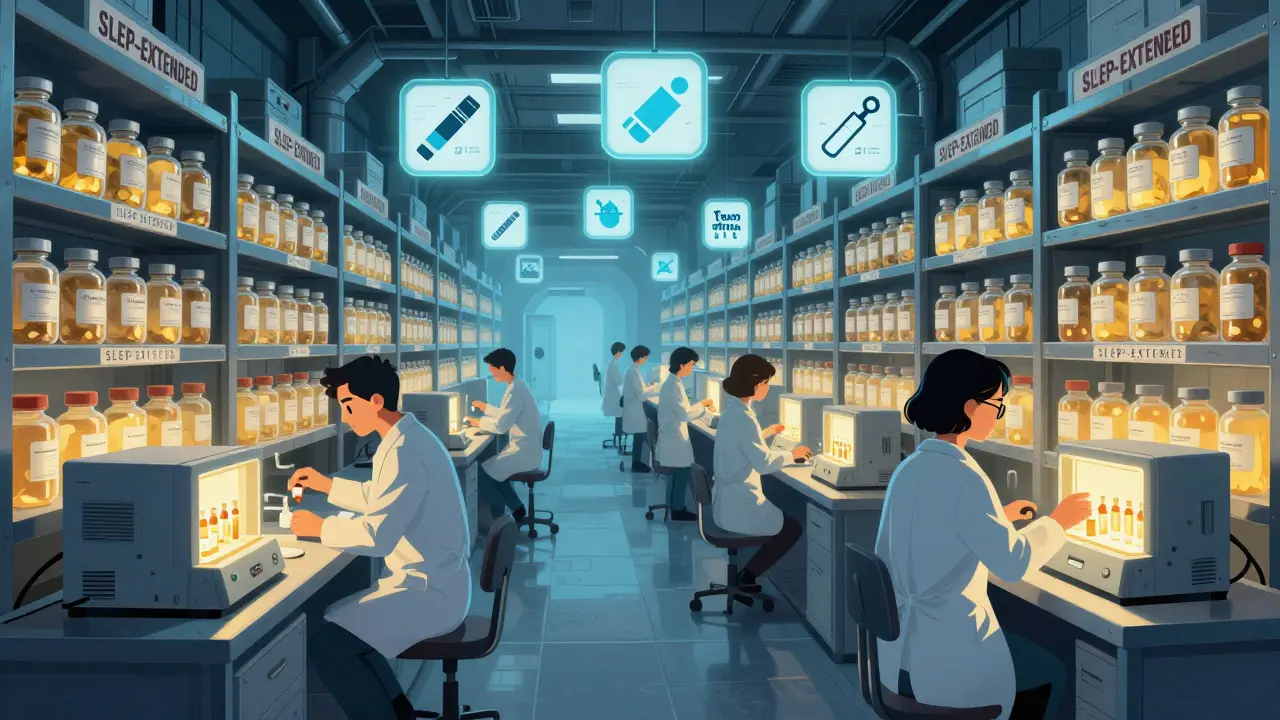
When you see an expiration date on a pill bottle, you might assume that after that date, the medicine turns useless-or worse, dangerous. But what if that date isn’t as final as it looks? The U.S. military’s Shelf-Life Extension Program (SLEP) has been quietly proving that many drugs last far longer than manufacturers claim, if they’re stored right. This isn’t a guess. It’s science backed by over 35 years of real-world testing, and the results are changing how we think about expired medications.
How SLEP Started and Why It Exists
In 1986, the Department of Defense noticed something odd. Military stockpiles of life-saving drugs-like antibiotics, antivirals, and epinephrine auto-injectors-were being thrown out just because they hit their labeled expiration date. But storage conditions in military depots were strict: controlled temperature, low humidity, sealed packaging. So they asked: What if these drugs were still good?
The answer came from lab tests. The FDA, working with DoD, started pulling samples from stockpiles and testing them for potency. What they found shocked even experts: most drugs still met the 85% potency threshold long after their printed date. Some stayed effective for over 15 years. That’s when SLEP became official. It wasn’t about cutting corners. It was about saving money and keeping critical supplies ready for emergencies.
Today, SLEP isn’t just a military program. It’s a federal system that supports the Strategic National Stockpile (SNS), which holds medicines for pandemics, bioterrorism, and natural disasters. Without SLEP, the U.S. would have to replace these drugs every 2-3 years, costing billions. With it? The Government Accountability Office found SLEP saved $2.1 billion between 2005 and 2015 alone.
How the Testing Works
SLEP doesn’t just look at the bottle. It tests the actual drug inside. Here’s how it works:
- A federal agency-like the DoD or HHS-nominates a drug for testing.
- The FDA collects random samples from sealed, properly stored stockpiles.
- Lab technicians analyze the chemical makeup using high-precision methods like HPLC (High-Performance Liquid Chromatography).
- The drug must retain at least 85% of its original potency to qualify for extension.
- If it passes, the FDA issues an official extension, and the DoD updates its records in the Shelf Life Extension System (SLES).
Testing isn’t done once and forgotten. Drugs are retested every 1-3 years, depending on their history. A 2022 report showed the average testing cycle took just 11.4 months-faster than ever thanks to new digital systems.
What’s remarkable is how few drugs fail. In a 2006 study of 122 medications, 88% passed stability tests. In 2021, the DoD reported that 92% of tested lots received extensions, with an average extension of 2.8 years per cycle. Some drugs-like doxycycline and atropine-have been extended over 10 times.
What SLEP Reveals About Drug Stability
Most drug expiration dates are set by manufacturers based on short-term stability studies-usually 2 to 3 years. These studies are done under ideal conditions, but they’re not meant to be the full story. They’re a conservative estimate, designed to protect companies from liability, not to reflect real-world longevity.
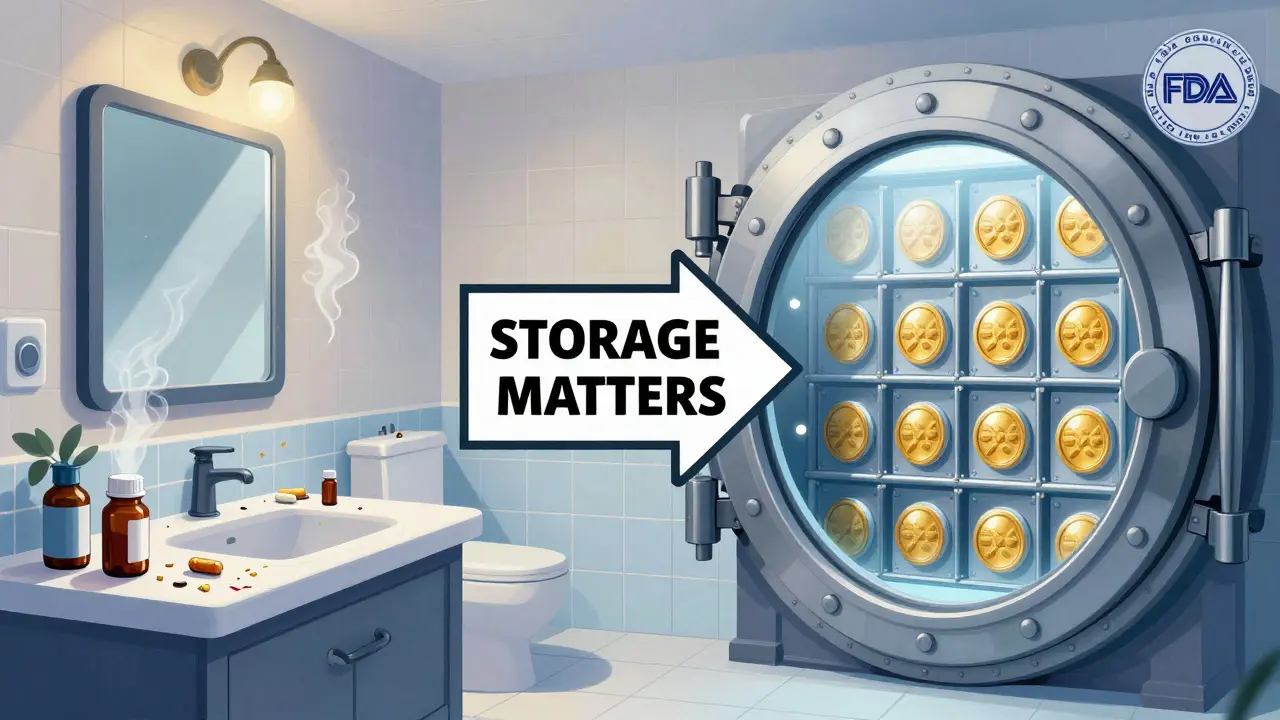
SLEP proves that many drugs are far more stable than their labels suggest. The key? Storage. Military stockpiles are kept in climate-controlled warehouses, away from light, moisture, and temperature swings. That’s not how most of us store medicine at home. But for drugs kept in those conditions, chemical breakdown is extremely slow.
Take oseltamivir (Tamiflu). In 2019, SLEP extended its shelf life by 3 years. That preserved 22 million treatment courses for flu pandemics. Or consider epinephrine-used in allergic emergencies. Even after 10+ years, samples tested still delivered the full dose. These aren’t outliers. They’re the norm.
Dr. Lawrence Yu, former FDA deputy director, put it plainly: “The data from SLEP has fundamentally changed our understanding of drug stability in properly stored conditions.”
Why This Matters Beyond the Military
SLEP isn’t just about saving money. It’s about preparedness. During the 2009 H1N1 flu outbreak, the U.S. had enough Tamiflu on hand because of SLEP extensions. During COVID-19, it helped maintain supplies of antivirals and ventilator medications. Without this program, the country would’ve been scrambling to replace stockpiles every few years-delaying responses and costing lives.
And it’s not just the U.S. Twelve NATO allies have copied SLEP’s model since 2010. Countries like Canada, Germany, and Australia now run their own shelf-life extension programs for emergency medical supplies.
But here’s the catch: SLEP doesn’t apply to your medicine cabinet. The FDA explicitly says extensions are valid only for the exact lot, packaging, and storage conditions tested. You can’t take a 10-year-old bottle from your bathroom and assume it’s safe. The military’s environment is controlled. Your home isn’t.
What SLEP Doesn’t Do
Some people hear “drugs last longer” and think: “So I can use expired pills.” That’s dangerous thinking.
SLEP only applies to federally stockpiled drugs stored under strict conditions. It doesn’t cover:
- Over-the-counter medications
- Drugs stored in homes, pharmacies, or clinics
- Biologics (like vaccines or insulin) unless specifically tested-though since 2021, some have been included
- Drugs exposed to heat, moisture, or sunlight
Dr. Michael D. Swartzburg from UCSF warns: “SLEP’s findings shouldn’t be generalized. A drug that lasts 15 years in a military warehouse may degrade in 6 months in a hot car.”
Also, not all drugs can be extended. Type I items-like certain liquids or unstable compounds-are not eligible. Only Type II items, which have shown consistent stability, are considered.

The Bigger Picture: Waste, Cost, and Future Risks
The pharmaceutical industry throws away $1.7 billion in expired drugs every year. Most of it is perfectly good medicine-just labeled as expired. SLEP shows this waste is avoidable, but only if you have the infrastructure to test and store properly.
For the military, SLEP has cut pharmaceutical waste by up to 42% in compliant facilities. One Army report estimated annual savings of $87 million just from reduced disposal.
But the program isn’t perfect. A 2018 survey found 35% of logistics personnel struggled to access SLES data due to complex login systems. The average wait time to get updated records? Over 7 business days. That’s a bottleneck in emergencies.
Looking ahead, the FDA and DoD are working on predictive modeling. Instead of waiting years to test, they’re using AI and mass spectrometry to forecast how drugs will degrade. The goal? Extend shelf life even further-without waiting for real-time data.
The 2023 National Defense Authorization Act added new funding to expand SLEP to cover chemical and radiological countermeasures. That’s a big step. But the Congressional Budget Office estimates it’ll cost $75 million more per year. Is it worth it? For a nation that needs to be ready for the next crisis? The answer is yes.
What You Can Learn From SLEP
You won’t get a shelf-life extension for your medicine. But you can still learn from SLEP:
- Expiration dates are conservative. Many drugs are safe and effective past their date-if stored right.
- Storage matters more than the date. Keep pills in a cool, dry place. Avoid bathrooms and kitchens.
- Don’t assume expired = useless. For non-critical meds (like pain relievers), a slightly expired tablet may still work. But never risk it with life-saving drugs like epinephrine, insulin, or heart medications.
- Ask your pharmacist. Some pharmacies test expired inventory for potency. It’s rare, but it happens.
At the end of the day, SLEP isn’t about stretching rules. It’s about trusting science. When we test drugs under real conditions, we find they’re more durable than we thought. That’s not magic. It’s chemistry. And it’s a lesson we should all pay attention to.
Are expired medications always unsafe to use?
Not always. Many medications, especially solid tablets stored in cool, dry places, retain potency well past their expiration date. But this doesn’t apply to all drugs. Insulin, nitroglycerin, antibiotics, and liquid medications degrade faster and should never be used after expiration. The military’s Shelf-Life Extension Program proves stability under strict conditions-but home storage rarely matches those standards.
Can I use a drug that passed SLEP testing if I found it in a military warehouse?
No. SLEP extensions apply only to the exact lot, packaging, and storage conditions tested. Even if a drug was extended by the DoD, you can’t legally or safely use it unless it was issued through official military channels. The program is not meant for public access or personal use.
Why don’t drug manufacturers extend expiration dates if the science shows drugs last longer?
Manufacturers set expiration dates based on limited testing and regulatory requirements, not long-term stability. Extending dates would require expensive, long-term studies and open them up to liability. The FDA allows extensions only for government stockpiles under controlled conditions. Commercial drugs are labeled conservatively to protect companies-not because the drugs necessarily expire at that date.
How does SLEP decide which drugs to test?
Drugs are nominated by federal agencies based on critical need-like those in the Strategic National Stockpile. Priority goes to antibiotics, antivirals, antidotes, and emergency medications. The program avoids biologicals (like vaccines) unless they’ve shown stability. Each drug is tested every 1-3 years, depending on its history. Over 2,500 products have been extended since 1986.
Is SLEP used in other countries?
Yes. Twelve NATO allies have adopted similar programs based on the U.S. model since 2010. Countries like Canada, Germany, and Australia now run their own shelf-life extension systems for emergency medical supplies. The U.S. program remains the largest and most comprehensive, but it’s become a global standard for stockpile management.


Adam M
March 13, 2026 AT 15:28Simple as that.
Stephanie Paluch
March 15, 2026 AT 12:59tynece roberts
March 16, 2026 AT 05:21Jimmy V
March 16, 2026 AT 21:10Richard Harris
March 18, 2026 AT 04:02Kandace Bennett
March 18, 2026 AT 19:31Jinesh Jain
March 19, 2026 AT 11:10douglas martinez
March 20, 2026 AT 04:16Sabrina Sanches
March 21, 2026 AT 17:12Shruti Chaturvedi
March 23, 2026 AT 11:26