
SSRI Dose Adjustment Calculator
How This Tool Works
This calculator estimates how your CYP2C19 and CYP2D6 metabolism status might affect your SSRI medication. Select your drug and metabolism status to see potential dose adjustments and side effect risks.
* This tool provides general guidance only and should not replace professional medical advice.
When you start an SSRI like Lexapro or Zoloft, you don’t know if your body will handle it well-or if you’ll end up dizzy, nauseous, or sleepless for weeks. That’s not just bad luck. It could be your genes.
Why Some People Crash on SSRIs While Others Don’t
Not everyone reacts the same way to antidepressants. One person takes sertraline and feels better in two weeks. Another takes the same dose and ends up in the ER with heart palpitations and vomiting. Why? It’s not about willpower, diet, or stress levels. It’s about how fast your body breaks down the drug-and that’s controlled by two genes: CYP2C19 and CYP2D6. These genes make enzymes in your liver that process most SSRIs. If your version of the gene is slow, the drug builds up in your blood. Too much? Side effects. If it’s too fast, the drug vanishes before it can help. Neither scenario is rare. About 1 in 10 people are poor metabolizers for CYP2D6. For CYP2C19, it’s about 1 in 5. That’s millions of people on SSRIs who are either getting too much or too little of their medication.What CYP2C19 and CYP2D6 Actually Do
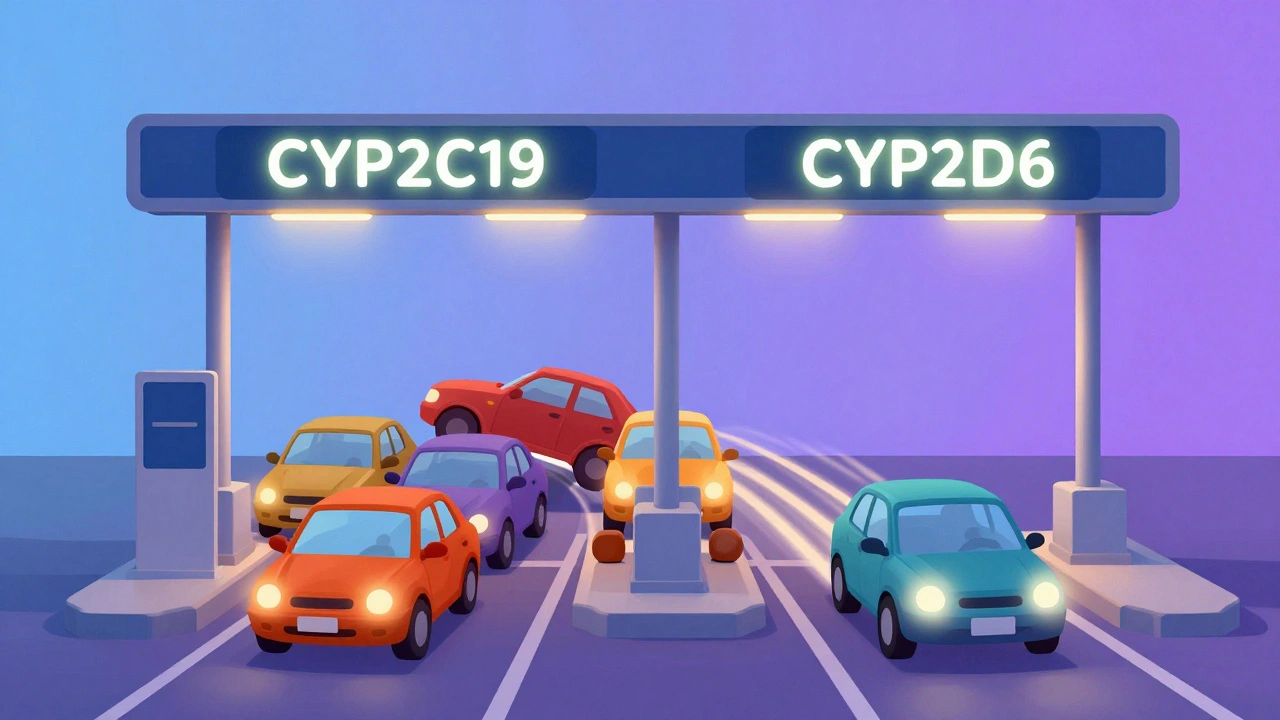
Think of these enzymes as tollbooths on a highway. SSRIs are cars. If the tollbooth (enzyme) is broken or slow, cars pile up. If it’s super fast, cars zoom through before you can collect the toll (therapeutic effect). - CYP2C19 handles citalopram (Celexa), escitalopram (Lexapro), and sertraline (Zoloft). If you’re a poor metabolizer, your escitalopram levels can be 3.5 times higher than normal. That’s not a small difference-it’s enough to trigger nausea, tremors, or even serotonin syndrome. - CYP2D6 processes fluoxetine (Prozac), paroxetine (Paxil), venlafaxine (Effexor), and duloxetine (Cymbalta). Poor metabolizers here have a 2.7 times higher risk of side effects with venlafaxine. One woman in a clinical case study had severe dizziness at 75mg-normal dose. At 37.5mg, she felt fine. Ultrarapid metabolizers are the opposite. They clear the drug so fast that standard doses don’t work. A man on 20mg of escitalopram felt nothing. His doctor doubled it to 40mg-and suddenly, his depression lifted. His genes were burning through the drug before it could act.Testing Is Available-But Is It Worth It?
You can get tested. Companies like GeneSight, Pillcheck, and Mayo Clinic offer panels that check CYP2C19 and CYP2D6. The test is simple: a cheek swab or blood draw. Results come back in 1-3 weeks. Accuracy? Around 95-99% for these two genes. But here’s the catch: knowing your metabolism doesn’t always tell you if the drug will work. Studies show clear differences in drug levels based on genotype-but not always in how people feel. One large study of over 5,800 people found no strong link between CYP2C19 status and whether escitalopram improved depression symptoms. The side effects? Yes. The mood boost? Not so much. That’s why the Clinical Pharmacogenetics Implementation Consortium (CPIC) gives CYP2D6 and SSRIs a Level B recommendation-meaning there’s good evidence for side effect risk, but not yet enough to say it improves outcomes. For tricyclic antidepressants like amitriptyline? Level A. Stronger proof. For SSRIs? Still evolving.
Real People, Real Results
Patient stories tell a clearer story than stats. - A 45-year-old woman on paroxetine developed panic attacks and insomnia. Her test showed she was a CYP2D6 poor metabolizer. Her doctor cut her dose in half. Within days, the panic stopped. - A 32-year-old man tried four SSRIs over two years. None worked. His test showed he was a CYP2C19 ultrarapid metabolizer. He switched to fluoxetine (processed by CYP2D6), and within three weeks, his anxiety eased. - A 2023 study found CYP2D6 poor metabolizers were 3.2 times more likely to report severe side effects with paroxetine. CYP2C19 poor metabolizers had 2.8 times more side effects with citalopram. But not everyone sees results. About 30% of patients say testing didn’t change their experience. Why? Depression isn’t just about metabolism. It’s brain chemistry, trauma, sleep, inflammation, even gut health. Genes are one piece.Who Should Get Tested?
You don’t need to test everyone. But it makes sense if:- You’ve tried one or two SSRIs and had bad side effects
- You’re on a high dose and still not improving
- You’ve had a family member who had a bad reaction to antidepressants
- You’re being prescribed multiple medications (polypharmacy) and want to avoid interactions

Cost, Coverage, and Barriers
Testing costs $250-$500 out of pocket. Insurance? Only 62% of U.S. insurers cover it for antidepressants as of mid-2024. Medicare doesn’t cover it routinely. Medicaid varies by state. Doctors often don’t order it because they don’t know how to interpret the results. A 6-hour CME course from the American Psychiatric Association helps-but most haven’t taken it. Pharmacists with pharmacogenomics certification? Only about 1,200 in the U.S. That’s one for every 27,000 people. The good news? CPIC offers free, easy-to-use online tools to decode your results. Just plug in your genotype and drug, and it tells you: “Start low,” “Avoid this drug,” or “Normal dose okay.”What’s Next?
The NIH just launched GUIDED-2-a $15.2 million study tracking 5,000 patients with treatment-resistant depression. They’re testing whether genetic guidance leads to faster recovery, fewer hospital visits, and lower costs. Results are due in 2027. Meanwhile, researchers are building polygenic scores-combining CYP2C19, CYP2D6, and 20 other genes with clinical data to predict response. Some clinics are already piloting these in 2025.Bottom Line: It’s Not Magic, But It’s Useful
Pharmacogenomic testing won’t cure depression. It won’t replace therapy or lifestyle changes. But it can stop the guesswork. If you’ve been stuck in a cycle of side effects and failed meds, a simple gene test might be the key to finally finding a drug that works-without the rollercoaster. It’s not perfect. But for many, it’s the first real step forward after years of trial and error.Is pharmacogenomic testing for SSRIs covered by insurance?
As of 2024, only about 62% of major U.S. insurers cover CYP2C19 and CYP2D6 testing for antidepressants. Coverage varies by plan, state, and whether you’ve tried other treatments first. Medicare and Medicaid rarely cover it unless part of a research program. Always check with your insurer before ordering the test.
Can I get tested without seeing a doctor?
Some direct-to-consumer companies offer testing kits you can buy online. But interpreting the results without medical guidance can be risky. A poor metabolizer might lower their dose too much and stop getting relief. An ultrarapid metabolizer might double their dose and overdose. Always work with a prescriber or pharmacist trained in pharmacogenomics to make sense of your results.
Do all SSRIs get processed by CYP2C19 and CYP2D6?
No. CYP2C19 mainly handles citalopram, escitalopram, and sertraline. CYP2D6 handles fluoxetine, paroxetine, venlafaxine, and duloxetine. Bupropion (Wellbutrin) and vortioxetine (Trintellix) use different enzymes. If you’re on one of these, CYP2C19/CYP2D6 testing won’t help. Always check which enzyme processes your specific drug.
If I’m a poor metabolizer, should I avoid SSRIs altogether?
No. You just need a different approach. Poor metabolizers can still take SSRIs-but often at lower doses. For example, a CYP2C19 poor metabolizer on escitalopram might start at 5mg instead of 10mg. Some drugs, like fluvoxamine, are less affected by CYP2C19 and may be better choices. The goal isn’t to avoid the drug-it’s to use it safely.
How long does it take to get results from a pharmacogenomic test?
Most labs deliver results in 1 to 3 weeks after your sample is received. Some offer expedited service for $100 extra, with results in 5-7 days. Once you have them, your doctor or pharmacist needs time to review and adjust your treatment plan-so plan for a full 14-day window from test to decision.
Can CYP2C19 and CYP2D6 testing help with other medications?
Yes. These genes affect many drugs beyond antidepressants. CYP2D6 processes beta-blockers, opioids like codeine, and some antipsychotics. CYP2C19 affects clopidogrel (Plavix), proton pump inhibitors like omeprazole, and some anti-seizure drugs. If you’re on multiple meds, testing can help avoid dangerous interactions.


nikki yamashita
December 11, 2025 AT 14:57Finally, someone gets it! I was on Lexapro for months and felt like a zombie. Got tested, turned out I'm a CYP2C19 poor metabolizer. Cut my dose in half and boom - I’m back to human. No more nausea, no more brain fog. This isn’t magic, it’s science.
Laura Weemering
December 13, 2025 AT 10:27…but isn’t it just… another way for Big Pharma to monetize your DNA? I mean, sure, the science checks out-but why is this only accessible to people who can afford $500? And why are we still treating depression like a chemical equation? The body isn’t a vending machine. You can’t just swap out the pills and expect your trauma to disappear.
Stacy Foster
December 14, 2025 AT 14:08They’re not telling you the whole story. CYP2C19 testing? It’s a distraction. The real issue is that SSRIs are designed for white, middle-class bodies. The genes they test for? Based on data from 90% Caucasian populations. What about people of color? We’re being dosed like lab rats. This isn’t precision medicine-it’s genetic colonialism.
sandeep sanigarapu
December 15, 2025 AT 03:53Interesting article. In India, we rarely have access to such testing. But I agree with the point that if someone has tried multiple SSRIs with side effects, genetic insight may help avoid further suffering. Medicine should be personalized, not trial-and-error.
Robert Webb
December 15, 2025 AT 10:06I’ve been reading up on this for a year now, mostly because my sister went through hell with Paxil-dizziness, weight gain, emotional numbness. She got tested, turned out CYP2D6 poor metabolizer. They dropped her dose to 10mg and suddenly she could sleep, laugh, even cook again. It’s not a cure-all, but it’s the first time in five years she felt like herself. I wish every psychiatrist had to take a pharmacogenomics course before prescribing. We’re still flying blind in so many cases.
Adam Everitt
December 17, 2025 AT 07:21honestly i think this is all just overhyped. i mean sure, genes matter-but depression isn’t just about enzymes. it’s your childhood, your job, your loneliness, your damn coffee habit. i got tested, turned out i’m ultra-rapid, switched to fluoxetine, still felt like crap. so… what’s the point?
wendy b
December 17, 2025 AT 08:47Let’s be clear: pharmacogenomics is the future, and if you’re not leveraging it, you’re practicing antiquated medicine. The CPIC guidelines are a good start, but they’re still too conservative. The data is unequivocal-CYP2C19 poor metabolizers exhibit significantly elevated plasma concentrations. To ignore this is not just negligent, it’s unethical. And if your doctor doesn’t know how to interpret the results? Find one who does.
Audrey Crothers
December 18, 2025 AT 02:27OMG YES!! I was the 32-year-old guy in the article!! Tried 4 SSRIs, felt nothing. Then tested-CYP2C19 ultrarapid. Switched to fluoxetine, and within 3 weeks? I cried for the first time in years. Not because I was sad… because I finally felt something. 🥹💊 Thank you for writing this. I wish I’d known this 5 years ago.
Reshma Sinha
December 20, 2025 AT 01:57As a clinical pharmacist in Delhi, I’ve seen this firsthand. One patient on sertraline had severe tremors-genetic test showed CYP2C19 poor metabolizer. Dose halved, symptoms vanished. But here’s the catch: no one in our system knows how to order this. We’re stuck with trial and error. We need education, infrastructure, and funding. This isn’t luxury medicine-it’s basic safety.
Lawrence Armstrong
December 21, 2025 AT 06:59Tested last year. CYP2D6 poor metabolizer. Took 20mg of sertraline, felt like I was underwater. Reduced to 5mg. Now I’m stable. I keep the report on my phone. When I see a new doc, I just show them. Saves time. Saves stress. No more guessing. 🧬✅
Donna Anderson
December 21, 2025 AT 12:08my dr said testing was 'not proven' so i didn't bother. then i had a panic attack after 10mg of zoloft. turned out i was a slow metabolizer. now i'm on 2.5mg and i'm alive again. why do doctors still ignore this? it's not rocket science.