
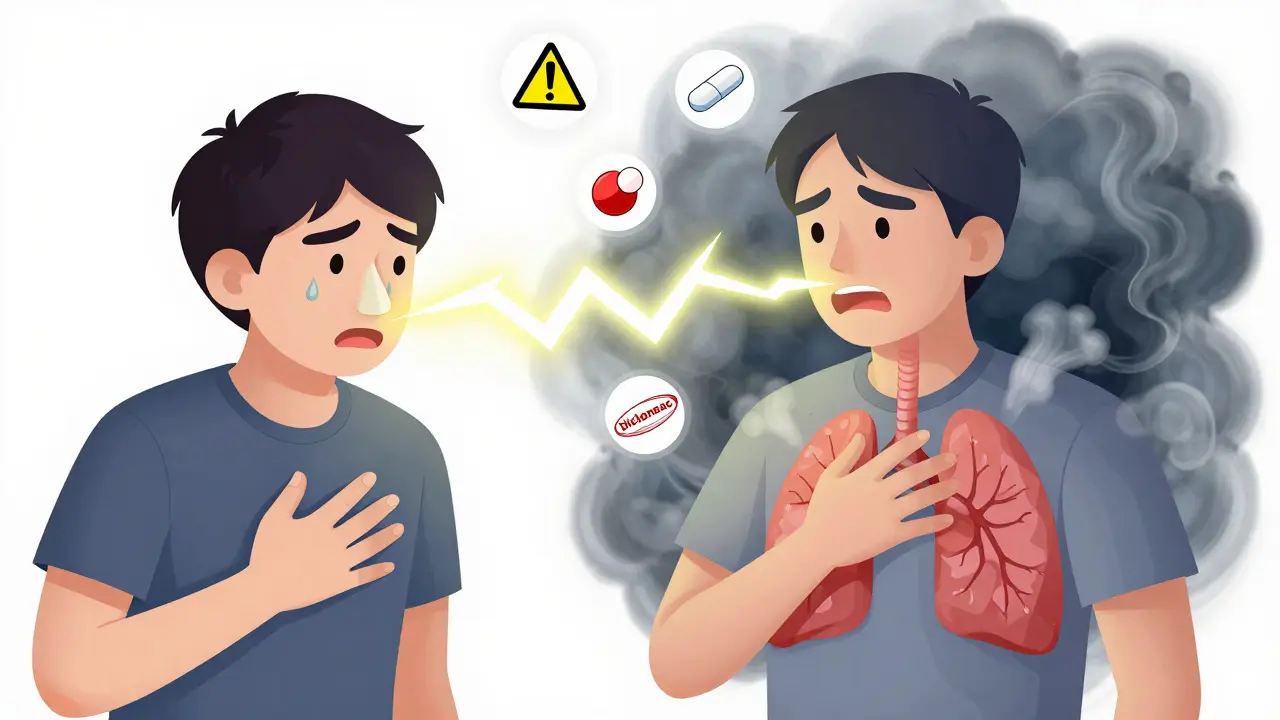
For many people with asthma, taking a common painkiller like ibuprofen or aspirin isn’t just risky-it can be life-threatening. This isn’t a rare side effect. It’s a well-documented condition called NSAID-Exacerbated Respiratory Disease (NERD), also known as Aspirin-Exacerbated Respiratory Disease (AERD). Around 7% of adults with asthma have it. But if you also have chronic nasal polyps or ongoing sinus issues, that number jumps to 40-50%. And yet, most people don’t know they’re at risk until they have a scary, sudden reaction.
What Happens When NSAIDs Trigger Asthma?
It starts with something simple: a headache, a sore muscle, a fever. You reach for the nearest pain reliever-ibuprofen, naproxen, aspirin. Within 30 minutes to 3 hours, your nose starts running, your sinuses feel blocked, and your chest tightens. Breathing becomes labored. Wheezing kicks in. You might feel like you’re drowning, even though you’re sitting still. This isn’t an allergy in the classic sense. It’s a biochemical domino effect.
NSAIDs block an enzyme called COX-1, which normally helps make protective prostaglandins. When that’s shut down, your body redirects arachidonic acid down another path-producing massive amounts of inflammatory chemicals called cysteinyl leukotrienes. These chemicals are like fire starters in your airways. They cause swelling, mucus overproduction, and bronchospasm. Your lungs react as if you’ve inhaled poison. For some, even a low-dose aspirin (75mg) can trigger this. For others, it takes a full tablet. But once it happens once, it will happen again with any NSAID.
Who’s Most at Risk?
You’re not equally likely to develop NERD. Certain patterns show up again and again in clinical data:
- You’re between 30 and 40 years old when symptoms first appear-rarely before age 20.
- You’re female. About 70% of diagnosed cases are in women.
- You have chronic sinusitis with nasal polyps. This is the biggest red flag.
- You’ve had asthma for years, but it’s gotten harder to control recently.
- You smoke, or used to smoke.
- You or a close family member has allergies or eczema.
Many patients don’t connect the dots. They think their worsening asthma is due to stress, pollution, or aging. They don’t realize that every time they took a cold tablet, a joint pain pill, or even a menstrual cramp remedy, they were setting off a slow-burning fuse. Nasal congestion often starts years before asthma symptoms. That’s a clue many doctors miss.
What Medications Are Dangerous?
Not all painkillers are equal. The problem isn’t pain relief-it’s the type of pain relief.
High Risk (Avoid Completely):
- Aspirin (even low-dose)
- Ibuprofen (Advil, Motrin)
- Naproxen (Aleve, Naprosyn)
- Diclofenac (Voltaren)
- Ketoprofen
- Indomethacin
These all strongly inhibit COX-1. If you’ve had one reaction, you’ll react to all of them. There’s no safe dose for someone with confirmed NERD.
Safer Alternatives:
- Acetaminophen (Paracetamol): Generally safe for most, but 5-10% of NERD patients still react to high doses (over 1000mg). Stick to 650mg if unsure.
- Celecoxib (Celebrex): A COX-2 selective inhibitor. Doesn’t trigger the same biochemical cascade. Proven safe in studies.
- Tramadol or acetaminophen combinations: For moderate to severe pain, these avoid COX inhibition entirely.
Watch out for hidden NSAIDs. They’re in cold medicines, flu remedies, menstrual relief packs, and even some topical gels. Read labels. Look for: ibuprofen, naproxen, diclofenac, ketoprofen, aspirin. If you see any, skip it.
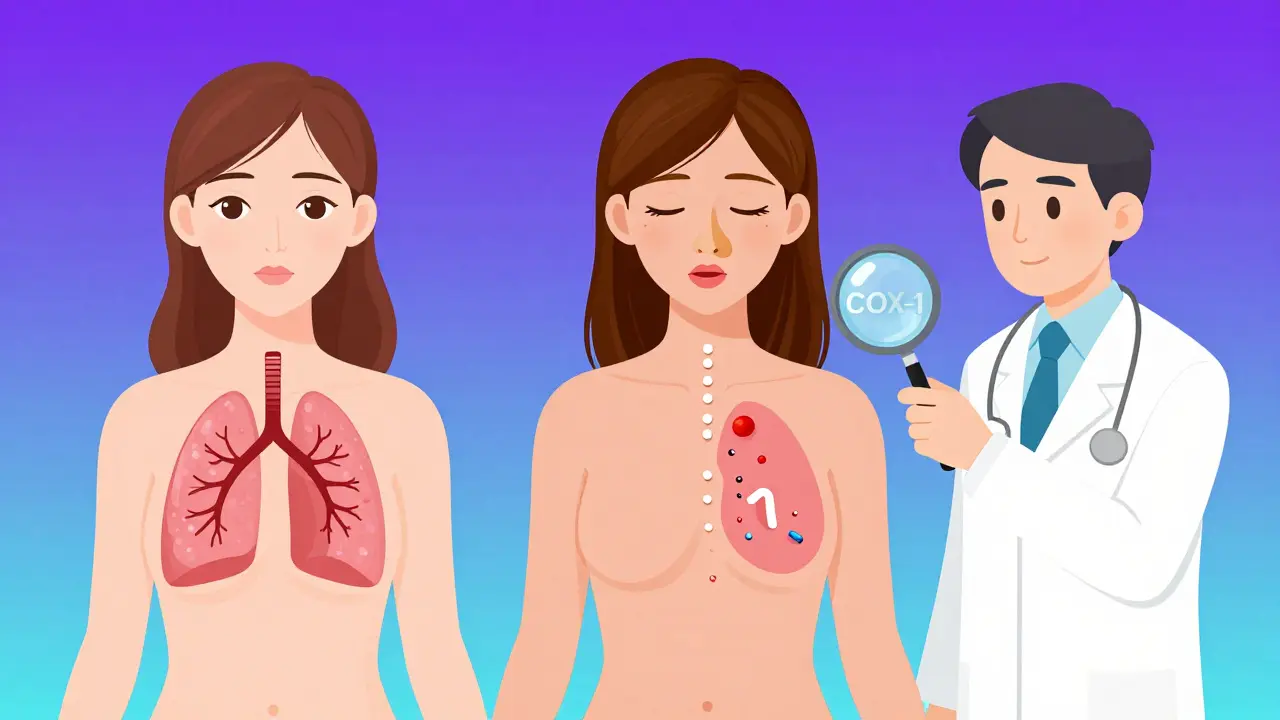
What Should You Do If You Suspect NERD?
If you’ve had a sudden asthma attack after taking a painkiller, especially if you also have nasal polyps or chronic congestion, talk to your doctor. Don’t wait until it happens again.
Your doctor may refer you to an allergist or respiratory specialist. There’s a safe, controlled test called an aspirin challenge that can confirm NERD. It’s done in a hospital setting with monitoring. If your symptoms improve after the test, it confirms the diagnosis-and opens the door to a powerful treatment: aspirin desensitization.
This isn’t a cure, but it’s life-changing. Under strict supervision, you’re given slowly increasing doses of aspirin over days. Your body learns to tolerate it. For many, this reduces nasal polyp size, improves breathing, cuts down on steroid use, and prevents emergency visits. It only works if you have confirmed NERD and are under expert care.
How to Stay Safe Every Day
Living with NERD means becoming a medication detective. Here’s how:
- Carry a medical alert card. List all NSAIDs to avoid. Include brand and generic names.
- Check every OTC product. Pain relievers, cold meds, flu tablets, and even some acne creams contain NSAIDs.
- Ask pharmacists. Don’t assume. Say: “I have NSAID-sensitive asthma. Is this safe?”
- Keep a symptom diary. Note when you had a reaction, what you took, and how long it took to start. This helps your doctor.
- Have a rescue inhaler handy. Always. Even if you’re feeling fine.
- Don’t rely on “natural” remedies. Willow bark contains salicin-a cousin of aspirin. Avoid it.
Many patients don’t realize their daily headache pills are worsening their asthma. One woman in Wellington, 38, had been taking ibuprofen for migraines for 12 years. Her asthma got worse each winter. After diagnosis, she switched to acetaminophen. Within 3 months, her nighttime wheezing dropped by 80%. She hadn’t realized the connection.
What About Children?
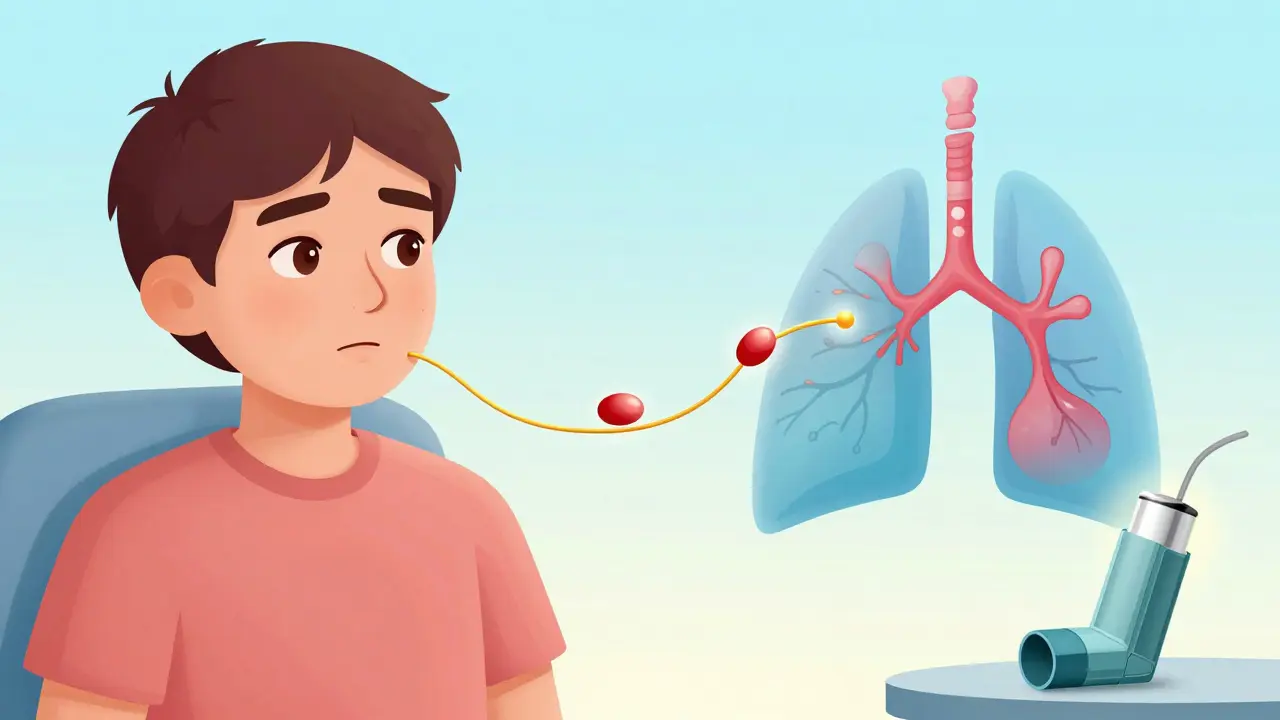
While NERD is rare under age 20, studies from Taiwan’s national health database show that short-term NSAID use in children with asthma increases the risk of an asthma flare-up by nearly 50%. The same study found no long-term risk-but that doesn’t mean it’s safe to use them casually. If your child has asthma and nasal congestion, avoid NSAIDs unless your pediatrician says otherwise. Acetaminophen is the go-to for fever and pain in kids with asthma.
What’s Next for NERD Treatment?
Researchers are looking at ways to block the harmful leukotrienes without touching COX-1. Drugs that mimic protective lipoxins (like LXA4) are in early trials. Blood tests measuring eosinophils and urinary LTE4 are becoming tools to spot NERD before it flares. The goal? To catch it early, before patients end up in the ER.
For now, awareness is the best defense. If you have asthma and chronic sinus issues, assume you might be sensitive. Don’t wait for a crisis. Talk to your doctor. Get tested. Know your triggers. Your lungs depend on it.
Can I take acetaminophen if I have NSAID-sensitive asthma?
Yes, acetaminophen (paracetamol) is generally safe for most people with NSAID-sensitive asthma. However, about 5-10% of patients still react to doses over 1000mg. Stick to 650mg per dose if you’re unsure. Avoid extended-release forms or combination products with unknown ingredients.
Are all NSAIDs equally dangerous for people with asthma?
Yes, if you have confirmed NERD, you’ll react to all NSAIDs that inhibit COX-1-including aspirin, ibuprofen, naproxen, diclofenac, and ketoprofen. It doesn’t matter which one you took before; if one triggered a reaction, they all will. The only exceptions are COX-2 inhibitors like celecoxib, which don’t affect the same pathway.
Why do nasal polyps increase the risk of NSAID sensitivity?
Nasal polyps are a sign of chronic airway inflammation. People with this condition already have low levels of protective prostaglandins in their nasal and lung tissue. When NSAIDs block the last remaining COX-1 activity, the imbalance worsens dramatically, triggering a surge in inflammatory leukotrienes. That’s why 40-50% of people with nasal polyps develop NERD, compared to only 7% of those with asthma alone.
Can I outgrow NSAID sensitivity?
No. Once NERD develops, it’s a lifelong condition. The underlying biochemical defect doesn’t go away. However, aspirin desensitization therapy can significantly reduce symptoms and improve quality of life for many patients. Avoiding NSAIDs completely is the safest long-term strategy unless you’ve undergone supervised desensitization.
What should I do if I accidentally take an NSAID?
If you have a history of NERD and accidentally take an NSAID, act fast. Use your rescue inhaler immediately. If breathing doesn’t improve within 10-15 minutes, call emergency services. Do not wait. Even if symptoms seem mild at first, they can worsen rapidly. Always carry your inhaler and know your emergency plan.




Katy Shamitz
March 10, 2026 AT 05:57Oh honey, I’ve been there. Took ibuprofen for a headache in 2018 and ended up in the ER wheezing like a broken accordion. My doctor acted like I was being dramatic-until I showed him the pattern. Now I keep a list of every sneaky NSAID on my fridge. And yes, I’ve yelled at a pharmacist for not knowing what ‘diclofenac’ means. You’re not alone. And no, ‘natural remedies’ don’t count as safe. Willow bark? That’s just aspirin in disguise. 🙄
Nicholas Gama
March 11, 2026 AT 21:35COX-1 inhibition → leukotriene surge. Basic biochemistry. If you can’t read a journal abstract, don’t self-diagnose.
Mary Beth Brook
March 13, 2026 AT 14:42America’s overmedicated. You think this is unique? In Russia, they use aspirin for everything. We don’t have this problem because we don’t coddle weak lungs. Acetaminophen is the American compromise. Weak. But safe.
Neeti Rustagi
March 14, 2026 AT 05:34Dear friend, I am deeply moved by the clarity of this post. As a healthcare professional in Mumbai, I have observed that patients often dismiss chronic nasal congestion as mere allergies. The biochemical cascade described here is both elegant and terrifying. May I suggest that primary care physicians be mandated to screen for NERD in asthma patients with polyps? A simple protocol could save lives. With profound respect, Neeti.
Dan Mayer
March 15, 2026 AT 08:24so i had this one time… i took advil for my back and then my chest felt like it was being squeezed by a giant hand. i thought i was having a heart attack. turns out it was just my lungs screaming. i still dont trust painkillers. also i think big pharma hides this bc they make more money off asthma inhalers. 🤔
Janelle Pearl
March 16, 2026 AT 03:57I’m so glad this exists. I used to feel like I was crazy-every time I took a cold medicine, I’d get worse. No one ever connected the dots. My pulmonologist finally said, ‘You’re not allergic. You’re sensitive.’ That one phrase changed everything. I carry my inhaler everywhere now. Even to the grocery store. And yes-I read every label. Even the ones on the lotion. I’m not paranoid. I’m prepared. 💙
Ray Foret Jr.
March 17, 2026 AT 16:11My mom had this and didn’t know for 15 years. She thought her asthma was just getting worse with age. Then she tried naproxen for arthritis and almost didn’t make it to the hospital. Now she’s on celecoxib and breathing like a normal human. 🙌 I told her to get tested. She did. And now she’s doing aspirin desensitization. It’s wild. It’s science. It’s hope. 🤗
Samantha Fierro
March 19, 2026 AT 15:44This is a meticulously researched and clinically vital overview. The distinction between COX-1 and COX-2 inhibition is not merely academic-it is life-preserving. I urge all primary care providers to integrate NERD screening into routine asthma management protocols. Furthermore, patient education materials should be standardized across healthcare systems. Awareness is not optional. It is a standard of care. Sincerely, Dr. Fierro.
Robert Bliss
March 21, 2026 AT 12:55My cousin had this. She thought it was just bad luck. Now she carries a card in her wallet. I carry one too. Just in case. 😊
Peter Kovac
March 23, 2026 AT 12:15The statistical correlation between nasal polyps and NERD is compelling, but the causal mechanism remains speculative. The prostaglandin-leukotriene imbalance theory lacks longitudinal validation. Furthermore, the 7% prevalence figure is drawn from tertiary care populations, introducing selection bias. Until randomized controlled trials confirm the biochemical cascade, this remains a hypothesis with clinical utility-not a definitive diagnosis.
Tom Sanders
March 24, 2026 AT 16:29ugh i dont even read this whole thing. just dont take painkillers. done.
Jazminn Jones
March 25, 2026 AT 08:34The author’s tone is alarmist and lacks appropriate scientific nuance. The term 'life-threatening' is hyperbolic without quantifying mortality rates. Furthermore, the assertion that 'there’s no safe dose' ignores emerging evidence on dose-dependent thresholds. This piece reads like a marketing brochure for aspirin desensitization clinics. Who funded this?
George Vou
March 26, 2026 AT 21:41so if you have asthma and nasal polyps… then every painkiller is poison? what about the 10% who react to acetaminophen? are they just doomed? i think this whole thing is a scam. big pharma wants you to buy celebrex. they dont want you to know about the real cure: turmeric. and also, the government is hiding this because NSAIDs are taxed. 🤫
Scott Easterling
March 27, 2026 AT 18:22Why is no one talking about the fact that this condition is 98% more common in women? Are we just biologically broken? Or is this another case of medicine ignoring female pain until it’s too late? And don’t get me started on how doctors dismiss nasal congestion as 'just allergies.' It’s not allergies. It’s a warning. A red flag. A silent scream. And we’re being told to take ibuprofen like it’s water.
Mantooth Lehto
March 27, 2026 AT 23:21OMG YES. I took Aleve for cramps and almost died. My husband thought I was faking. I had to go to the ER screaming. Now I have a whole binder. Labels. Pictures. Lists. I even made a spreadsheet. And I don’t care if you think I’m obsessive. I’m alive. You’re not. 😘