
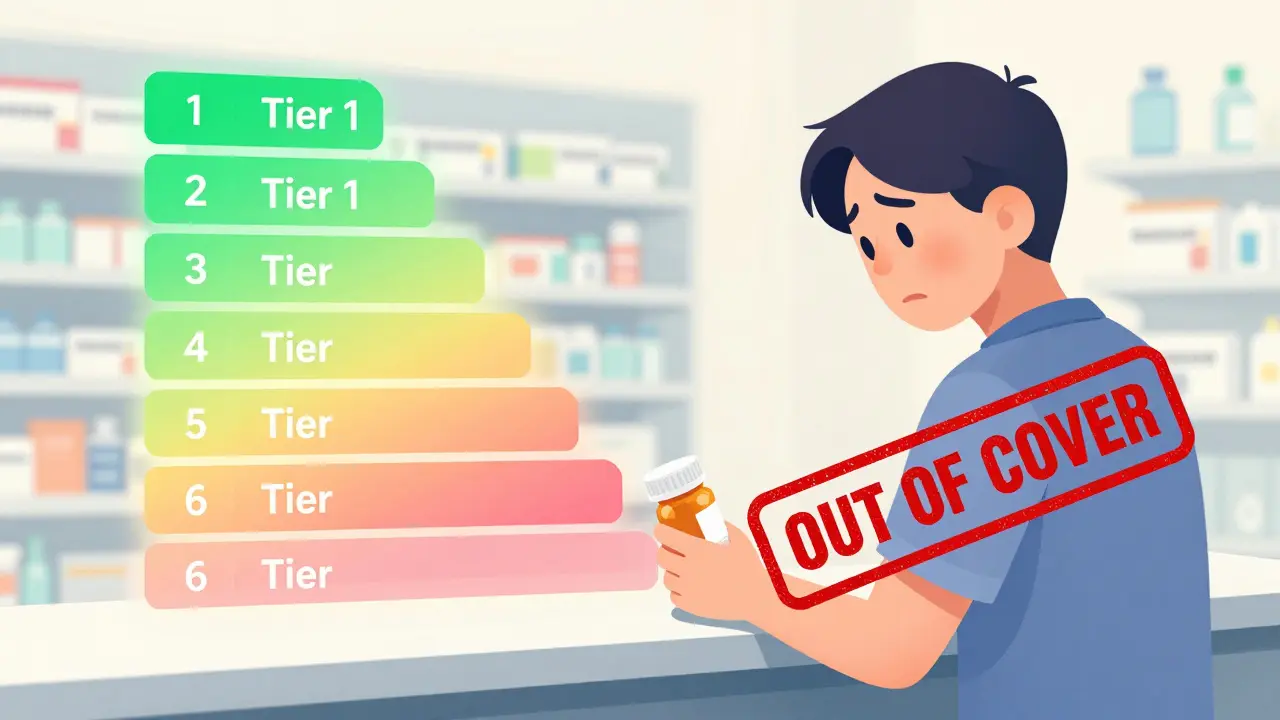
When your insurance plan suddenly stops covering your medication-or pushes it into a much higher cost tier-it’s not just a paperwork issue. It’s a health risk. For millions of people on chronic medications, a formulary change can mean choosing between paying hundreds more a month or going without treatment. In 2024, formulary changes affected 34% of Medicare beneficiaries and caused 18% of patients to stop taking their meds altogether. That’s not just inconvenient. It’s dangerous.
What Is a Formulary, Really?
A formulary is a list of drugs your insurance plan agrees to cover. But it’s not just a simple catalog. It’s a tiered system that determines how much you pay. Most plans use 3 to 6 tiers. Tier 1 usually means generic drugs with the lowest copay. Tier 2 is brand-name drugs with moderate cost. Tier 3 and above? Those are specialty drugs-often biologics like Humira or Enbrel-with coinsurance rates that can hit 30% or more. Some plans even have a Tier 5 or 6 for ultra-expensive treatments, where you might pay hundreds per month just to get your prescription filled. The goal of formularies isn’t to punish patients. It’s to control costs. Insurance companies and pharmacy benefit managers (PBMs) negotiate rebates with drug makers. The drugs that offer the best discounts end up on lower tiers. But here’s the catch: the cheapest drug for the plan isn’t always the best one for you. A 2023 study found patients forced to switch due to formulary changes spent an extra $587 per year out of pocket. And if that switch doesn’t work? Hospital visits go up.Why Do Formularies Change?
Formularies aren’t static. They change for a few reasons:- New drugs enter the market and get added-usually on a higher tier until their cost-effectiveness is proven.
- Generic versions become available, pushing older brands off the formulary.
- Drug manufacturers stop offering rebates, so the plan drops the drug to save money.
- Clinical guidelines update, and a drug is no longer considered first-line treatment.
- Regulatory changes, like CMS rules for Medicare Part D, force plans to adjust coverage.
How Formulary Changes Hit Patients
The real damage happens when patients aren’t warned. A 2024 CAQH survey found 57% of patients received no advance notice before their medication was changed. Commercial plans often give as little as 22 days’ notice. Medicare is required to give 30 to 60 days-but even that’s not enough if you’re on a drug that takes weeks to stabilize. Take the story of a Crohn’s patient who’d been on Humira for seven years. One month, their copay jumped from $50 to $650. Why? The drug moved to a non-preferred specialty tier. They had to scramble for manufacturer assistance, file appeals, and go without medication for weeks. That’s not an outlier. GoodRx data shows 47% of patients abandon their prescriptions when a drug moves from Tier 2 to Tier 3. For diabetes meds? That number hits 58%.
What You Can Do: A Step-by-Step Plan
If your medication is affected, don’t panic. You have options.- Verify your coverage immediately. Log into your insurer’s website or call member services. Ask: Is my drug still covered? What tier is it on? Are there alternatives on formulary?
- Check for exceptions. You can request a formulary exception if your doctor says the drug is medically necessary. In 2023, 64% of medically justified exceptions were approved. Submit the request within 15 business days of notification. For urgent cases (like cancer or autoimmune conditions), Medicare must respond within 72 hours.
- Ask about manufacturer assistance. Drug companies offer patient assistance programs to help with copays. In 2024, these programs covered $6.2 billion in out-of-pocket costs. Visit the manufacturer’s website or call their patient support line.
- Explore alternatives. Work with your doctor to find a similar drug on formulary. For example, if you’re on a brand-name statin that got dropped, there are usually 3-5 generic options with the same effect.
- Use free tools. Medicare beneficiaries can use the Plan Finder tool (used by 68% of users in 2023). Commercial plan members can use their insurer’s formulary lookup tool (available on 92% of websites).
What Providers Should Do
Doctors and pharmacists aren’t just bystanders. They’re critical in managing these changes.- Use e-prescribing systems that check formulary status in real time. 76% of large medical groups now do this.
- Review your patients’ medications during annual wellness visits-don’t wait for a crisis.
- Know your plan’s prior authorization rules. Some drugs require step therapy: you must try two cheaper drugs first.
- Keep a list of formulary changes affecting your practice. Many clinics now track changes 60 days in advance and switch patients during routine visits.
How to Prepare Before It Happens
The best way to avoid disruption is to plan ahead:- Review your plan’s formulary every year during open enrollment.
- Ask your insurer: “Will my current medications be covered next year?”
- Sign up for email alerts from your pharmacy or insurer.
- If you’re on a specialty drug, set a calendar reminder 90 days before your plan year ends.
- Keep a printed copy of your medication list and your insurer’s contact info in your wallet.

What’s Changing in 2025?
The rules are shifting fast. Starting in 2025:- Medicare beneficiaries will pay no more than $2,000 per year out of pocket for drugs-no matter how expensive their meds are.
- All Medicare Part D plans must standardize their formulary exception criteria.
- 71% of commercial plans will use accumulator adjustment programs, which stop manufacturer coupons from counting toward your deductible.
- Value-based formularies (which reward drugs that improve outcomes, not just cut costs) are expected to grow from 25% to 45% of employer plans by 2027.
When to Get Help
You don’t have to fight this alone. If you’re overwhelmed:- Call your State Health Insurance Assistance Program (SHIP). Medicare beneficiaries who used SHIP had a 37% higher success rate with formulary exceptions.
- Reach out to patient advocacy groups like the National Patient Advocate Foundation or the Medicare Rights Center.
- Ask your pharmacist-they often know about obscure assistance programs and can help you navigate appeals.
The Bigger Picture
Formularies are here to stay. They saved the U.S. healthcare system $112 billion in drug spending in 2023. But they’re not perfect. When designed without patient input, they hurt the most vulnerable. A 2023 Harvard study found that excessive restrictions increased emergency room visits by 12% among low-income Medicare patients. The future of formularies lies in balance: using data to match the right drug to the right patient, not just the cheapest one. Some insurers are already testing AI tools that predict which patients are likely to stop taking a drug after a change-with 89% accuracy. The goal? To intervene before someone goes without treatment. But until then, the power is in your hands. Know your plan. Ask questions. Fight for your meds. Your health depends on it.What should I do if my medication is removed from my insurance formulary?
First, confirm the change by checking your insurer’s website or calling member services. Then, ask your doctor if there’s a similar drug on formulary. You can also request a formulary exception-64% of medically justified requests are approved. If you need help, contact your manufacturer’s patient assistance program or your State Health Insurance Assistance Program (SHIP).
How much notice am I supposed to get before a formulary change?
Medicare Part D plans must give you 30 to 60 days’ notice for non-urgent changes. Commercial plans are not federally required to give advance notice, but most provide at least 22 days on average. If you’re on a specialty drug, check your plan’s policy-some offer 60-day advance alerts for members with chronic conditions.
Can I switch to a generic version if my brand-name drug is dropped?
Often, yes. Many brand-name drugs have generic equivalents that work just as well. For example, if your brand-name statin is removed, there are usually 3-5 generic options with the same active ingredient. Ask your doctor or pharmacist if a generic is appropriate for your condition. But be cautious-some drugs, like certain biologics, don’t have true generics, only biosimilars, which may require special approval.
What’s the difference between a formulary exception and a prior authorization?
A prior authorization is when your doctor must prove a drug is medically necessary before the plan will cover it-this is common for specialty drugs. A formulary exception is when you ask the plan to cover a drug that’s not on their list at all. Both require documentation from your doctor, but exceptions are harder to get. Still, 64% of exceptions are approved if the medical case is strong.
Are there free tools to check if my drug is covered?
Yes. Medicare beneficiaries can use Medicare’s Plan Finder tool. Most commercial insurers offer formulary lookup tools on their websites-92% of them do. You can also use GoodRx or NeedyMeds to compare prices and find patient assistance programs. Always double-check with your plan directly, since third-party sites may not be up to date.
Why do some drugs get moved to higher tiers even if they’re not more expensive?
It’s usually about rebates. Insurance plans get discounts from drug manufacturers. If a manufacturer stops offering a rebate, the plan may move the drug to a higher tier to push patients toward cheaper alternatives-even if the drug’s list price hasn’t changed. It’s not about cost to you-it’s about cost to the plan.
How do formulary changes affect people with rare diseases?
They’re hit hardest. About 73% of specialty drugs for rare diseases require prior authorization. Many have no alternatives, and manufacturers often don’t offer assistance programs. If a drug is dropped, patients may have no legal recourse except to appeal or go without treatment. Advocacy groups recommend keeping detailed medical records and contacting organizations like the National Organization for Rare Disorders (NORD) for support.



Sarthak Jain
December 15, 2025 AT 21:09man this hits hard. i got switched off my biologic last year and had to beg my doc for a prior auth. took 3 weeks and i was in pain the whole time. pbms are just profit machines pretending to be healthcare. no one warns you until you’re at the counter with your card declined. 64% approval rate? lucky if you get a human on the phone.
Dwayne hiers
December 17, 2025 AT 16:42Formulary changes are a symptom of a broken PBM structure. The rebate system incentivizes insurers to favor drugs with the highest kickbacks, not the best clinical outcomes. A 2023 JAMA study showed that 42% of drugs moved to higher tiers had no clinically meaningful difference from their predecessors. This isn't cost containment-it's arbitrage disguised as care management. Clinicians need real-time formulary integration in EHRs, not post-hoc alerts after patients are already non-adherent.
Edward Stevens
December 17, 2025 AT 18:12so let me get this straight. we’ve got a system where the drug that saves your life is only covered if the manufacturer gave the insurer a 20% discount… and if they didn’t? congrats, you’re now a statistic. the real tragedy? the people who designed this system will never have to take a single pill they don’t cover.
Alexis Wright
December 18, 2025 AT 10:25Let’s be brutally honest: formularies are a form of medical rationing disguised as fiscal responsibility. The fact that 18% of patients stop taking meds because of this isn’t an accident-it’s the design. You think they don’t know people are dying? They do. They calculate it. They run the numbers. They see the ER visit spikes, the hospital readmissions, the disability claims-and they still move the drug to Tier 5 because the rebate from the competitor’s drug is 12% higher. This isn’t incompetence. It’s malice with a balance sheet.
And don’t even get me started on accumulator adjustment programs. That’s not a policy-it’s a bait-and-switch that turns patient assistance into a trap. You think you’re getting help? No. You’re just being funneled into higher deductibles so the insurer can pretend they’re saving money. It’s financial cannibalism.
And yes, I’ve seen it firsthand. My sister’s autoimmune drug got moved. She had to sell her car. She’s still on it. She’s alive. But the system didn’t care. It just counted the coins.
Until we break the PBM-monopoly and force transparency on rebates, this won’t change. And if you’re still voting for politicians who take pharma money? You’re part of the problem.
Stop asking for exceptions. Start demanding systemic overhaul. Your life isn’t a spreadsheet.
Daniel Wevik
December 18, 2025 AT 14:54As a pharmacist with 14 years in community care, I’ve watched this unfold. The real failure isn’t the formulary-it’s the lack of proactive communication. We’re the last line of defense, and we’re not being given the tools. E-prescribing systems still don’t auto-flag formulary changes in real time. Most patients don’t know to check until they’re out of pills. I’ve had patients cry in the parking lot because their $800/month drug just became $1,200. We need mandatory pre-emptive alerts-60-day notice minimum for all chronic meds. And insurers need to be legally required to notify prescribers before changing coverage. It’s not complicated. It’s just ignored.
Also: don’t trust third-party price tools blindly. I had a patient use GoodRx to save $300 on a drug… only to find out the coupon didn’t count toward their deductible because of an accumulator program. They ended up owing $1,800 by year-end. We need standardized disclosure rules. Period.
And yes, generics work for 80% of cases. But for biologics? Biosimilars aren’t interchangeable without clinical validation. And most patients don’t know that. We’re not just managing meds-we’re managing misinformation.
jeremy carroll
December 19, 2025 AT 04:21yo i just wanna say… you’re not alone. i’ve been on my RA med for 5 years and they tried to switch me last year. i fought it, called my doc, got the exception approved, and now i’ve got a calendar alert 90 days before open enrollment. it’s a pain but it works. also, the manufacturer’s copay card saved me $2k last year. don’t give up. you got this.
Daniel Thompson
December 20, 2025 AT 17:10It is imperative to note that formulary changes are not inherently nefarious. They are a reflection of market dynamics and the need for sustainable healthcare financing. To frame this as a moral failing is to misunderstand the economic underpinnings of pharmaceutical pricing. The issue lies not in formularies, but in the absence of universal price regulation. One cannot blame insurers for optimizing cost structures when the underlying drug pricing is unregulated. The solution is not patient advocacy, but federal price controls.
Rulich Pretorius
December 21, 2025 AT 03:34From South Africa, I’ve seen how this plays out in resource-limited settings. Here, we don’t have PBMs or tiered formularies-we just don’t have the drugs at all. What you’re fighting against in the U.S. is a luxury problem. Yes, the system is broken, but you still have access to specialists, appeals, assistance programs, and advocacy groups. In many countries, if your drug is off-formulary, you simply don’t get it. No appeals. No coupons. No SHIP. I’m not saying your pain isn’t real-but it’s not the worst version of this crisis. Keep fighting, but don’t forget how many are still waiting for the first step.
Wade Mercer
December 21, 2025 AT 16:19People complain about formularies, but they don’t take responsibility. If you’re on a specialty drug, you should’ve checked your plan’s formulary during open enrollment. You didn’t? Then you’re part of the problem. Stop blaming insurers. Start being proactive. Your health is your responsibility-not theirs.