
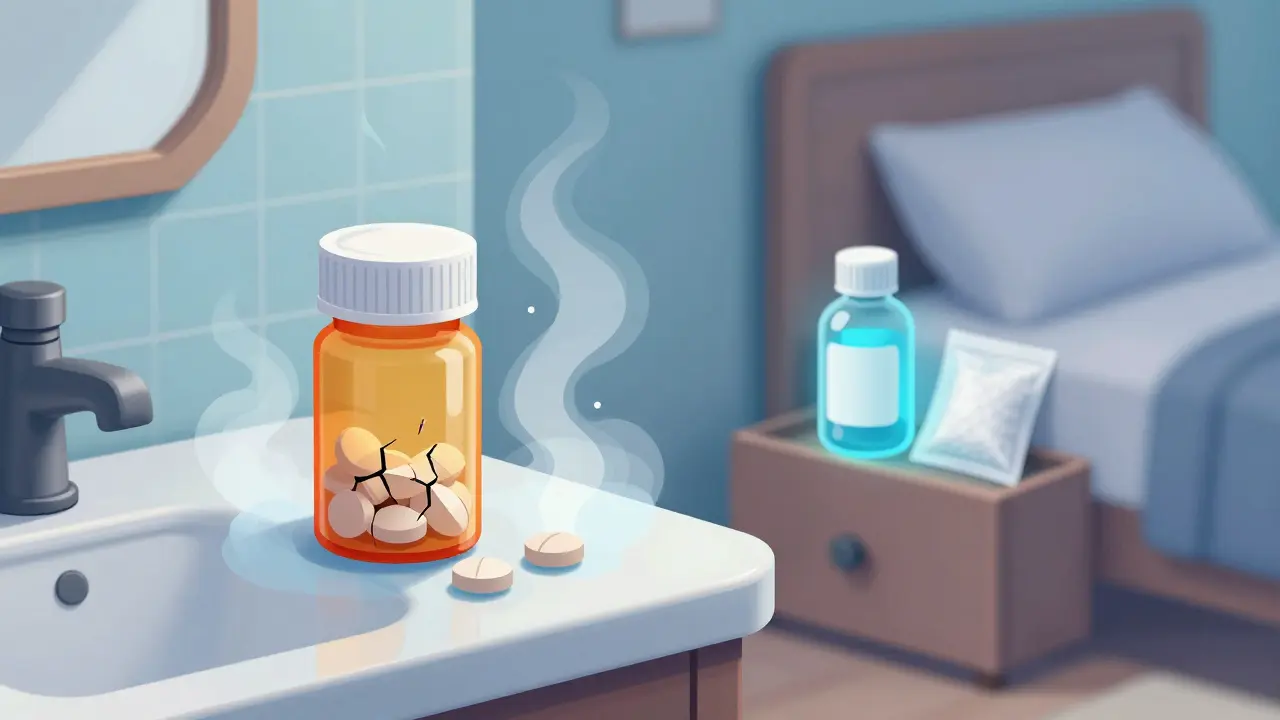
Moisture doesn’t just ruin your phone or your socks-it can wreck your medication. If your pills or capsules feel sticky, discolored, or smell off, they might already be damaged. And that’s not just a nuisance. Moisture can break down the active ingredients, making your medicine less effective-or worse, toxic. Aspirin turns into vinegar and salicylic acid. Vitamin C oxidizes. Antibiotics lose potency. In humid climates like Wellington, where damp air rolls in off the harbor, this isn’t a theoretical problem. It’s a daily risk.
Why Moisture Destroys Pills and Capsules
Pills and capsules aren’t just little pills in a bottle. They’re engineered chemical systems. Many active ingredients, especially antibiotics like amoxicillin/clavulanic acid or vitamins like C, are highly sensitive to water. When moisture gets in, it triggers hydrolysis-a chemical reaction where water breaks molecular bonds. This isn’t slow decay. It can happen in weeks. A study by Colorcon found that uncoated tablets lost nearly all their clavulanic acid after just 10 days outside sealed packaging. That means if you leave your antibiotic bottle open on the bathroom counter, you’re not just risking a bad dose-you’re risking a completely ineffective one. Oxidation is another silent killer. Moisture speeds up reactions with oxygen, especially in vitamin-based supplements. The result? Reduced potency, strange odors, or even harmful byproducts. The FDA has issued warning letters to manufacturers whose products degraded due to poor moisture control. And it’s not just the factory’s job. Once you open the bottle, every time you take a pill, you’re letting in humid air. A 500-pill bottle gets opened about 250 times. Each time, moisture floods the headspace. Without protection, that’s enough to ruin the rest of the bottle.The Three-Layer Defense System
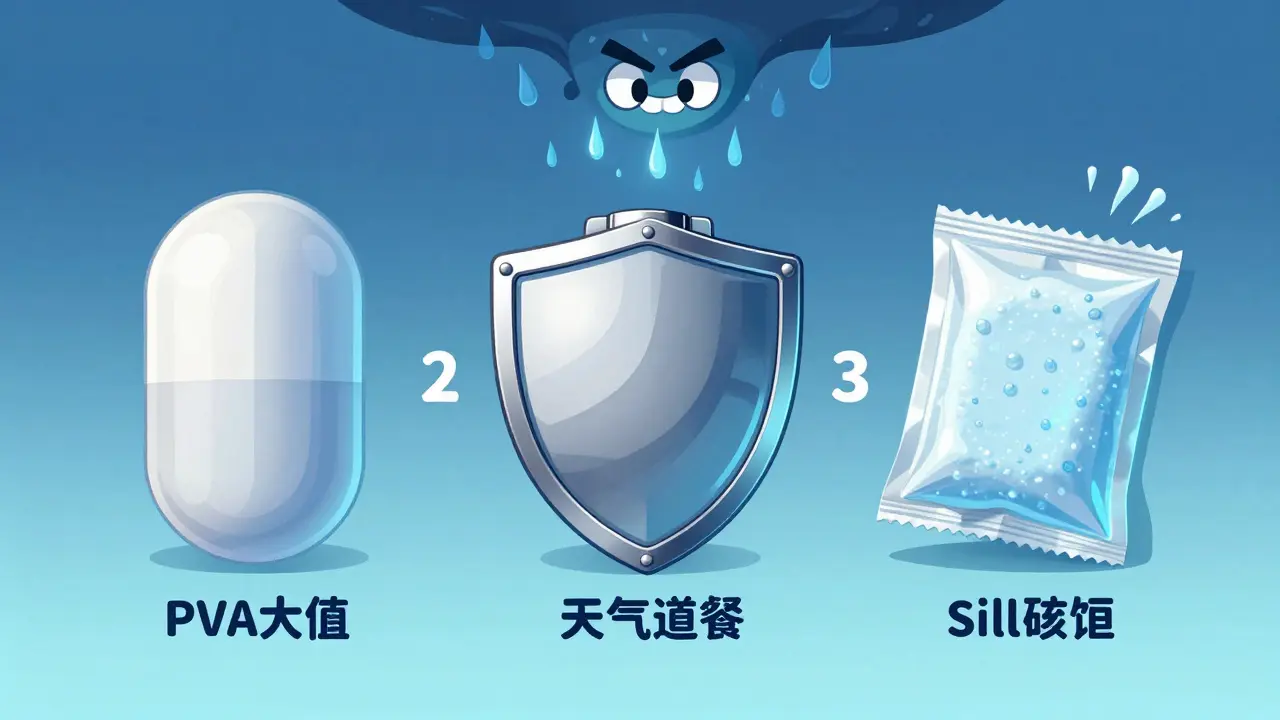
The best way to protect your medication isn’t one trick-it’s three layers working together.- Layer 1: Film Coating - This is the first line of defense, built into the pill itself. Not all coatings are the same. Most pills use HPMC (hydroxypropyl methylcellulose), which is okay-but not great. Newer PVA-based coatings like Opadry® amb II are three times better at blocking moisture. They create a tighter, more durable barrier that keeps water out even when the bottle is left open. If your medication has this coating, you’re already ahead of the game.
- Layer 2: Packaging - HDPE plastic bottles are common, but they’re not moisture-proof. They stop liquid spills, but water vapor? It slips right through. Aluminum foil blisters are better, but they’re not always practical for daily use. The best packaging combines a tight seal with a moisture-trapping inner layer. Look for bottles with child-resistant caps that snap shut tightly. Avoid clear plastic if you can-light and heat speed up degradation.
- Layer 3: Desiccants - This is the unsung hero. Silica gel packets (the little bags labeled “Do Not Eat”) aren’t just for shoeboxes. In pharmaceutical packaging, they absorb moisture before it touches your pills. Wisesorbent’s testing shows that properly sized silica gel can keep moisture levels in a pill bottle from rising more than 0.3% over two years-even in high humidity. The key? Size matters. Too small, and it’s useless. Industry best practice says the desiccant should handle at least 150% of the expected moisture load from bottle openings. If your bottle has no packet, or the packet is tiny, ask your pharmacist for a refill.
Studies show that combining all three layers reduces moisture-related failures by over 90%. A pharmacy in Brazil switched to PVA-coated antibiotics with silica gel packs and cut customer complaints from five per month to zero. That’s not luck. That’s science.
What to Do If Your Pills Are Already Damaged
If you notice any of these signs, don’t take the pills:- Sticky or clumped tablets
- Discoloration (yellowing, dark spots)
- Crumbly or chalky texture
- Strong vinegar or sour smell
- Changed taste (bitter, metallic, off)
Even if they look fine but have been stored in a bathroom or kitchen sink area, assume they’re compromised. Heat and moisture go hand-in-hand. The bathroom is the worst place to store meds. It’s warm, steamy, and humid. A drawer in a cool, dry bedroom is better. A medicine cabinet above the sink? Avoid it.
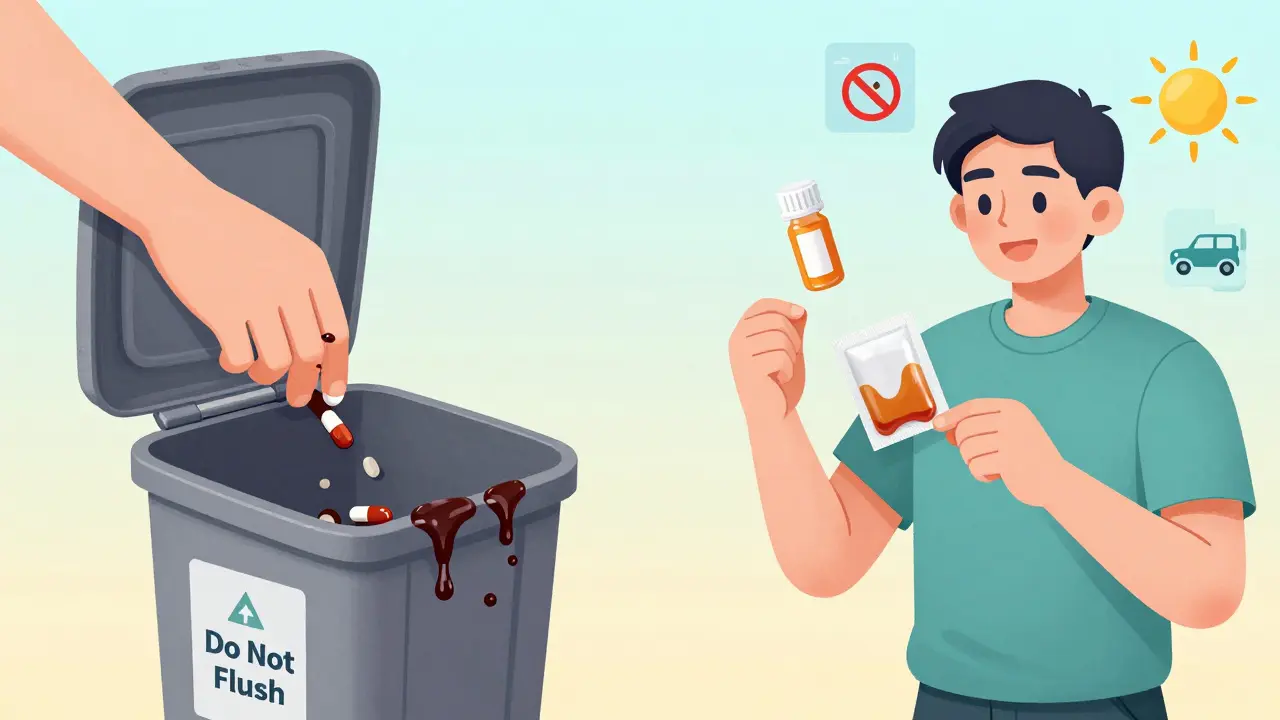
Don’t try to dry out wet pills. You can’t reverse hydrolysis. Once the chemistry is broken, it’s broken. Dispose of them safely-don’t flush them, don’t toss them in the trash. Take them to a pharmacy that offers a drug take-back program. Most pharmacies in New Zealand now do.
What Pharmacists and Manufacturers Are Doing
The industry knows this problem well. In 2023, 72% of moisture-sensitive medications used film coating plus desiccants. That number is rising. Companies like Colorcon and Wisesorbent are now designing desiccants that change color when they’re full-so you know when to replace them. Some are even testing moisture-scavenging ingredients that work inside the pill itself, not just in the bottle.But not everyone is on board. Smaller manufacturers still cut corners. You’ll still find bottles without desiccants, especially with generic drugs. If you’re buying medication online or from a discount pharmacy, check: Is there a desiccant packet? Is the coating glossy and smooth (sign of PVA)? If not, ask for a better option.
Regulations in the U.S. and Europe now require manufacturers to prove their packaging protects the drug for its entire shelf life. But enforcement varies. In places with high humidity-like Southeast Asia, the Caribbean, or here in New Zealand-these rules matter more than ever.
Practical Tips for Everyday Use
- Keep meds in their original bottle. Don’t dump them into a pill organizer unless you’re using one with a tight seal and a desiccant inside.
- Use a desiccant in your pill organizer. Buy small silica gel packs (they’re sold for electronics) and put one in the bottom of your weekly pill box. Replace it every month.
- Store in a cool, dry place. Bedroom drawer. Kitchen cabinet away from the stove. Not the bathroom. Not the car. Not the windowsill.
- Check expiration dates. Moisture damage can shorten shelf life. If a pill is past its date and has been exposed to humidity, toss it.
- Ask for PVA-coated meds. If you’re on a long-term medication, ask your pharmacist: “Is this coated with PVA?” If they don’t know, it’s probably not. You deserve better.
- Replace desiccants. If the packet is torn, wet, or crumbly, throw it out. Get a new one. Most pharmacies will give you a free refill.
One pharmacist on Reddit said, “Since we switched to Opadry-coated antibiotics, customer complaints dropped from five per month to zero.” That’s not marketing. That’s real-world proof.
What Happens When You Ignore Moisture
Ignoring this isn’t just about wasted money. It’s about health. A study found that 78% of pharmacists say moisture-damaged meds reduce patient adherence. If your antibiotics don’t work because they’re degraded, you might not get better. You might develop resistance. You might need a stronger drug. You might end up in the hospital.Moisture damage is silent. It doesn’t scream. It doesn’t explode. It just slowly, quietly, makes your medicine useless. And then you wonder why you’re not getting better.
Protecting your pills isn’t about being paranoid. It’s about being smart. You wouldn’t leave your insulin in the sun. Don’t leave your antibiotics in the bathroom.




Alex Ogle
February 9, 2026 AT 17:29My pharmacist even gave me a refill packet last time. Free. They’re not trying to upsell you; they’re trying to keep you alive.
Brandon Osborne
February 11, 2026 AT 11:33Marie Fontaine
February 11, 2026 AT 16:17Ken Cooper
February 13, 2026 AT 02:25MANI V
February 14, 2026 AT 02:17Random Guy
February 14, 2026 AT 08:18Ryan Vargas
February 14, 2026 AT 20:02And PVA coating? It’s not ‘better.’ It’s a Band-Aid on a hemorrhage. We need regulated humidity-controlled storage at the point of sale. Not ‘put a packet in your drawer.’ We need policy. Not personal hacks.
Tasha Lake
February 14, 2026 AT 20:55Alex Ogle
February 16, 2026 AT 00:07