The Danger of the "5-Day Grace Period"
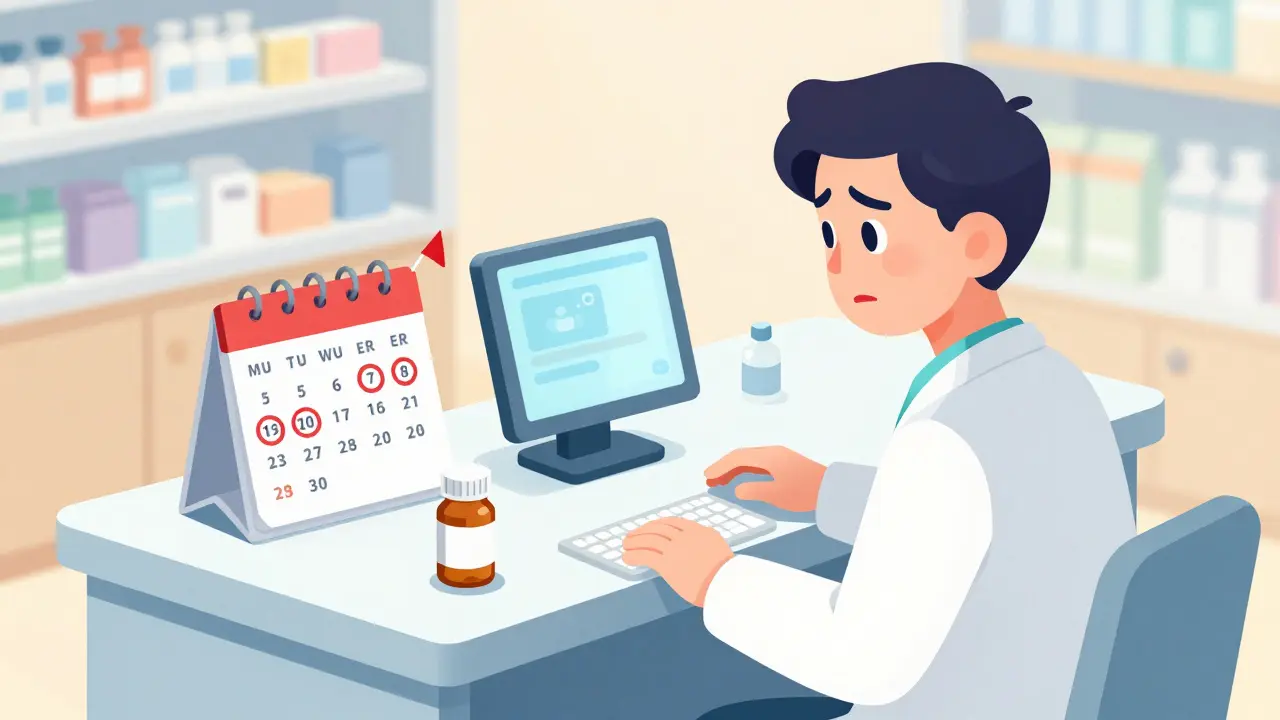
One of the biggest hurdles in preventing early refills is the inconsistency between insurance policies and clinical safety. Many standard insurance plans allow a patient to refill a 30-day supply about five days early. This creates a psychological loophole where patients believe they are "allowed" to use their medication faster than prescribed. If a patient consistently hits that five-day window every month, they aren't actually adhering to the dose; they are effectively taking more medication than intended over time. Pharmacy staff often face pushback when they flag these patterns. Patients might argue that the doctor wrote the script, so they should get it, or offer to pay cash to bypass insurance blocks. However, the goal isn't to be a barrier to care-it's to identify misuse. For high-risk medications, some pharmacies implement a strict "two days early" rule. Anything beyond that requires a documented legitimate purpose, such as a planned vacation or a dosage change confirmed by the provider.Building a Tiered Refill Protocol
Not all medications carry the same risk. Treating a nasal steroid refill the same way you treat a Schedule II narcotic is an inefficient use of a provider's time. To solve this, many clinics use a tiered protocol system to categorize medications by their risk profile. This allows medical assistants or nurses to handle routine refills while reserving the doctor's attention for high-risk cases.| Risk Level | Example Medications | Refill Rule | Who Approves? |
|---|---|---|---|
| Low Risk | Nasal steroids, basic vitamins | Standard approval based on history | Nurse / MA |
| Moderate Risk | Antihypertensives, Diabetes meds | Refill for 3 months if seen within 3 months | Nurse / MA (via protocol) |
| High Risk | Opioids, Benzodiazepines | Strict date checks; no early refills without prior OK | Physician only |
Stopping Duplicate Therapy at the Counter
Duplicate therapy happens when a patient is taking two medications that do the same thing, often because they are seeing multiple specialists. For example, a cardiologist and a primary care physician might both prescribe a beta-blocker under different brand names. The pharmacist is the last line of defense here. To catch this, pharmacists shouldn't just assume that because a patient has taken a drug before, it's still appropriate. A thorough review of the patient profile is mandatory. This means looking for:- Gaps in pharmacy service care, which suggest the patient is using multiple pharmacies to hide overlapping prescriptions.
- New prescriptions that mirror the therapeutic effect of existing ones.
- Discontinued therapies that are still appearing as "active" on a refill request.
Leveraging EHRs to Block Errors
Technology is the best way to remove human error from the equation. Electronic Health Records (EHRs) can be configured to act as a safety net. Instead of relying on memory, providers can use specific phrasing in the system to prevent automatic refills. Using the phrase "cancel all prior" effectively kills old reminders and stops the cycle of automatic duplicate requests. Furthermore, when a prescription is picked up early for a legitimate reason, the provider should note this explicitly in the chart. Without this note, the next person reviewing the file might see the early pickup as a sign of misuse or, conversely, fail to realize the patient is running out faster than expected. Clinical Decision Support (CDS) tools can also trigger alerts when a refill request fails a "temporal rule," such as when a patient is overdue for a required lab test or a follow-up visit. This ensures that medication is never dispensed without the necessary health monitoring.
Dealing with High-Risk Controlled Substances
Controlled substances require a different level of scrutiny. The Drug Enforcement Administration (DEA) mandates strict controls, and for many Schedule II substances, refills aren't even permitted-a new prescription is required every time. This is a built-in safety mechanism to prevent stockpiling and diversion. For patients on long-term pain management, a proactive agreement is the best way to prevent friction. Patients should agree from the start that early refills will not be granted unless there is a dramatic change in their condition, and that they must agree to specialist evaluations if misuse is suspected. When the expectations are set in writing, it removes the "negotiation" phase at the pharmacy counter and keeps the focus on clinical safety.Why do insurance companies allow refills a few days early?
Insurance companies often provide a small grace period (usually around 5 days) to account for mailing delays, pharmacy processing times, or patient travel. However, this is a financial/administrative convenience, not a clinical guideline. Pharmacists are encouraged to ignore this grace period if they suspect the patient is taking more medication than prescribed.
What is the difference between a duplicate therapy error and a drug interaction?
A drug interaction occurs when two different drugs react poorly together. Duplicate therapy is specifically when a patient takes two or more medications from the same pharmacological class that perform the same function. This effectively doubles the dose of that specific therapy, increasing the risk of toxicity and overdose.
How can a clinic reduce the time spent on refill requests?
Implementing evidence-based refill protocols allows non-provider staff (like nurses and MAs) to approve low- and moderate-risk refills if the patient meets specific criteria, such as having a visit within the last three months. This reduces provider burnout and speeds up the process for the patient.
What should a pharmacist do if a patient insists on an early refill by paying cash?
Paying cash does not remove the clinical risk. The pharmacist should still verify the remaining supply and contact the prescribing physician to ensure the early refill is medically necessary. If the request is for a controlled substance and lacks a clear medical justification, the pharmacist should exercise professional judgment and potentially refuse the fill.
How do Clinical Viewers help prevent medication errors?
Clinical Viewers allow pharmacists to see a patient's prescription history across different pharmacies if those prescriptions were filled through public drug programs. This exposes "pharmacy shopping," where patients visit multiple locations to obtain duplicate therapies or early refills of controlled substances.