Key Takeaways
- Candidacy: Generally, if two tolerated antiseizure medications fail to provide seizure freedom, you qualify for a surgical evaluation.
- Success Rates: Up to 60-80% of people with temporal lobe epilepsy achieve seizure freedom.
- Timing: Earlier referral correlates with better cognitive outcomes and higher success rates.
- Risks: While rare, permanent neurological deficits occur in about 1-2% of traditional resections.
- Modern Options: New techniques like LITT offer minimally invasive alternatives with lower complication rates.
Who Actually Qualifies for Epilepsy Surgery?
Not everyone with epilepsy is a candidate for surgery. The goal is to find a "seizure focus"-a specific, localizable spot in the brain where the seizures start. If the electrical activity is spread across both hemispheres or is generalized, removing a single piece of tissue won't help. To determine candidacy, doctors follow a two-step process. First, they look for "red flags" that suggest you'd benefit from an evaluation. These include having disabling seizures (typically one or more per month) and failing two properly chosen Antiseizure Medications (ASMs). For children, certain conditions like Tuberous Sclerosis Complex is almost always drug-resistant, meaning children with this diagnosis are often referred for surgery immediately. Once you're referred to a Level 4 epilepsy center, the second step is the deep dive. This is where a multidisciplinary team-including neurosurgeons and neuropsychologists-determines if the risk of surgery is lower than the risk of continuing to have seizures. They are looking for a "surgically remediable syndrome," which essentially means the problem is in a place they can safely remove without destroying your ability to speak, move, or remember.The Presurgical Evaluation: What Happens?
Walking into a surgical evaluation can feel overwhelming because it's not just one appointment; it's a comprehensive diagnostic marathon that usually lasts two to six weeks. The team needs to map your brain with incredible precision to ensure they don't cut into "eloquent" cortex (areas that control vital functions).Here is what a typical evaluation looks like:
- Video-EEG Monitoring: You'll likely stay in a specialized unit for 5-7 days. This allows doctors to record the exact electrical signature of your seizures while watching them on video to see how they manifest physically.
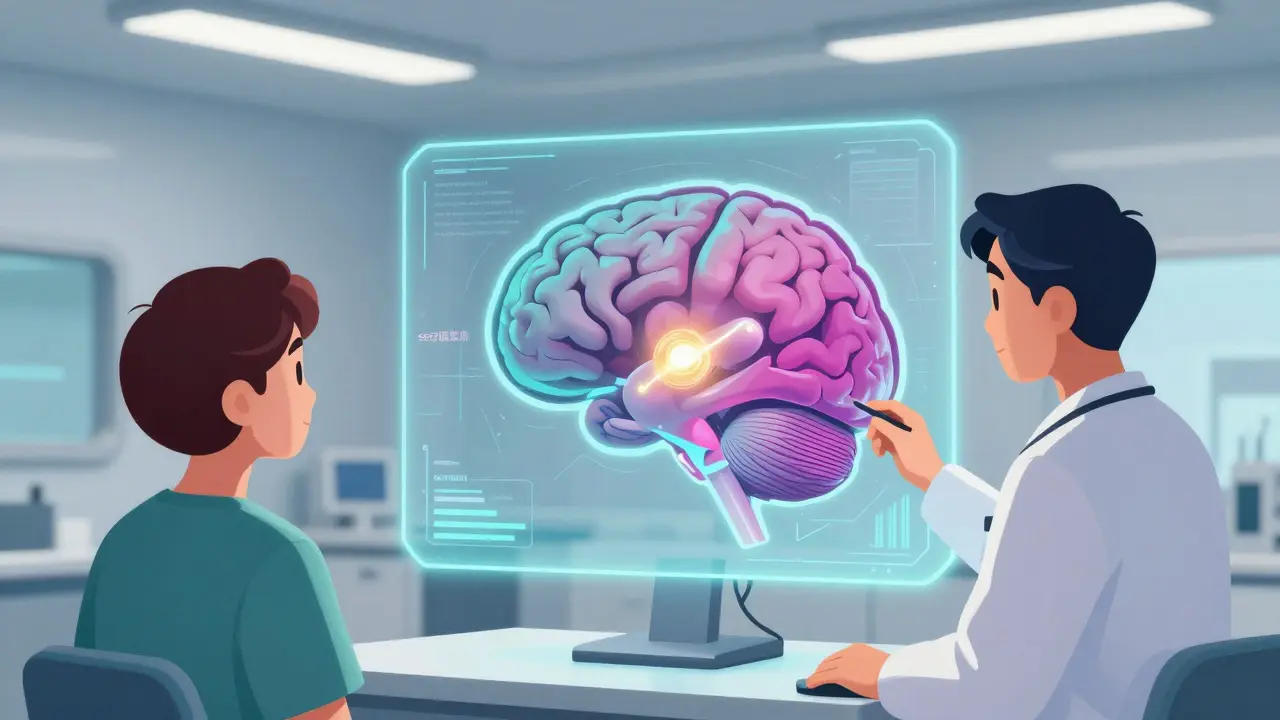
- High-Resolution Imaging: You'll get a 3T MRI with slices as thin as 1mm. This helps them find structural issues, like Hippocampal Sclerosis, which is a common cause of focal epilepsy in the temporal lobe.
- Functional Mapping: Tools like FDG-PET scans show how your brain uses glucose, helping identify areas that are "quiet" between seizures.
- Neuropsychological Testing: A series of tests to measure your current memory and cognitive function. This creates a baseline so the surgeon knows exactly what needs to be protected.
Types of Surgical Procedures and Their Trade-offs
Depending on where your seizures start, the surgeon will choose a different strategy. Some involve removing tissue, while others involve "silencing" a circuit.| Procedure | Primary Target | Success Rate (Seizure Freedom) | Risk Level |
|---|---|---|---|
| Temporal Lobectomy | Mesial Temporal Lobe | 60-80% | Moderate (1-2% permanent deficit) |
| LITT (Laser Therapy) | Small, deep focal points | ~55% | Low (2.3% complication rate) |
| RNS (Responsive Neurostimulation) | Difficult-to-remove foci | Variable (Focuses on reduction) | Low (Implantable device) |
| Corpus Callosotomy | Generalized/Drop attacks | Low (<20% total freedom) | Moderate |
The Temporal Lobectomy is the gold standard for focal epilepsy. It involves removing the hippocampus and surrounding tissue. While it has the highest rate of complete seizure freedom, it carries a higher risk of transient complications, such as temporary memory loss or swelling.
If you aren't a candidate for full removal, RNS is a game-changer. Instead of removing brain tissue, it implants a device that monitors your brain's electricity and delivers a tiny shock to stop a seizure before it even starts. This is often used for patients who can't undergo a lobectomy because the seizure focus is too close to critical language centers.
Understanding the Risks: The Honest Truth
Brain surgery is a heavy decision. The biggest fear most patients have is waking up with a personality change or losing their memory. It's important to balance these fears with the reality of living with uncontrolled seizures. From a clinical perspective, the risk of permanent neurological deficit in a standard temporal lobectomy is roughly 1-2%. However, you must weigh this against the risk of SUDEP (Sudden Unexpected Death in Epilepsy), which affects about 1 in 1,000 people with epilepsy annually. For many, the risk of a surgical complication is actually lower than the long-term risk of a fatal seizure event. Common complications include:- Memory Issues: Especially if the surgery is on the dominant (usually left) hemisphere, you might notice short-term memory gaps.
- Transient Swelling: Post-operative edema can cause temporary confusion or weakness.
- Infection: As with any major surgery, there is a small risk of meningitis or wound infection.
Expected Outcomes and Quality of Life
What does "success" actually look like? For some, it's the "Engel Class I" outcome, which is the medical term for being completely seizure-free. For others, success is simply reducing seizures from 20 a month to 2 a year. Both are massive wins. Beyond the medical charts, the real victory is in the daily logistics. A significant number of postoperative patients-roughly 79% in some studies-report being able to drive for the first time in decades. This restores a level of independence that medication alone rarely provides. There is also a cognitive "rebound." When your brain is no longer under the constant stress of seizures and the heavy sedation of multiple ASMs, many patients report improved clarity and mood. In fact, successful surgery often pays for itself within three years by reducing emergency room visits and allowing the person to return to full-time employment.
Overcoming the Barriers to Care
Despite the evidence, surgery is wildly underutilized. In the U.S., fewer than 1% of the 1.2 million people with drug-resistant epilepsy are referred to specialized centers each year. Why? Because many doctors still treat surgery as a "last resort"-something to do only after 10 years of failure. If you're facing barriers, here are some practical tips:- Push for Earlier Evaluation: If you've failed two meds, don't wait years. Ask your neurologist specifically for a referral to a Level 4 Epilepsy Center.
- Fight Insurance Denials: About 42% of initial requests for surgical evaluation are denied. Don't take the first "no" as a final answer; roughly 78% of appeals are successful.
- Keep a Seizure Diary: Document at least 3-5 typical events in detail. This data is gold for your surgical team and can speed up your evaluation.
Does epilepsy surgery guarantee I'll be seizure-free?
No guarantee. While 60-80% of temporal lobe surgery patients achieve seizure freedom, some only see a significant reduction in frequency. The outcome depends heavily on whether the seizure focus was completely identified and removed.
Will I lose my memory after brain surgery?
There is a risk of memory impairment, especially if the surgery is on the dominant side of the brain. However, neuropsychological testing during the evaluation helps surgeons avoid critical memory areas to minimize this risk.
How long is the recovery time for epilepsy surgery?
Most patients spend 3-7 days in the hospital. Initial recovery takes a few weeks, but full cognitive and physical recovery can take several months as the brain heals from the swelling.
Can I still take medication after surgery?
In many cases, yes. Some people can taper off medications entirely if they are seizure-free, while others continue a single, low-dose medication to ensure stability.
What happens if the surgery doesn't work?
If a resection doesn't stop the seizures, other options like RNS (Responsive Neurostimulation) or palliative neuromodulation can often be explored to manage the frequency and severity.