
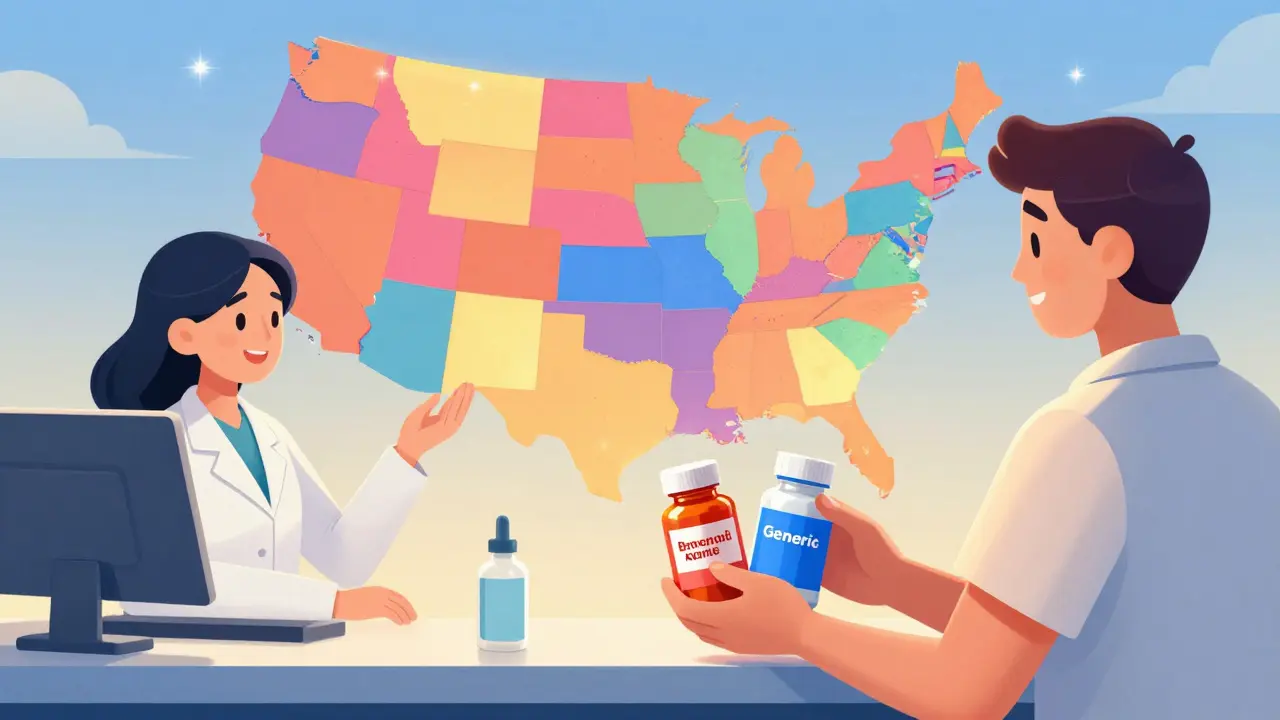
When you pick up a prescription, you might not think about the legal maze behind whether you get the brand-name drug or a cheaper generic. But in the United States, the decision isn’t just up to your doctor or pharmacist-it’s controlled by state laws, and those laws are wildly different depending on where you live. One state might require pharmacists to swap in a generic unless you say no. Another might demand your written permission. And in a few, certain drugs can’t be switched at all-even if they’re officially labeled as equivalent.
Why Do State Laws Even Exist?
Generic drugs save money. A lot of it. Since 2009, they’ve saved the U.S. healthcare system over $1.7 trillion. That’s not just a number-it means lower co-pays for patients, less strain on Medicaid, and more affordable care for millions. But savings aren’t the only concern. Some drugs, like warfarin or levothyroxine, have a narrow therapeutic index (NTI). That means even tiny differences in how the drug is absorbed can lead to serious side effects-too little and it doesn’t work; too much and it’s dangerous.
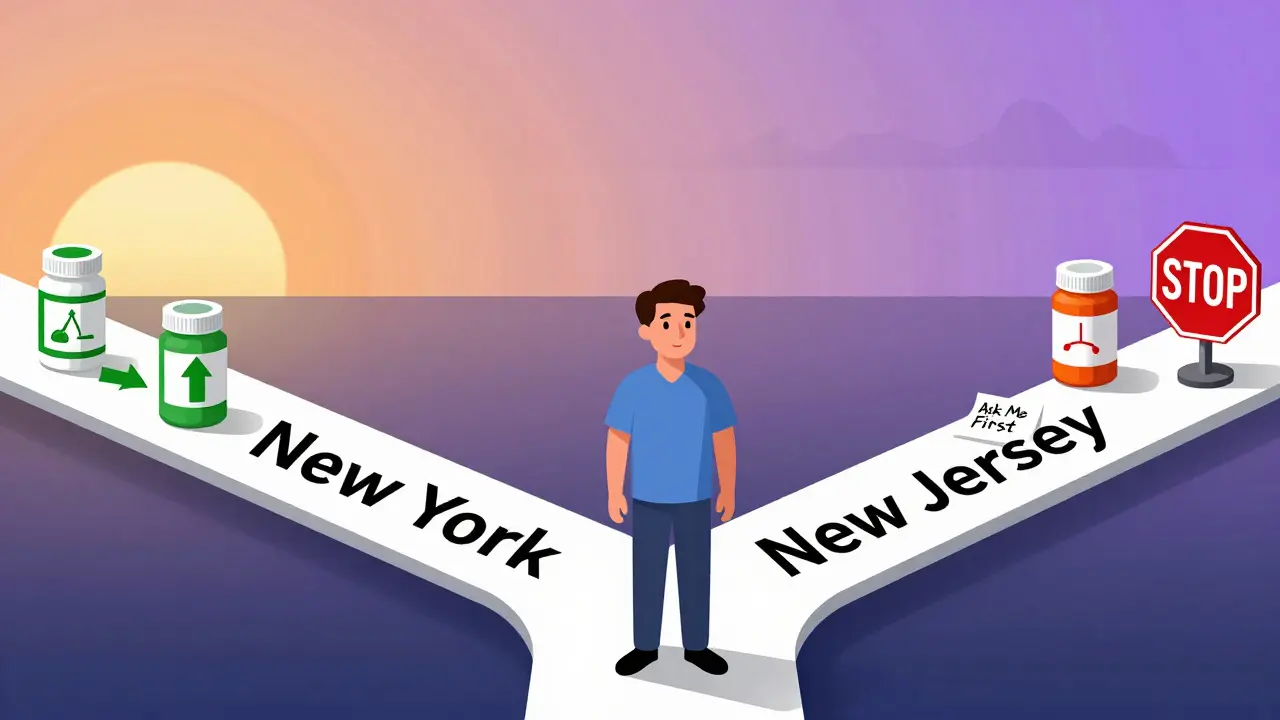
So states stepped in. After the federal Hatch-Waxman Act in 1984 made it easier to approve generics, every state created its own rules. The goal? Let people save money without risking their health. But the result? A patchwork of 50 different systems. If you live in New York and your cousin lives in New Jersey, you might get your generic automatically. They might have to ask first. And if you move? You’re suddenly dealing with a whole new set of rules.
Four Ways State Laws Differ
Not all state laws are created equal. They vary in four key areas:
- Pharmacist Duty to Substitute - In 22 states, pharmacists must substitute a generic unless the doctor or patient says no. In the other 28 states and D.C., substitution is optional. The pharmacist can do it, but they don’t have to.
- Patient Consent - In 32 states, it’s presumed you’re okay with a generic unless you say otherwise. In 18 states, you must give clear, active permission before the switch happens.
- Notification Requirements - Forty-one states require pharmacists to tell you after they’ve made the switch. That might be a note on the label, a verbal warning, or a printed sheet. In the other nine, they don’t have to say anything.
- Liability Protection - If a pharmacist follows the rules correctly, 37 states protect them from lawsuits. But if they mess up? They’re on the hook. That’s why pharmacists spend so much time double-checking.
These differences aren’t just paperwork. They affect real outcomes. States with mandatory substitution and presumed consent see about 12% more generic fills than states that make it optional. That’s billions in savings. But it also means more chances for confusion-or worse, errors.
What Drugs Can’t Be Switched?
The FDA says generics are therapeutically equivalent to brand names. But some doctors and patients don’t believe that-especially with drugs that have a narrow therapeutic index. That’s why 15 states keep their own lists of drugs that can’t be substituted, even if the FDA says they’re safe to swap.
For example, Kentucky bans substitution for antiepileptic drugs like phenytoin and digitalis glycosides. Minnesota has had documented cases where switching warfarin generics led to dangerous blood clotting or bleeding. In Hawaii, even biosimilars (a newer kind of generic for complex biologic drugs) require both doctor and patient consent for antiepileptic drugs.
These restrictions aren’t arbitrary. They’re based on real patient reports. Between 2020 and 2022, the FDA’s MedWatch system recorded 217 complaints about changes in how patients felt after a generic switch. Nearly half of those involved levothyroxine or warfarin. That’s why many cancer patients and people with rare diseases are told by their doctors to write “dispense as written” on the prescription.
How Pharmacists Keep Up
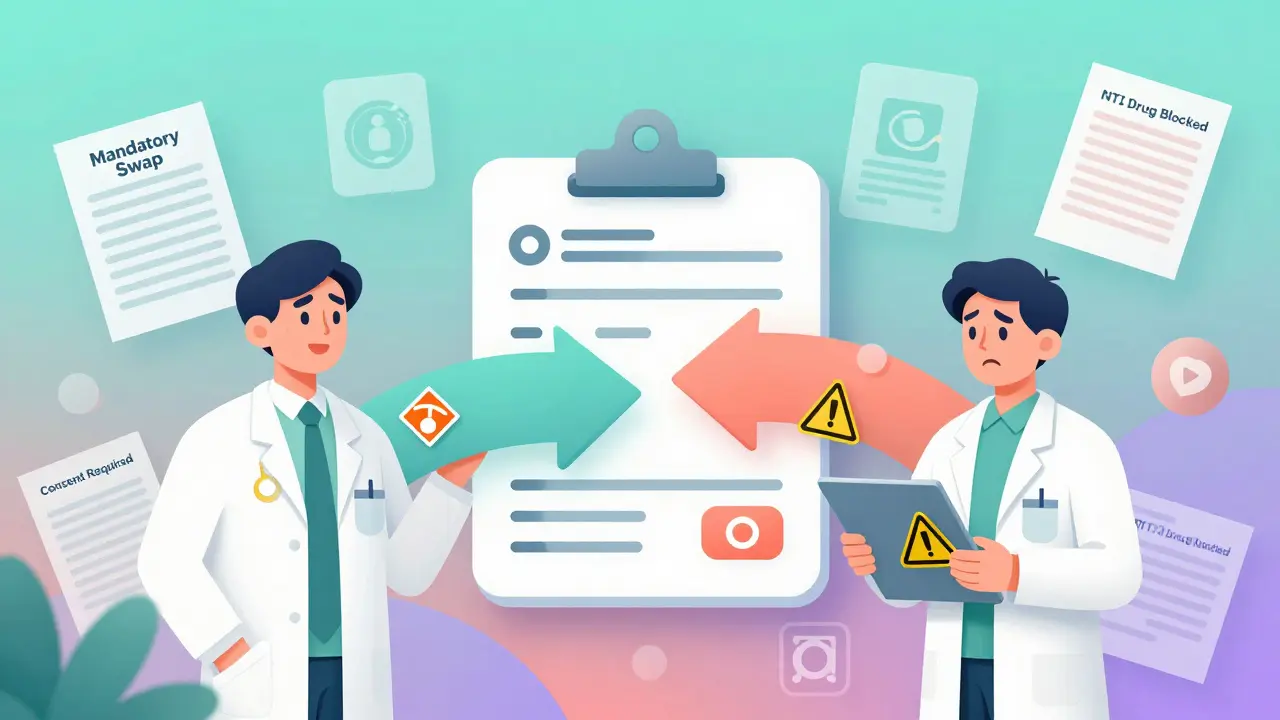
Imagine you’re a pharmacist. You fill 80 prescriptions a day. Half of them are for generics. But each one could be subject to a different rule depending on where the prescription came from. Was it written in Texas? Ohio? California? Each state has its own list of NTI drugs, its own consent rules, its own notification requirements.
On average, pharmacists spend over 12 minutes per prescription just checking the rules. That’s time they could spend counseling patients. To help, 83% of pharmacy software systems now auto-check state laws. They pull data from the FDA’s Orange Book, cross-reference state NTI lists, and flag when a switch isn’t allowed. These tools cut substitution errors by 64%.
But technology doesn’t fix everything. Pharmacists still need to know the law. Nearly all states require this knowledge for licensing. Pharmacy schools now teach 45 to 60 hours of state-specific substitution rules. And even then, mistakes happen-especially when prescriptions cross state lines. About 18% of chain pharmacy transactions involve prescriptions from another state, and each one adds complexity.
What Patients Experience
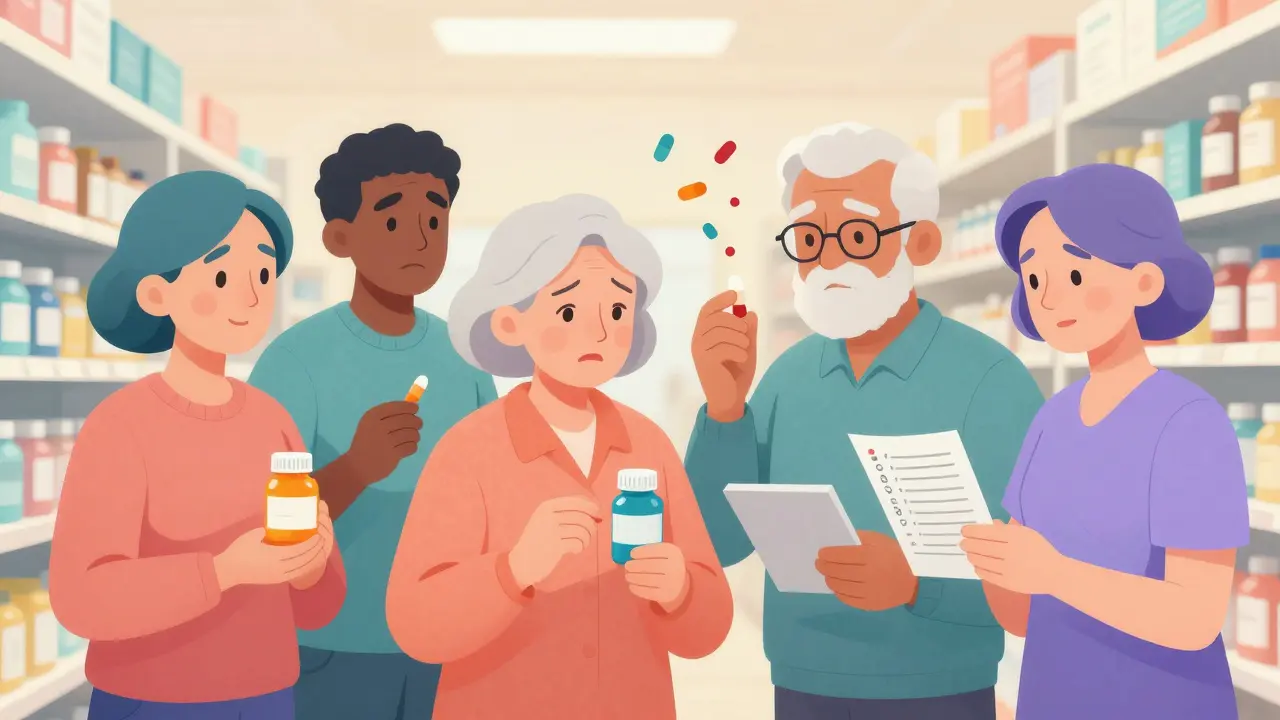
Patients don’t always understand why they got a different pill. Some think the generic is weaker. Others worry it’s made in a cheaper factory. Reddit threads from pharmacy workers show real confusion: “I have patients who live right on the New York-New Jersey border. One gets the generic automatically. The other has to ask. They both get mad when they find out the rules are different.”
Some patients love generics. In Texas, pharmacists report a 15% drop in people abandoning prescriptions after switching to generics-especially for statins. Lower cost means fewer people skip doses because they can’t afford it.
But others are scared. A 2023 survey by the Life Raft Group found that 41% of patients with rare diseases were worried about substitution for NTI drugs. And 28% said their doctor specifically told them to avoid generics. That’s not paranoia-it’s experience. One woman in Minnesota switched from her brand-name warfarin to a generic and ended up in the ER with a pulmonary embolism. Her INR levels were off. The generic was FDA-approved. But her body reacted differently.
The Bigger Picture
Generic drugs now make up 92.5% of all prescriptions filled in the U.S. That’s up from 78% two decades ago. States with strict substitution laws average 94% generic fills. States with loose rules? Only 88%. That gap is why Medicaid programs save $1.2 billion a year in states with mandatory substitution.
But the system is strained. The American Pharmacists Association says 78% of pharmacists feel confused when handling prescriptions from out-of-state. The FDA has added 17 new therapeutic equivalence ratings for biosimilars in 2023 alone. Twenty-three states are reviewing their laws to keep up.
There’s movement toward change. The Uniform Law Commission drafted a model act in 2023 to standardize biosimilar substitution rules across states. If adopted, it could cut down on confusion and errors. But some groups warn against too much standardization. The National Organization for Rare Disorders argues that patients with rare diseases need flexibility-not uniform rules. What works for a statin might not work for a rare autoimmune drug.
So where does this leave you? If you’re on a medication with a narrow therapeutic index, ask your doctor: “Can you write ‘dispense as written’ on this prescription?” If you notice a change in how you feel after switching to a generic, tell your pharmacist and doctor. Don’t assume it’s all in your head. And if you move to a new state? Check the rules. Your pharmacy might be required to do something completely different now.
What’s Next?
The federal government isn’t stepping in to fix this. So the patchwork will stay-for now. But pressure is building. The Congressional Budget Office estimates harmonizing state laws could save an extra $8.7 billion by 2028. That’s money for hospitals, for patients, for lower premiums.
But savings can’t come at the cost of safety. The real challenge isn’t just making substitution easier. It’s making it smart. The best system doesn’t force generics on everyone. It gives patients control, protects vulnerable populations, and keeps pharmacists from drowning in rules. Until then, the law stays local-and so does the responsibility to understand it.

Madhav Malhotra
January 11, 2026 AT 01:49Wow, this is such a cool breakdown! In India, we don’t have this mess-generic is generic, and everyone just takes it. But I can see how chaotic it must be in the US with 50 different rulebooks. Kudos for explaining it so clearly 😊
Christian Basel
January 12, 2026 AT 20:14NTI drugs are a pharmacoeconomic nightmare. The FDA’s therapeutic equivalence designations are fundamentally inadequate for drugs with nonlinear pharmacokinetics. The patchwork regulatory landscape is a direct consequence of federalism’s failure to harmonize clinical risk stratification protocols.
Roshan Joy
January 13, 2026 AT 13:03This is super interesting! I’ve had friends switch generics and feel totally off-like fatigue or brain fog. Never realized it could be state laws causing the confusion. Maybe we need a simple app that tells you your rights based on your zip code? 🤔
Sean Feng
January 14, 2026 AT 05:12Pharmacists should just do what the FDA says stop making it complicated
Adewumi Gbotemi
January 14, 2026 AT 16:35Man this reminds me of how in Nigeria we just get whatever is in stock. No rules no fuss. But I get it safety matters. Maybe just make a simple card patients can carry? Like a generic passport?
Priya Patel
January 15, 2026 AT 07:54I used to work at a pharmacy and let me tell you-people lose their minds when they get a different pill. One lady cried because her generic levothyroxine looked ‘too white’ 😭 I had to sit with her for 20 minutes. This system is broken but the savings? Real.
Alfred Schmidt
January 15, 2026 AT 18:43Why are we even allowing this?! The FDA says they’re equivalent-so why do states get to play god with people’s lives?! This is bureaucratic insanity! I’ve seen people have seizures because some pharmacist in Ohio decided to swap their phenytoin without telling them!!!
Priscilla Kraft
January 16, 2026 AT 17:13As a pharmacist, I can confirm: the software flags 90% of issues, but the real problem is when prescriptions come from out of state. I spent 45 minutes last week just checking Kentucky’s NTI list for a single script. We need a national database. And yes, I always ask patients if they’ve noticed changes-because they’ve told me things I never expected 😊
Vincent Clarizio
January 16, 2026 AT 17:43Think about it-this isn’t just about drugs, it’s about the very fabric of American identity. We celebrate individualism, yet we force patients into a system where their medication is subject to the whims of state legislatures. The FDA’s equivalence standards are a colonial relic, a pseudo-scientific attempt to reduce human physiology to a binary algorithm. We’re not just talking about warfarin-we’re talking about autonomy, about the soul of medicine in a fractured republic. The fact that a man in Alabama can get his generic automatically while his neighbor in New Hampshire must sign a waiver… that’s not healthcare, that’s Kafkaesque theater. And don’t even get me started on biosimilars.
Sam Davies
January 17, 2026 AT 04:27Oh look, another American ‘crisis’ that could be solved by one federal law… but no, let’s let 50 states reinvent the wheel while pharmacists cry into their barcode scanners. Truly, the land of the free and the home of the bewildered.
Alex Smith
January 18, 2026 AT 18:55Actually, this is kind of beautiful. It’s like a living experiment in decentralized policy. Sure, it’s messy-but it means real people are shaping the rules. The real failure isn’t the patchwork-it’s that we don’t teach patients how to navigate it. We need a national ‘Know Your Rx’ campaign. Not just for NTI drugs-for everyone.
Michael Patterson
January 19, 2026 AT 00:27you guys are overthinking this its just pills why does it matter what state you in? the FDA says its the same so just take it stop being so sensitive and if you dont like it go to canada or something