
Antibiotic & Alcohol Safety Checker
Know Your Medication Safety
This tool helps you understand whether your antibiotic has a known interaction with alcohol based on current scientific evidence. The common warning about metronidazole may be outdated.
Select Your Antibiotic
Alcohol Interaction Results
Select your antibiotic to see the interaction information.
For decades, doctors and pharmacists have told patients: don’t drink alcohol while taking metronidazole. The warning is everywhere - on pill bottles, in patient leaflets, even in dental offices. The reason? A scary-sounding "disulfiram-like reaction" that’s supposed to cause flushing, nausea, vomiting, headaches, and even a dangerous drop in blood pressure. But what if that warning is based on a myth?
The Origin of the Warning
The story starts in 1964. A doctor named Saldivar noticed one patient taking metronidazole for an infection seemed to lose interest in alcohol. The patient reported feeling sick after drinking. That single case became the foundation for a global medical rule. By the 1970s, every medical textbook included the same warning: metronidazole and alcohol = bad combo. It stuck. Even today, you’ll find it in FDA labels, hospital protocols, and pharmacy counseling sheets. But here’s the problem: that original case was just one person. No controlled study ever confirmed it. No consistent biochemical mechanism was proven. And yet, the warning became gospel.What Is a Disulfiram-Like Reaction, Anyway?
To understand why this matters, you need to know how alcohol is normally processed. When you drink, your body turns ethanol into acetaldehyde - a toxic compound. Then, an enzyme called aldehyde dehydrogenase (ALDH) quickly breaks it down into harmless acetate. If ALDH is blocked, acetaldehyde builds up. That’s what causes the flushing, rapid heartbeat, and nausea. That’s exactly what happens with disulfiram (Antabuse), a drug used to treat alcohol dependence. It shuts down ALDH on purpose. People taking disulfiram who drink alcohol get violently ill - and that’s the point. For years, doctors assumed metronidazole did the same thing. But here’s the truth: multiple studies have shown it doesn’t.The Evidence That Changed Everything
In 2023, a major study changed the game. Researchers at a large U.S. hospital system looked at over 1,000 patients who ended up in the emergency room with alcohol in their system. Half were taking metronidazole. The other half weren’t - but they had the same amount of alcohol in their blood, same age, same sex. The result? Both groups had the exact same rate of symptoms - 1.98%. That’s not a reaction to metronidazole. That’s just what happens when people drink too much alcohol. Other studies back this up. A 2020 review of 17 controlled trials found 15 showed no increase in acetaldehyde levels or symptoms when metronidazole and alcohol were combined. Animal studies showed metronidazole might raise acetaldehyde in the gut - but not in the bloodstream, where it causes real harm. Even more telling: metronidazole doesn’t inhibit ALDH. Disulfiram does. Metronidazole doesn’t. That’s a fundamental difference.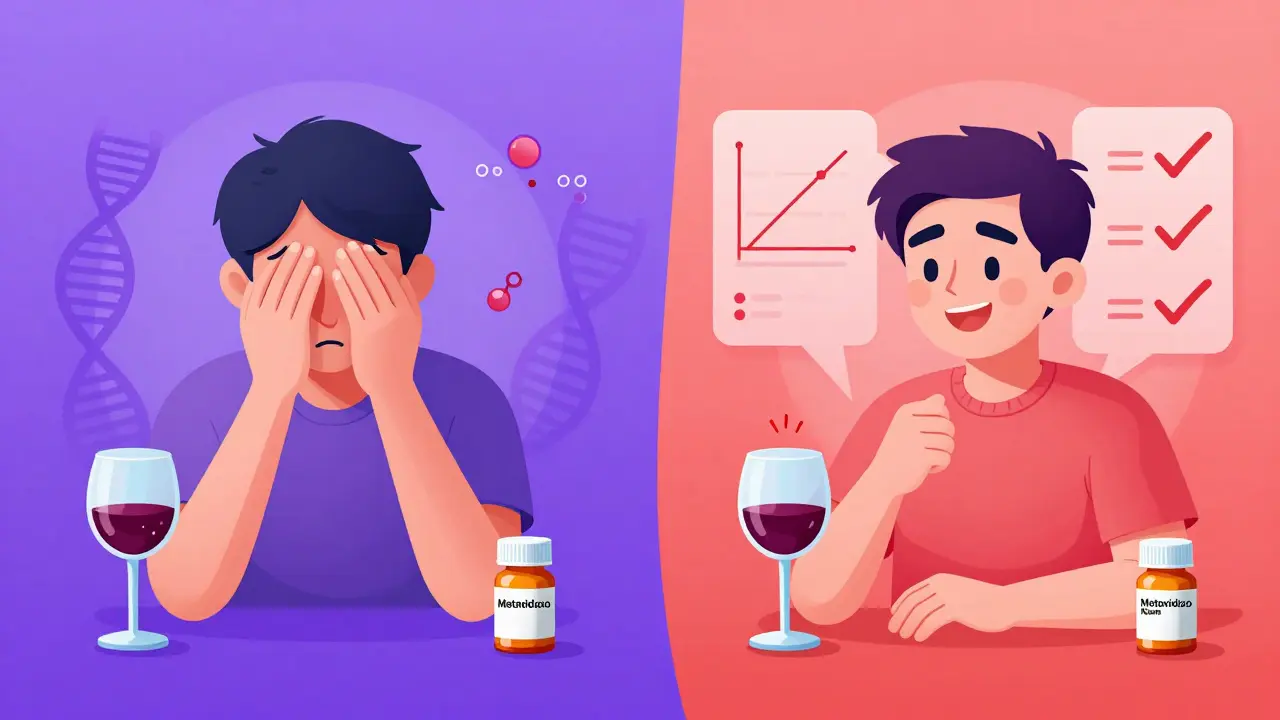
So Why Do People Still Get Sick?
If it’s not a disulfiram-like reaction, why do some people report nausea, flushing, or dizziness after drinking while on metronidazole? One theory comes from a 2024 study by researchers in Greece. They found metronidazole increases serotonin levels in the brain - by 250% in rats. Alcohol does the same. When you combine the two, you might be triggering something closer to serotonin syndrome - a condition that can cause flushing, nausea, rapid heart rate, and confusion. That’s not the same as a disulfiram reaction. But it’s still unpleasant. And it’s still something to be aware of. Another possibility? Placebo effect. If you’ve been told for 50 years that mixing alcohol and metronidazole is dangerous, your body might react just because you expect it to. And let’s not forget: metronidazole itself causes nausea and a metallic taste. Alcohol can make that worse. That’s not an interaction - that’s just two things that irritate your stomach.What About Other Antibiotics?
Not all antibiotics are the same. Some definitely cause real disulfiram-like reactions. - Tinidazole - a cousin of metronidazole - has strong evidence of increasing acetaldehyde. Avoid alcohol with this one. - Cefoperazone and cefotetan - certain cephalosporin antibiotics - have proven interactions. Blood acetaldehyde levels spike 3-5 times higher. Metronidazole is different. It’s not on that list.Why Do Doctors Still Say "Don’t Drink"?
The answer is simple: fear. Even with solid evidence, most doctors still warn against alcohol. Why? Because: - The FDA label still says "avoid alcohol." - Medical schools still teach it as fact. - A single bad outcome could lead to a lawsuit, even if the risk is unproven. A 2023 survey found that 89% of clinicians still advise patients to avoid alcohol - even if they’ve read the new studies. Only 34% of infectious disease specialists do. The rest are playing it safe. And here’s the irony: telling patients to avoid alcohol might be doing more harm than good. Some people stop taking metronidazole entirely because they’re scared. Others switch to more expensive or less effective antibiotics. One study estimated that unnecessary avoidance of metronidazole costs the U.S. healthcare system $28 million a year.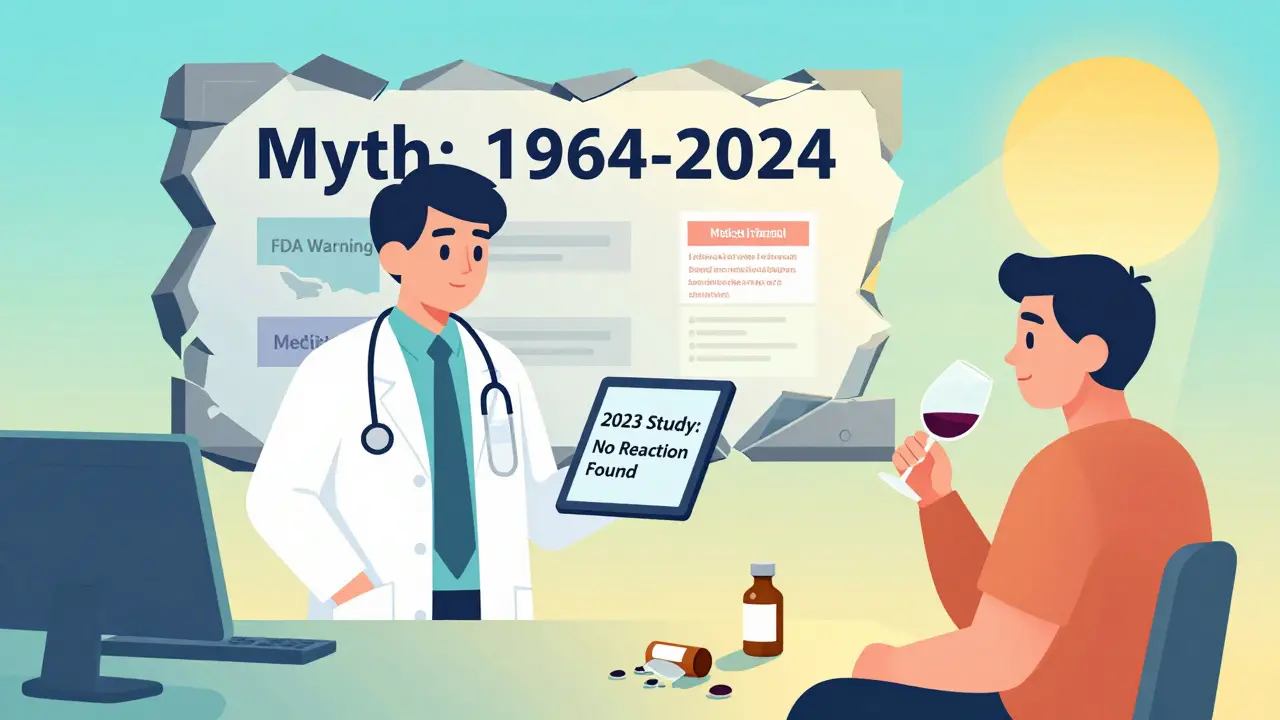
What Should You Do?
If you’re prescribed metronidazole, here’s what you really need to know:- There’s no proven disulfiram-like reaction. The risk of serious symptoms from alcohol is extremely low - if it exists at all.
- Alcohol can still make nausea worse. Metronidazole already causes stomach upset. Drinking might make that worse. If you feel sick, skip the alcohol.
- Don’t drink heavily. Binge drinking is dangerous with or without antibiotics. Your liver is already working hard.
- If you have alcohol use disorder, talk to your doctor. You might need a different antibiotic, not because of metronidazole, but because of your overall health.
- Check the label on other medicines. Cough syrups, mouthwashes, and some liquid medicines contain alcohol. A 7-year-old child once had a reaction after taking metronidazole with a cough syrup that had 7% ethanol. That’s real - and avoidable.


Vicky Zhang
January 15, 2026 AT 03:00Wow, this is such a relief to read. I was so scared to have even a glass of wine while on metronidazole after my dentist prescribed it for a bad abscess. I thought I was gonna die if I took a sip. Turns out I was just scared of a myth. I had a beer last night and didn’t turn blue or throw up. Just felt a little queasy, but that’s probably because I ate nothing all day and the meds taste like metal. Thank you for putting this out there. Doctors need to update their info.
Also, why do we still listen to 60-year-old case studies like they’re holy scripture? We have way better tools now. It’s wild.
Anyway, I’m gonna enjoy my wine now. No guilt. No fear. Just me, my glass, and my antibiotics doing their job.
Susie Deer
January 16, 2026 AT 02:58Stop coddling patients. If you cant handle a warning dont take the med. Alcohol kills more people than all antibiotics combined. Your body can handle a little ethanol. Stop acting like a baby.
Andrew Freeman
January 17, 2026 AT 14:06so like... metronidazole doesnt block aldh but somehow still makes u feel sick with alcohol? huh. so its not the disulfiram thing but its still kinda bad? so what exactly are we supposed to do? drink or dont drink? this is like a riddle written by a med school dropout.
also i drank beer with this stuff twice and i was fine. so maybe the real reaction is just people panicking and thinking theyre gonna die. which is kinda worse than the drug.
says haze
January 18, 2026 AT 06:33The persistence of this myth is a textbook case of epistemic inertia in medical culture. The disulfiram-like reaction was never empirically validated in a controlled setting, yet it became dogma because it was narratively convenient: it reinforced the binary of ‘safe’ versus ‘dangerous’ behavior, allowing clinicians to avoid nuanced discussions about pharmacokinetics and patient autonomy.
What’s more disturbing is the sociological mechanism of fear-based compliance-patients are not informed, they are warned. And warnings, when unmoored from evidence, become moral injunctions. We’ve conflated caution with certainty.
The serotonin hypothesis is far more plausible. But even that is speculative. The real takeaway? Medicine is still haunted by anecdotes dressed as axioms. Until we institutionalize critical appraisal of guidelines-not just their content but their provenance-we’ll keep treating patients like children afraid of their own liver.
Alvin Bregman
January 19, 2026 AT 08:15man i read this whole thing and i just feel better. i took metronidazole last year for some stomach thing and i had a couple beers. felt fine. no crazy symptoms. just kinda tired. and now i know it wasnt the medicine killing me it was just me being a mess.
also i had a mouthwash with alcohol in it and got sick. so maybe its not the beer its the other stuff. thanks for clearing that up. i think doctors just repeat what they heard in med school and never checked if it was real.
we should stop treating patients like they cant handle truth.
Sarah -Jane Vincent
January 21, 2026 AT 06:44THIS IS A BIG PHARMA COVERUP. THEY DONT WANT YOU TO KNOW THAT METRONIDAZOLE IS SAFE WITH ALCOHOL BECAUSE THEN PEOPLE WOULD STOP BUYING MORE EXPENSIVE ANTIBIOTICS. THEY’RE PROFITING OFF FEAR. ALSO THE 2023 STUDY WAS FUNDED BY A PHARMACEUTICAL COMPANY THAT MAKES GENERIC METRONIDAZOLE. THEY WANT YOU TO DRINK SO THEY CAN SELL MORE.
THEY’RE LYING TO YOU. THE FDA IS LYING. THE DOCTORS ARE LYING. EVEN THE UNIVERSITY OF WISCONSIN STUDY? A DISTRACTION. THEY’RE HIDING THE REAL TOXICITY. I’VE SEEN PEOPLE TURN BLUE. I KNOW WHAT I’VE SEEN.
Henry Sy
January 23, 2026 AT 00:33so let me get this straight - you’re telling me i can drink while on metronidazole? like, full-on whiskey shots? bro that’s the kind of info that gets you a tattoo. i’m gonna do it tonight just to prove i’m not a coward. if i die, post my obit: ‘He died doing what he loved - drinking and being right.’
also, why do we still have to ask if we can drink? why not just say ‘hey here’s what actually happens’ instead of ‘DON’T DO IT OR ELSE’? it’s like the medical world is stuck in a 1980s after-school special.
Anna Hunger
January 23, 2026 AT 01:17While the empirical evidence presented in this article is compelling and aligns with recent clinical reviews, it is imperative that healthcare providers continue to exercise caution in patient communication. The potential for individual variability in metabolism, concurrent medication use, and preexisting hepatic conditions necessitates a conservative approach until broader consensus is reached among professional societies. Furthermore, patient education must prioritize harm reduction, not merely the absence of documented risk. The psychological burden of perceived contraindications, while not pharmacological, remains a clinically relevant factor in adherence and outcomes.
Therefore, while the disulfiram-like reaction may be overstated, the recommendation to avoid alcohol remains prudent in the absence of individualized risk assessment.
Jason Yan
January 23, 2026 AT 04:55I love how this post breaks down the myth without being condescending. It’s not that doctors are dumb - they’re just trained in a system that rewards repetition over revision. We’re taught to memorize warnings, not question them. And once a warning gets into a textbook, it becomes gospel.
But here’s the thing - we’re not children. We can handle complexity. We can handle the truth that sometimes, the danger isn’t in the drug, but in the fear we’ve been taught to feel.
I’ve had metronidazole twice. Once I avoided alcohol completely. The second time, I had a single glass of wine. No flushing. No vomiting. Just a quiet moment of realizing I’d been lied to for years - not maliciously, but carelessly.
Maybe the real lesson here isn’t about metronidazole. Maybe it’s about how we treat knowledge. We need to stop treating science like a religion and start treating it like a conversation.
shiv singh
January 23, 2026 AT 08:15you people are so stupid. you think because some study says its fine then its fine? you dont know what happens to your body. alcohol and medicine always bad. always. even if you feel fine now, your liver will hate you later. you think you are smart? you are just lazy. you want to drink so you find excuses. this is why your country is falling apart. no discipline. no respect for medicine. just selfishness.
i dont drink. i dont need to. i am strong. you are weak.
Sarah Triphahn
January 23, 2026 AT 16:47Let’s be real - if you’re the type of person who needs to ask whether it’s safe to drink alcohol while on antibiotics, you probably shouldn’t be drinking at all. This isn’t about pharmacology. It’s about self-control. The fact that we’re having this debate at all proves how broken our relationship with substances has become. We don’t need permission to drink. We need to learn to say no.
Also, the serotonin hypothesis is the only plausible explanation. If you’re combining two CNS-affecting substances, you’re asking for trouble. Whether it’s acetaldehyde or serotonin, the result is the same: you’re poisoning yourself. Don’t pretend you’re being ‘scientific’ when you’re just being reckless.
Allison Deming
January 25, 2026 AT 11:56It is deeply irresponsible to suggest that patients should disregard longstanding medical advisories based on a single cohort study. While the 2023 paper is interesting, it is observational, retrospective, and subject to confounding variables - including self-reporting bias, variable alcohol consumption levels, and undiagnosed comorbidities. The absence of evidence is not evidence of absence.
Moreover, the potential for harm, however rare, remains. A single adverse event - even one that is statistically negligible - can have catastrophic consequences for an individual. Medical ethics demand that we err on the side of caution, especially when the cost of avoidance is minimal and the cost of error is potentially fatal.
Do not mistake scientific curiosity for clinical permission.
TooAfraid ToSay
January 27, 2026 AT 04:58lol so now we’re telling people to drink while on antibiotics? next they’ll say it’s fine to smoke while on chemo. this is why america is dying. no one has discipline anymore. you think your liver is a video game? you can just ‘level up’ and ignore warnings?
the fact that you’re celebrating this like it’s a win says everything about your culture. i’m from nigeria. we don’t mess with medicine. you drink, you die. simple. no studies needed.
Vicky Zhang
January 27, 2026 AT 10:29Anna, you’re right to be cautious - but caution shouldn’t be the same as silence. If we keep saying ‘don’t drink’ without explaining why, we’re not protecting people. We’re just scaring them. The real harm isn’t the beer - it’s the shame people feel when they drink and then panic because they were never told the truth.
What if we taught patients to listen to their bodies instead of just memorizing rules? That’s the real medicine.