
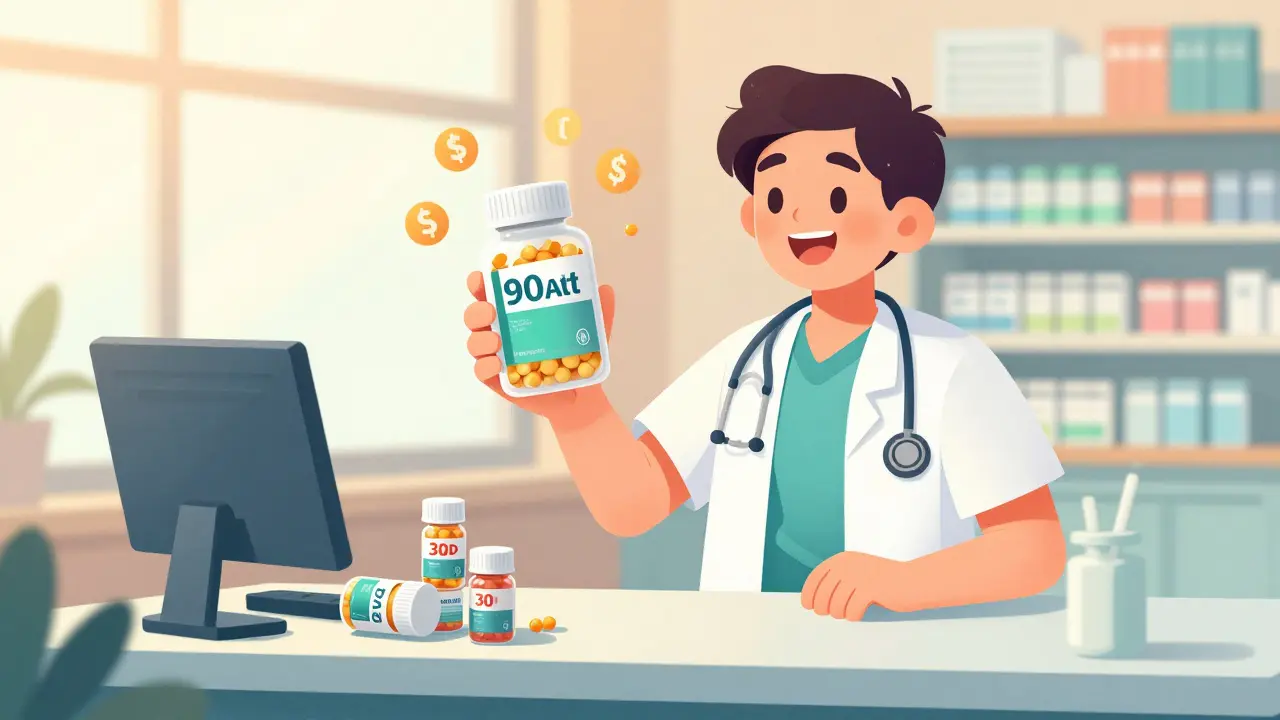
If you take medication every day for a chronic condition like high blood pressure, diabetes, or high cholesterol, you’re probably paying the same copay every month - even though you’re getting the same medicine. What if you could get three months’ worth of pills for the same price as one month? That’s not a trick. It’s a real, widely available option called a 90-day fill, and it can save you hundreds of dollars a year without changing your medication or insurance.
How a 90-Day Fill Saves You Money
Most people get their prescriptions filled in 30-day supplies. That means you visit the pharmacy every month, pay your copay, and walk out with a bottle. But here’s the catch: your insurance plan often charges you the same copay whether you get 30 days or 90 days of medication. For example, if your copay is $4.90 for a 30-day supply, you might pay $4.90 for a 90-day supply - meaning you get three times the pills for the same price. That’s $14.70 in savings per refill, or $39.20 a year for just one medication. For someone taking five maintenance medications, that adds up to nearly $200 in annual savings. And that’s just the copay. If you use mail-order pharmacy services, you often avoid retail markups entirely. Some plans even offer lower copays for 90-day fills than for 30-day ones. The math is simple: same cost, more medicine.Who Qualifies for a 90-Day Fill?
Not every medication or every person can get a 90-day supply right away. Insurance plans and pharmacies have rules. To qualify, you typically need to:- Be taking the medication for a chronic condition (like high blood pressure, asthma, thyroid disease, or statins for cholesterol)
- Have already taken the medication for at least one full 30-day cycle without issues
- Have a prescription that includes refills
How to Get a 90-Day Fill
There are two main ways to get a 90-day supply: through your local pharmacy or by mail order. Both are equally valid - it just depends on what’s easier for you.Option 1: Ask Your Retail Pharmacy
Many pharmacies - including CVS, Walgreens, and Rite Aid - now offer 90-day fills right in-store. You don’t need a special prescription. Just bring your current 30-day prescription and ask if they can dispense a 90-day supply. If your prescription has at least two refills left, they can usually fill it as a 90-day supply without contacting your doctor. If your prescription only has one refill left, they’ll check with your insurance to see if they’ll cover the 90-day amount. Most plans allow this if you’ve been taking the drug for a while. If your pharmacy says no, ask them to call your doctor’s office. Many doctors are happy to switch the prescription to a 90-day supply if you’re stable on the medication.Option 2: Use Mail-Order Pharmacy
Mail-order pharmacies like CVS Caremark, OptumRx, or HPSM’s Postal Prescription Services (PPSRX) specialize in 90-day fills. You sign up online or by phone, and they ship your medication directly to your door - often with free delivery. This is especially helpful if you’re on a fixed income, have mobility issues, or just hate going to the pharmacy. Mail-order services typically require you to use a dedicated pharmacy in your plan’s network. But once you’re set up, you’ll get your 90-day supply every three months automatically. Many plans even let you set up automatic refills so you never run out.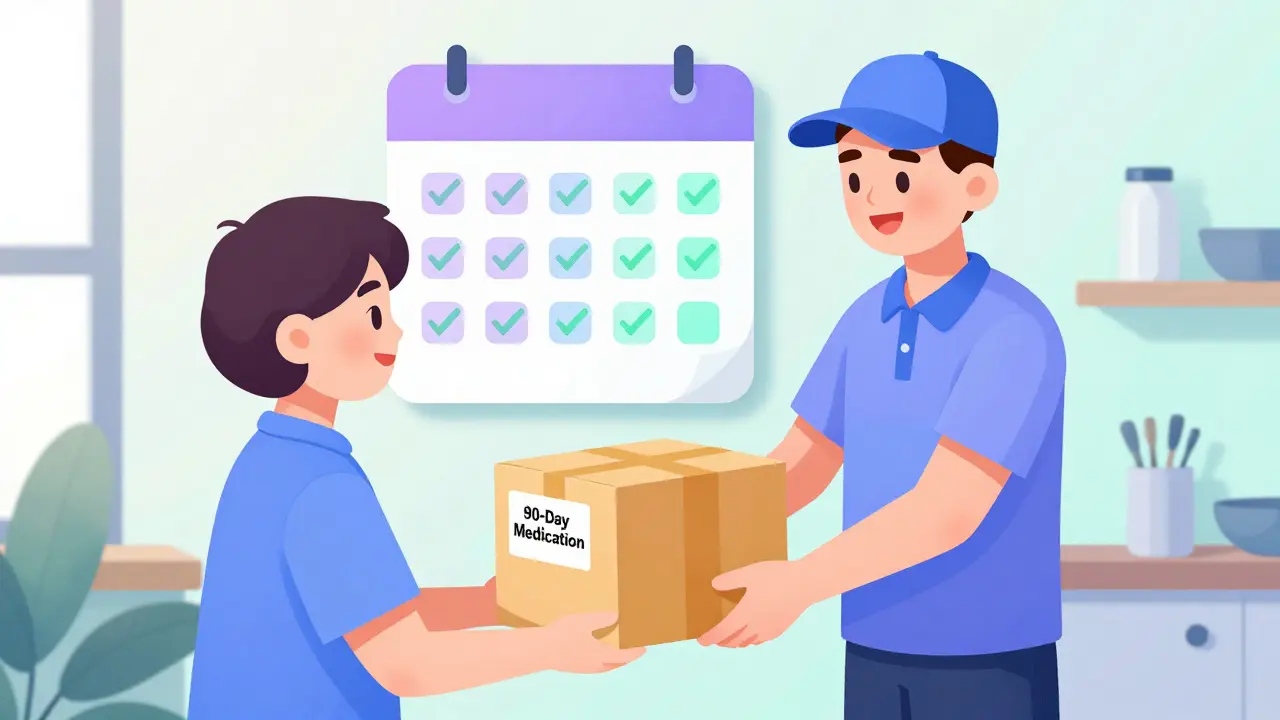
Why It’s Not Just About Saving Money
Saving cash is great, but the real benefit of 90-day fills is better health. Studies show that people who get 90-day supplies are more likely to take their medication consistently. Why? Because you’re not forgetting to refill every month. You’re not running out in the middle of a holiday weekend. You’re not skipping doses because you’re too busy to go to the pharmacy. One analysis found that patients on 90-day fills had 20% fewer missed doses than those on 30-day refills. That means fewer hospital visits, fewer emergency room trips, and fewer complications from uncontrolled conditions. For someone with diabetes or heart disease, that’s not just a cost saving - it’s a life saver.What to Watch Out For
Not every plan works the same. Some insurance companies only allow 90-day fills through mail order. Others restrict certain medications - like insulin or specialty drugs - to 30-day supplies. Some plans require prior authorization, which means your doctor has to submit paperwork before the pharmacy can fill it. Always check with your insurer before assuming you can get a 90-day fill. Call the number on your insurance card and ask:- Does my plan cover 90-day fills for this medication?
- Do I need to use mail order, or can I get it at a retail pharmacy?
- Is there a copay difference between 30-day and 90-day supplies?

Real Savings Examples
Let’s say you take:- Metformin for diabetes - $4.90 copay for 90 days
- Lisinopril for blood pressure - $4.90 copay for 90 days
- Atorvastatin for cholesterol - $4.90 copay for 90 days
How to Get Started Today
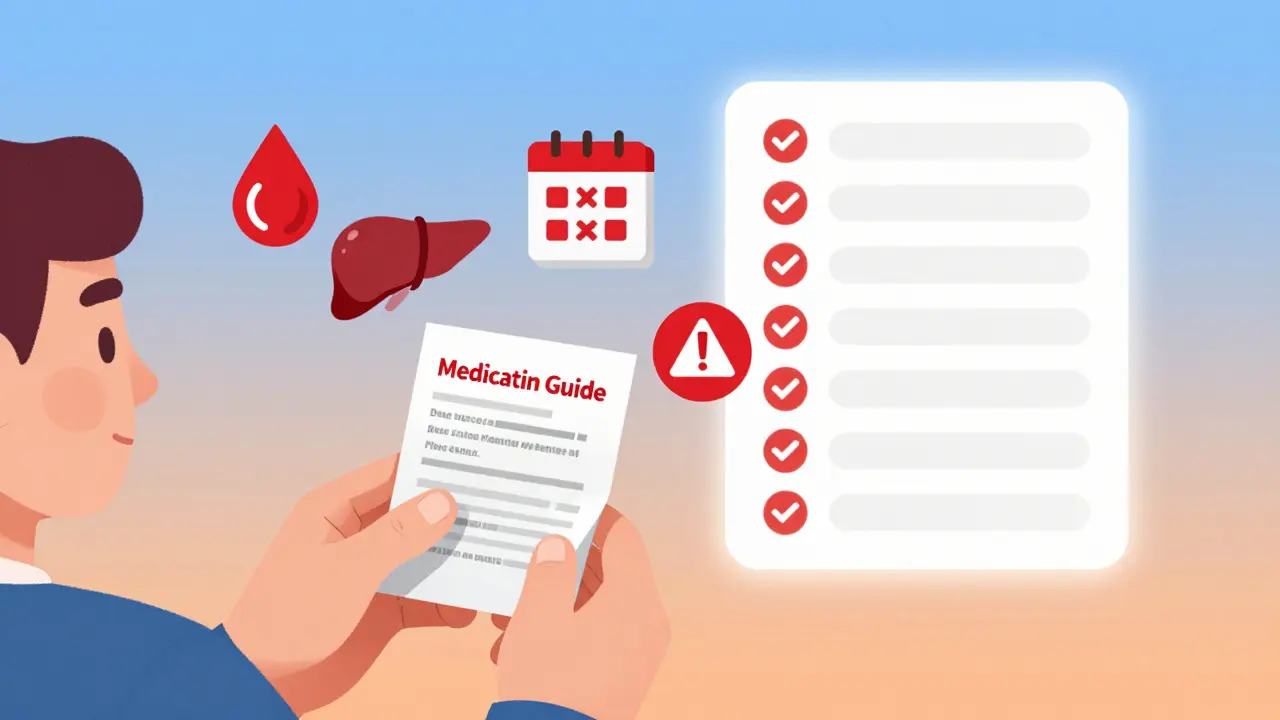
Here’s your simple action plan:- Look at your current prescriptions. Are they for long-term conditions?
- Check your insurance plan’s website or call them to ask about 90-day fill rules.
- Call your pharmacy and ask if they can fill your next refill as a 90-day supply.
- If they say no, ask them to contact your doctor’s office to change the prescription.
- If mail order is an option, sign up - it’s free to enroll and often cheaper.
Why This Matters Now
In 2025, more than 12% of maintenance prescriptions in the U.S. are filled as 90-day supplies - mostly through mail order. But that number is growing fast. Retail pharmacies are now offering 90-day fills in-store because patients demand it. Insurance companies are designing plans around it because it reduces overall healthcare costs. The industry estimates that if adoption jumped from 12% to 70%, consumers could save $1.9 billion in the first year alone. That’s not theoretical - it’s already happening. The question isn’t whether 90-day fills are worth it. It’s why you haven’t tried it yet.Can I get a 90-day supply for any medication?
No - only medications taken for chronic conditions like high blood pressure, diabetes, cholesterol, thyroid issues, or asthma qualify. Short-term drugs like antibiotics or pain relievers usually aren’t eligible. Your insurance plan and pharmacy will have a list of approved medications.
Do I need a new prescription for a 90-day supply?
Not always. If your current prescription has refills, your pharmacy can often dispense a 90-day supply without changing the prescription. But if you want to switch permanently, your doctor may need to write a new prescription for 90 days with three refills. It’s a quick call to their office.
Is mail-order pharmacy safe?
Yes. Mail-order pharmacies are licensed, regulated, and inspected just like retail pharmacies. They use sealed, tamper-proof packaging and temperature-controlled shipping for sensitive medications. Many also offer tracking and 24/7 pharmacist support.
Can I switch back to 30-day fills if I need to?
Absolutely. If your condition changes, you’re traveling, or you just prefer monthly refills, you can always switch back. Your pharmacy or mail-order service will adjust your supply based on your needs. There’s no penalty or long-term commitment.
Why doesn’t my pharmacy offer 90-day fills?
Some smaller pharmacies don’t stock large quantities of maintenance medications due to space or cost. Others may not have contracts with your insurance for 90-day dispensing. If your local pharmacy says no, ask if they can refer you to a network pharmacy or mail-order service that does.

Marie Crick
February 21, 2026 AT 11:30Jonathan Rutter
February 23, 2026 AT 09:41Caleb Sciannella
February 23, 2026 AT 15:52Arshdeep Singh
February 23, 2026 AT 20:48Maddi Barnes
February 24, 2026 AT 06:41Jana Eiffel
February 25, 2026 AT 07:00John Cena
February 26, 2026 AT 13:39aine power
February 27, 2026 AT 21:18Tommy Chapman
March 1, 2026 AT 11:51Robin bremer
March 1, 2026 AT 19:03Hariom Sharma
March 2, 2026 AT 11:38Nina Catherine
March 4, 2026 AT 00:50Taylor Mead
March 5, 2026 AT 16:15Amrit N
March 6, 2026 AT 15:34Courtney Hain
March 7, 2026 AT 17:49