
Grapefruit-Simvastatin Risk Calculator
Your Risk Assessment
This calculator estimates your risk of muscle damage when taking simvastatin with grapefruit products based on daily consumption.
Drinking a glass of grapefruit juice with breakfast might seem like a healthy habit-until you're taking simvastatin. For millions of Americans on this cholesterol-lowering drug, that citrusy sip could be quietly increasing the risk of muscle damage, kidney failure, or worse. This isn't a myth. It's a well-documented, clinically significant interaction that's been studied for over 25 years. And if you're on simvastatin, you need to know exactly where the line is between safe and dangerous.
Why Grapefruit Juice Changes How Simvastatin Works
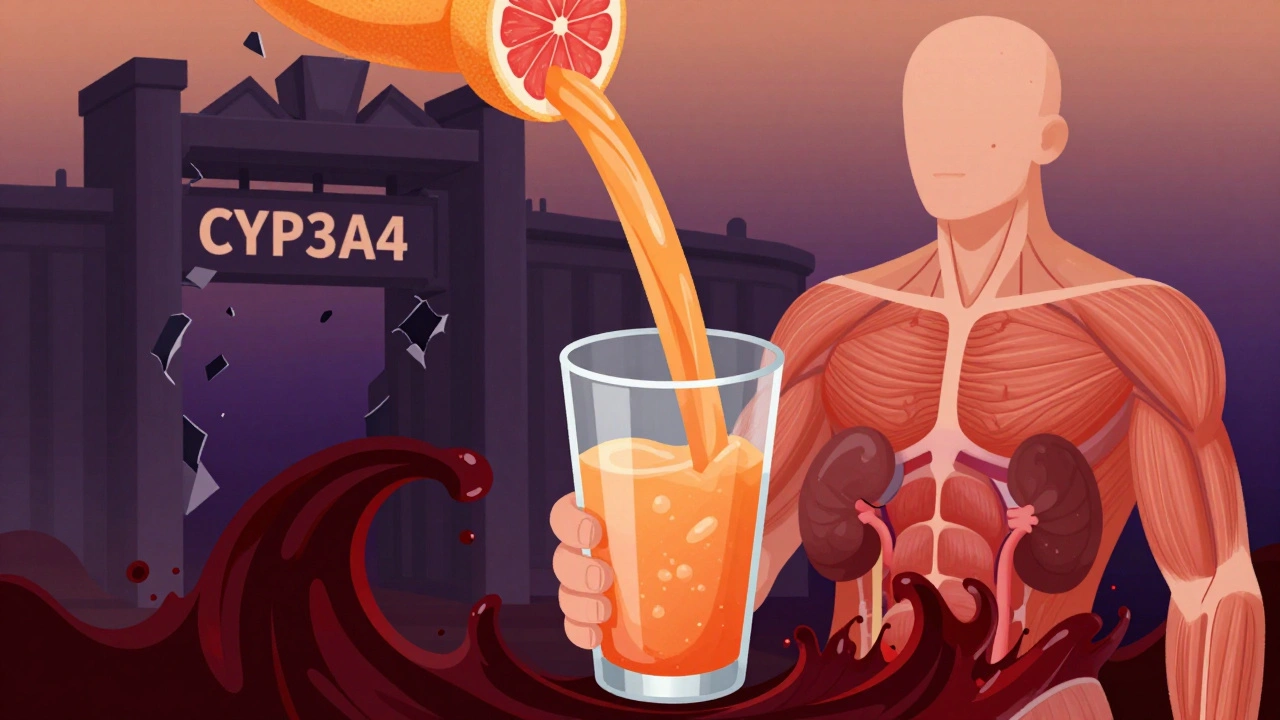
Simvastatin is broken down in your gut by an enzyme called CYP3A4. This enzyme acts like a gatekeeper, limiting how much of the drug enters your bloodstream. Grapefruit juice doesn't just block this gate-it smashes it. The juice contains chemicals called furanocoumarins, mainly bergamottin and 6',7'-dihydroxybergamottin. These compounds bind to CYP3A4 and permanently disable it. Your body has to make new enzymes to replace them, which takes 3 to 7 days.
What happens next is dramatic. Normally, only a small fraction of simvastatin gets into your blood. With grapefruit juice, that number can jump by up to 16 times. That means your body is exposed to far more of the drug than intended. And while your liver still processes the active form of the drug (simvastatin acid) at a slower rate, the sheer increase in total drug load is enough to push you into dangerous territory.
The Real Danger: Myopathy and Rhabdomyolysis
Statins like simvastatin can cause muscle pain, weakness, or cramps-a condition called myopathy. That’s common enough that many people brush it off. But when grapefruit juice is added, the risk spikes. In rare cases, muscle tissue starts breaking down rapidly, spilling proteins into your blood. This is rhabdomyolysis, a medical emergency.
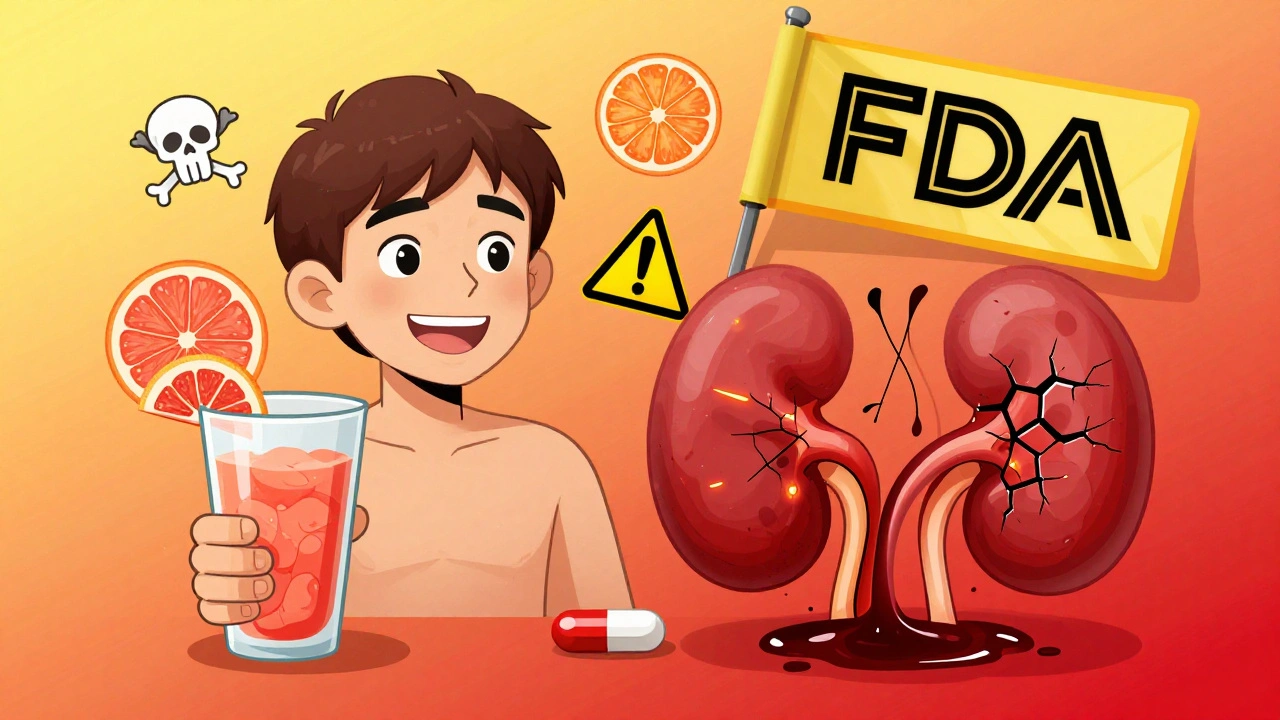
When muscle fibers break down, they release myoglobin. Your kidneys filter it out, but too much overwhelms them. This can lead to kidney failure, dialysis, or even death. While rhabdomyolysis affects only about 0.1% of statin users overall, that number climbs significantly with grapefruit juice. Studies show the risk increases sharply when daily grapefruit juice intake exceeds 1.2 liters-about five 8-ounce glasses.
And here’s the scary part: you might not feel anything until it’s too late. Muscle damage can build silently. The FDA warns to watch for unexplained muscle pain, tenderness, weakness, fatigue, or dark urine. If you’re drinking grapefruit juice and notice any of these, stop immediately and call your doctor.
Not All Statins Are the Same
Not every cholesterol drug reacts the same way with grapefruit. The interaction is strongest with simvastatin and lovastatin-both rely heavily on CYP3A4 for metabolism. Atorvastatin (Lipitor) shows a moderate increase in blood levels, up to 3.3 times higher with heavy grapefruit juice use. But pravastatin and rosuvastatin? They’re safe. These statins are cleared by different pathways and don’t depend on CYP3A4.
This matters because simvastatin is still one of the most prescribed statins in the U.S., with over 23 million prescriptions filled in 2023. Even though atorvastatin and rosuvastatin are more popular overall, simvastatin remains widely used because it’s cheaper and available as a generic. That means millions of people are still at risk.
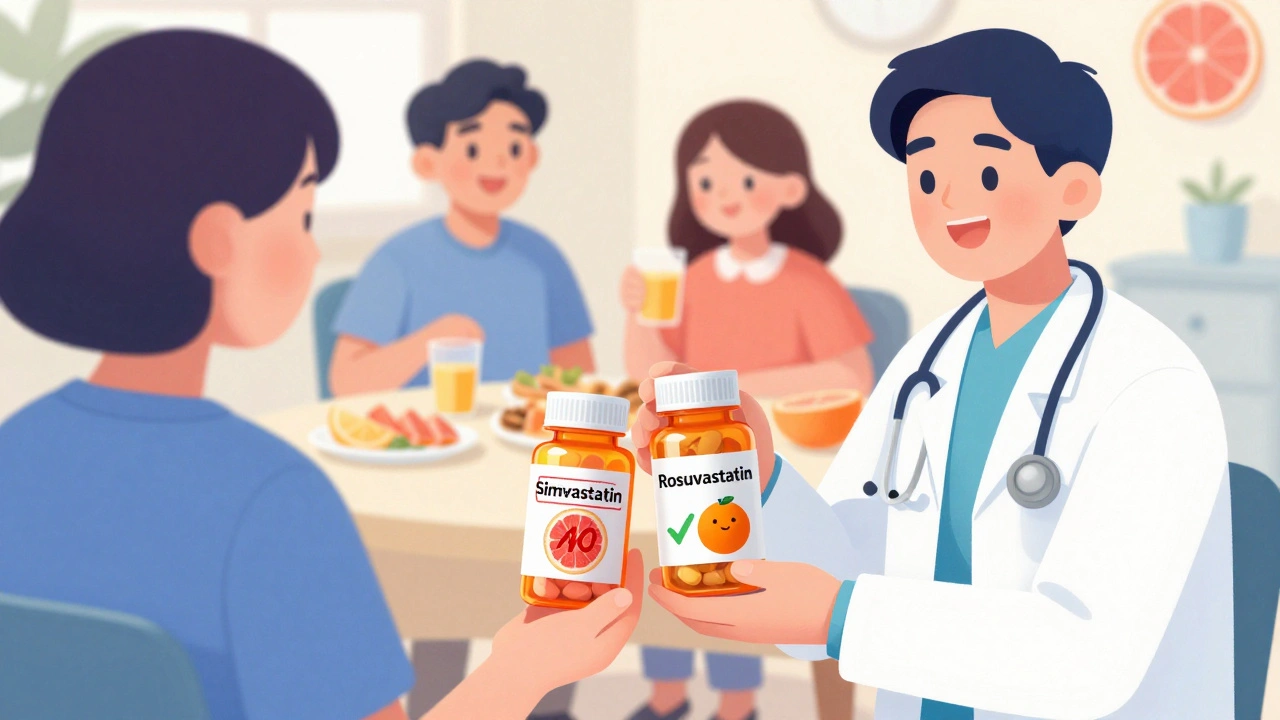
If you’re on simvastatin and love grapefruit, talk to your doctor about switching. Pravastatin and rosuvastatin work just as well for lowering cholesterol-and they don’t care if you drink orange juice, eat a whole grapefruit, or sip grapefruit smoothies. No warning label. No hidden danger.
How Much Is Too Much?
The FDA says consuming more than 1.2 liters of grapefruit juice per day is dangerous with simvastatin. That’s five 8-ounce glasses. But here’s the twist: some experts say even one glass a day could be risky for certain people.
Dr. Stanley L. Hazen from Cleveland Clinic says most patients can safely have half a grapefruit or one glass of juice if they’ve been on simvastatin without side effects. But he also warns: "We can’t predict who will develop muscle damage." That’s why the American Heart Association says the risk is low unless you’re drinking more than a quart (32 ounces) daily.
But here’s the problem: most people don’t measure their juice. A large glass at breakfast? That’s 12 ounces. Add a glass at lunch? Now you’re at 24 ounces. A smoothie after the gym? You’ve hit the danger zone without realizing it.
A 2022 Mayo Clinic survey found 63% of statin users thought even small amounts of grapefruit juice were dangerous, while 28% were drinking more than the safety limit. Confusion is widespread. The solution? Stick to the five-glass rule. If you’re unsure, avoid it entirely.
What About Other Citrus Fruits?
Not all citrus is the same. Seville oranges (used in marmalade) and pomelos also contain furanocoumarins and should be avoided. Regular orange juice? Safe. Tangerines? Safe. Limes? Safe. Lemons? Safe. The problem is unique to grapefruit and a few close relatives.
Some people think switching to grapefruit-flavored water or candy is a workaround. It’s not. Those products usually don’t contain real grapefruit juice or furanocoumarins. But if you’re not sure, check the ingredient list. If it says "grapefruit juice" or "grapefruit extract," skip it.
What Should You Do If You’re on Simvastatin?
Here’s a simple action plan:
- Check your prescription. Is it simvastatin or lovastatin? If yes, proceed with caution.
- Ask your doctor. Can you switch to pravastatin or rosuvastatin? Both are equally effective and don’t interact with grapefruit.
- If you keep simvastatin, avoid grapefruit juice. No exceptions. Not even one glass. If you must have it, limit to less than 8 ounces per day and never take it at the same time as your pill.
- Know the warning signs. Muscle pain, weakness, dark urine, fatigue? Stop the juice and call your doctor immediately.
- Don’t assume "natural" means safe. Grapefruit juice isn’t harmful on its own. But with simvastatin, it becomes a hidden toxin.
The Future: Safer Grapefruit?
Scientists are working on solutions. The University of Florida has developed a new grapefruit hybrid called UF Sweetie, with 87% less bergamottin-the main culprit behind the interaction. Early tests show it doesn’t raise simvastatin levels. It’s not on shelves yet, but it’s a sign that science is catching up.
In the meantime, the best protection isn’t a new fruit. It’s awareness. Over the next decade, better patient education and smarter prescribing could cut grapefruit-related statin toxicity by 35-40%. That means fewer hospital stays, fewer kidney failures, and fewer lives disrupted.
For now, though, the rule is simple: if you’re on simvastatin, skip the grapefruit juice. Your muscles-and your kidneys-will thank you.
Can I drink grapefruit juice if I take simvastatin once a week?
No. The interaction doesn’t depend on how often you take simvastatin-it depends on how much grapefruit juice you drink and how long the enzyme inhibition lasts. Even if you take simvastatin once a week, drinking grapefruit juice daily will still block CYP3A4 enzymes for 3-7 days. That means the drug builds up in your system each time you take your dose. The risk of muscle damage remains high.
Is it safe to eat grapefruit instead of drinking the juice?
No. The same furanocoumarins that are in grapefruit juice are also in the fruit’s pulp and peel. Eating half a grapefruit has the same effect as drinking 8-12 ounces of juice. The risk is identical. If you’re on simvastatin, avoid the fruit entirely.
How long should I wait between grapefruit juice and simvastatin?
There’s no safe waiting period. Grapefruit juice disables CYP3A4 enzymes for up to 72 hours. Even if you take your simvastatin 4 or 6 hours after juice, the enzyme is still blocked. The interaction isn’t about timing-it’s about whether the enzyme is working. The only safe choice is to avoid grapefruit completely.
What are the signs of muscle damage from this interaction?
Watch for unexplained muscle pain, tenderness, or weakness-especially in your shoulders, thighs, or lower back. You might feel unusually tired or notice dark, tea-colored urine. These are signs that muscle tissue is breaking down. If you have these symptoms and have been drinking grapefruit juice, stop the juice and contact your doctor right away. This is not something to wait on.
Can I switch to a different statin to avoid this problem?
Yes. Pravastatin and rosuvastatin are not broken down by CYP3A4, so they don’t interact with grapefruit juice. Atorvastatin has a mild interaction, but it’s much lower than simvastatin’s. If you enjoy grapefruit regularly, switching to pravastatin or rosuvastatin is the safest move. Talk to your doctor-this is a simple change that removes a major health risk.



Inna Borovik
December 6, 2025 AT 09:33Let’s be clear: this isn’t about grapefruit. It’s about pharmaceutical negligence. The FDA’s own data shows simvastatin’s half-life is already borderline unsafe, and the fact that manufacturers didn’t reformulate it decades ago speaks volumes. I’ve seen patients with CKD stage 3 because their PCP didn’t even know CYP3A4 inhibition was dose-dependent. This isn’t a dietary warning-it’s a systemic failure.
Arjun Deva
December 8, 2025 AT 06:07Who really benefits from this? Pharma companies. They know grapefruit ruins simvastatin-but they keep selling it because it’s cheap. Meanwhile, they push pravastatin at 3x the price. Coincidence? Or a profit-driven conspiracy to make you pay more for a ‘safer’ version they already had in stock? I’m not paranoid-I’m informed.
Jackie Petersen
December 9, 2025 AT 03:03Ugh, another ‘avoid natural things’ scare piece. Grapefruit juice has been around since the 1500s. Statins have been around since the 80s. If this was really a crisis, why are we only hearing about it now? Probably because someone in Big Pharma wants you to switch to their expensive brand. Stay skeptical.
Karen Mitchell
December 10, 2025 AT 03:39One must ask: if the risk of rhabdomyolysis is 0.1% without grapefruit, and increases to 0.4% with it, is this truly a public health emergency-or merely an opportunity for medical paternalism? The language here is alarmist, bordering on coercive. We are adults; we should be trusted with nuanced information, not fear-based directives.
Geraldine Trainer-Cooper
December 11, 2025 AT 17:33grapefruit juice = bad. statins = kinda bad. together = real bad. but also… like… maybe just don’t drink it if you’re on it? idk. i’m just a person with a liver and a taste for citrus. 🍊
Nava Jothy
December 13, 2025 AT 05:29Oh my GOD. I just realized I’ve been drinking grapefruit juice every morning for 4 years while on simvastatin. 😭 I’m going to the ER. My legs feel like jelly. My urine looks like soy sauce. I’m going to die alone. 😭💔 #RhabdoOrBust #GrapefruitIsTheDevil
Kay Jolie
December 14, 2025 AT 01:14From a pharmacokinetic standpoint, the CYP3A4 inhibition profile of furanocoumarins is uniquely irreversible-unlike competitive inhibitors, which are transient. This makes grapefruit’s effect on simvastatin a non-linear, time-dependent phenomenon that defies simple dosing adjustments. The clinical implications are profound. We’re not talking about ‘moderate interaction’-we’re talking about a pharmacological bomb.
Clare Fox
December 14, 2025 AT 11:32it’s funny how we treat food like a drug when it suits us. we’ll take a pill that’s been tested on rats for 10 years, but freak out over a fruit that’s been eaten for centuries. maybe the real problem isn’t grapefruit… it’s how we’ve outsourced our health to labs and prescriptions.
Akash Takyar
December 15, 2025 AT 06:12Thank you for sharing this vital information. It is imperative that patients understand the metabolic pathways involved. I encourage all individuals on statins to consult with their pharmacist, who can provide a comprehensive review of drug-food interactions. Small changes can lead to significant improvements in long-term outcomes. Stay informed, stay healthy.
Mansi Bansal
December 16, 2025 AT 11:39Let me tell you something-my cousin’s neighbor’s yoga instructor’s cousin had a stroke after eating grapefruit with simvastatin. He was 42. He had a dog named Biscuit. Now he’s in a wheelchair. The hospital bill? $2.3 million. And the FDA? They’re still selling it. This isn’t science. This is corporate murder.
pallavi khushwani
December 17, 2025 AT 22:51my mom switched from simvastatin to rosuvastatin last year and now she eats grapefruit like it’s candy. she says her muscles feel better and her cholesterol’s lower. maybe the real fix isn’t avoiding fruit… it’s choosing the right medicine?
Dan Cole
December 18, 2025 AT 19:18You’re all missing the point. The real issue is that simvastatin was approved in 1991 with a 40mg maximum dose. The FDA didn’t update the labeling for grapefruit interactions until 2012. That’s a 21-year delay in patient safety. This isn’t about juice-it’s about regulatory capture. The system failed. And now you’re all just arguing about fruit like it’s a tea party.
Katie O'Connell
December 20, 2025 AT 12:42While the empirical evidence is robust, one must also consider the epistemological framework through which laypersons interpret medical advice. The conflation of pharmacological mechanism with moral imperative-i.e., the notion that ‘natural’ equals ‘safe’-reflects a deeper cultural pathology. The solution is not merely substitution of statins, but the cultivation of scientific literacy. One cannot rely on regulatory bodies to protect one from oneself.