

Carbamazepine Birth Control Risk Calculator
Calculate your pregnancy risk when taking carbamazepine with different birth control methods. Based on data from the American College of Obstetricians and Gynecologists.
Select Your Birth Control Method
Results
When you're taking carbamazepine for seizures, you might not think about your birth control - until you start spotting between periods, or worse, find out you're pregnant. This isn't rare. Carbamazepine doesn't just treat epilepsy; it quietly undermines the effectiveness of most hormonal contraceptives, turning what should be a reliable method into a gamble. The risk isn't theoretical - it's backed by data, clinical observations, and real stories from women who weren't warned.
How Carbamazepine Breaks Down Birth Control
Carbamazepine - sold under brand names like Tegretol and Carbatrol - triggers your liver to produce more enzymes, especially CYP3A4. These enzymes are designed to break down toxins, but they don’t distinguish between harmful substances and your birth control hormones. Ethinyl estradiol and progestins, the key ingredients in most pills, patches, and rings, get metabolized too fast. Their levels in your blood drop below what’s needed to stop ovulation.
A 1987 study in the British Journal of Clinical Pharmacology showed carbamazepine slashed ethinyl estradiol levels by 42% and levonorgestrel by 40%. That’s not a small drop - it’s enough to let ovulation slip through. Even if you take your pill at the same time every day, your body is processing it like it’s a foreign substance, not a contraceptive.
For women on standard-dose pills (30-35 mcg estrogen), the annual failure rate jumps from 7% to 25-30%. That means one in four women using birth control pills while on carbamazepine will get pregnant each year. If you miss a pill? The risk climbs past 30%. And this isn’t about user error - it’s about drug interaction. Your body is working against the pill, no matter how careful you are.
Breakthrough Bleeding: A Red Flag You Can’t Ignore
If you start spotting between periods, don’t brush it off as stress or a weird cycle. It’s a warning sign. Breakthrough bleeding happens when hormone levels fluctuate too much to keep the uterine lining stable. Studies show 25-35% of women on carbamazepine experience this. The NHS explicitly says: "Look out for bleeding between periods - it might mean your pill isn’t working."
But here’s the catch: not having breakthrough bleeding doesn’t mean you’re safe. Ovulation can still occur without any bleeding changes. One woman on Reddit shared: "I was on 1000mg Tegretol daily and got pregnant on Loestrin despite never missing a pill - my neurologist never warned me." She wasn’t careless. She was misinformed.
The Real Danger: Birth Defects
Carbamazepine is a known teratogen. If you get pregnant while taking it, your baby’s risk of neural tube defects like spina bifida rises from 0.1% in the general population to about 1%. That’s a tenfold increase. And because the interaction is silent - no symptoms, no alarms - many women don’t realize they’re at risk until it’s too late.
That’s why experts say: if you’re on carbamazepine and could get pregnant, you need contraception that doesn’t rely on hormones your liver will destroy. Relying on pills, patches, or rings isn’t just risky - it’s dangerous.
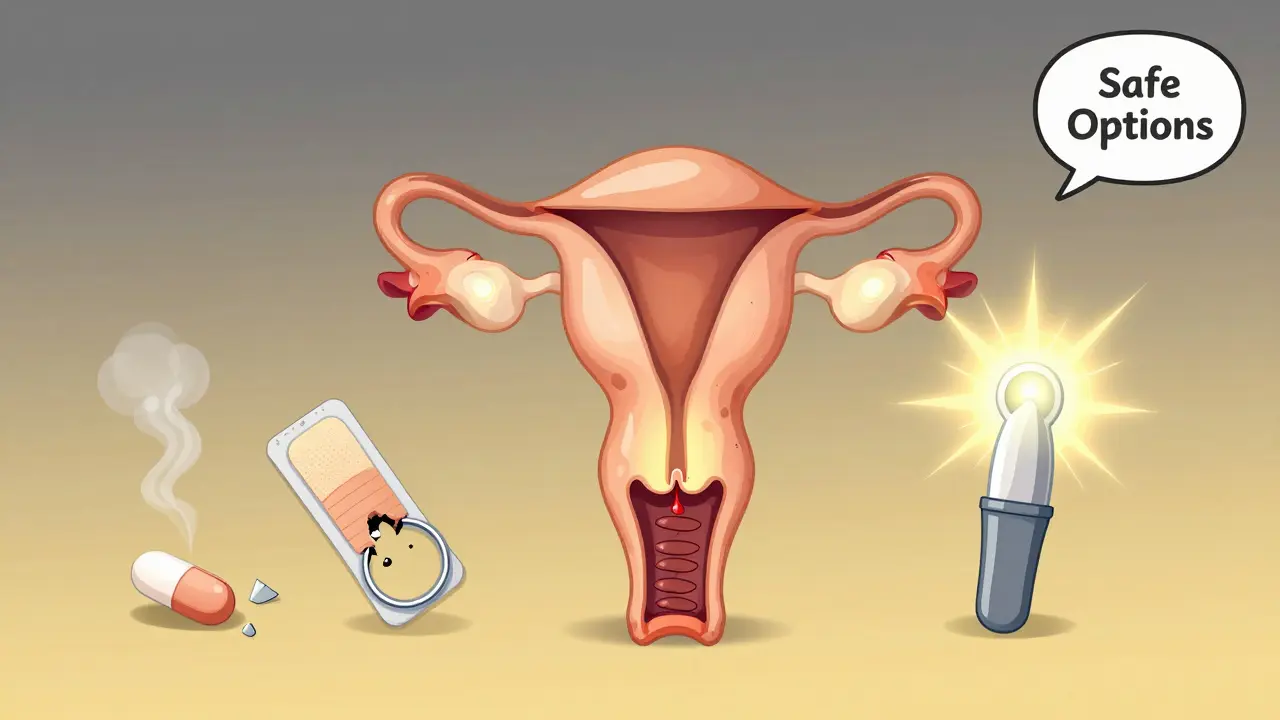
What Actually Works: The Only Safe Options
Not all birth control fails with carbamazepine. Some methods bypass the liver entirely.
- Copper IUD (Paragard): 99.2% effective. No hormones. No interaction. Lasts up to 12 years.
- Hormonal IUD (Mirena, Kyleena): Releases progestin locally into the uterus. Blood levels stay low enough that liver enzymes can’t break them down. Less than 0.1% failure rate.
- Contraceptive implant (Nexplanon): A small rod under the skin that releases progestin slowly. Not affected by carbamazepine. Failure rate under 0.1%.
- Depo-Provera shot: Given every 3 months. Injected into muscle, bypassing first-pass liver metabolism. Still effective, with failure rates below 1%.
These are the gold standard options recommended by the American College of Obstetricians and Gynecologists (ACOG) and the Cleveland Clinic. They’re not "alternatives" - they’re the only reliable choices.
What Doesn’t Work - And Why
- Combined oral contraceptives (pills): All of them. Even high-dose pills (50 mcg estrogen) are discouraged. They raise the risk of blood clots by 2.5 times without reliably fixing the problem.
- Contraceptive patch (Xulane): May be slightly better than pills because hormones enter through the skin. But effectiveness still drops by 20-25%. Not recommended as a primary method.
- Vaginal ring (NuvaRing): Same problem as pills. Hormones go through the liver. Avoid.
- Progestin-only pills (mini-pills): Too sensitive to enzyme induction. Failure rates jump. Not safe.
Some doctors still try to "solve" the problem by switching to higher-dose pills. That’s outdated thinking. The American Academy of Neurology warns this approach increases venous thromboembolism risk by 4.3 times - especially in women over 35. The risk of a clot is higher than the risk of pregnancy.

What to Do Next
If you’re on carbamazepine and using hormonal birth control:
- Stop assuming your pill is working. It’s not.
- See your doctor or gynecologist. Ask for an IUD or implant.
- If you’re not ready for a procedure, use condoms + a copper IUD. Double protection is the safest approach.
- If you’ve had breakthrough bleeding, assume you’re at risk of pregnancy. Take a test.
- Ask your neurologist: "Is there a seizure medication that doesn’t interfere with birth control?" Newer drugs like lacosamide and brivaracetam don’t affect hormones.
A 2021 Cleveland Clinic survey found 72% of women prescribed carbamazepine were never warned about contraceptive failure. That’s a failure of care. You deserve better.
Why This Matters Beyond Birth Control
This isn’t just about avoiding pregnancy. It’s about autonomy. Women with epilepsy already face stigma, unpredictable seizures, and side effects. Adding the risk of unintended pregnancy - and the potential for birth defects - compounds the burden. Reliable contraception isn’t optional. It’s essential.
Changing your birth control method isn’t a setback. It’s a step toward control. The copper IUD doesn’t require daily action. The implant lasts three years. These methods give you back the peace of mind that carbamazepine took away.





Danielle Arnold
March 23, 2026 AT 19:47Donna Fogelsong
March 24, 2026 AT 18:18Seth Eugenne
March 25, 2026 AT 22:09rebecca klady
March 26, 2026 AT 03:47Namrata Goyal
March 27, 2026 AT 19:00Jefferson Moratin
March 28, 2026 AT 05:09Caroline Dennis
March 29, 2026 AT 18:06Zola Parker
March 30, 2026 AT 16:48florence matthews
March 31, 2026 AT 20:13Raphael Schwartz
April 1, 2026 AT 10:14Marissa Staples
April 2, 2026 AT 23:33Rachele Tycksen
April 4, 2026 AT 13:21Grace Kusta Nasralla
April 5, 2026 AT 09:22