
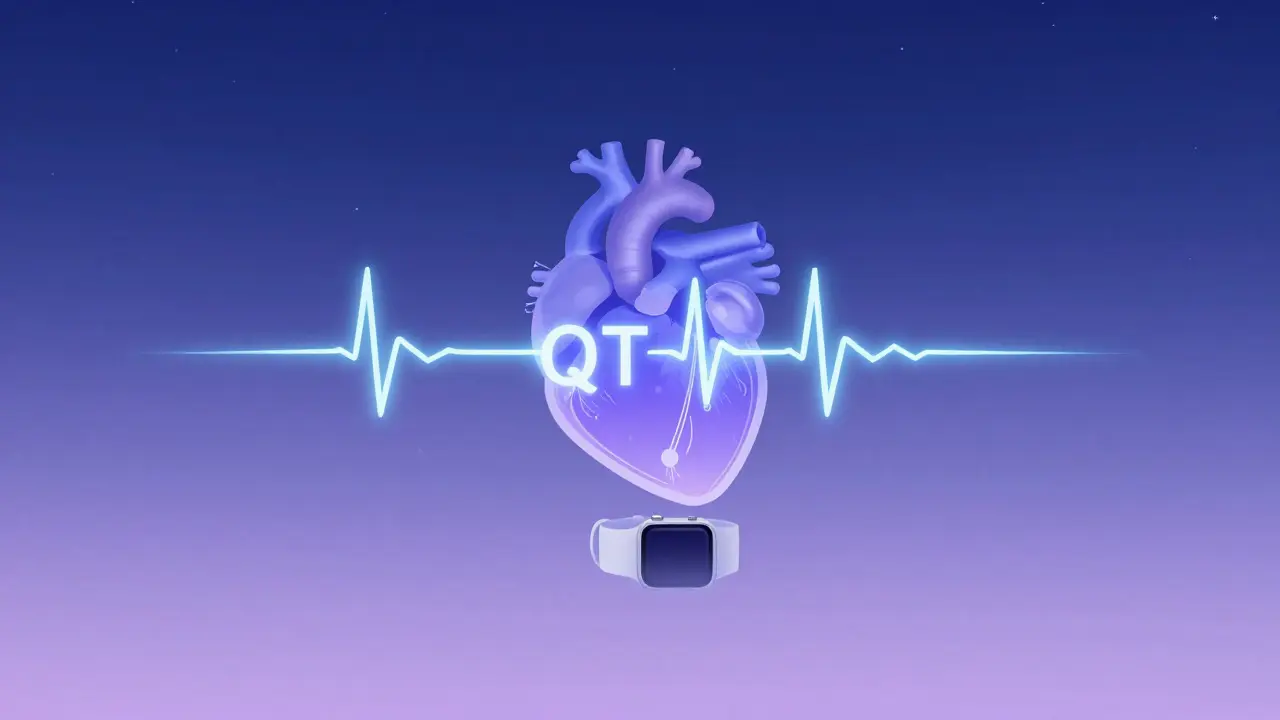
QT Interval Safety Calculator
How to Use This Tool
This calculator helps you understand if your QT interval measurements indicate potential cardiac risk. Based on guidelines from the article, values above 500 ms indicate high risk of torsades de pointes.
Important: This is for educational purposes only. Always consult a healthcare professional for clinical decisions.
What Does QT Interval Mean?
The QT interval measures the time it takes for the heart's lower chambers to recharge between beats. Normal values are under 450 ms in men and 460 ms in women. When it exceeds 500 ms, the risk of dangerous heart rhythms increases significantly.
Enter Your Measurements
Results
Enter your measurements to see results
Every year, thousands of people take medications that can dangerously prolong the QT interval - a tiny but critical part of the heart’s electrical cycle. Drugs like certain antibiotics, antipsychotics, and antiarrhythmics can throw off this timing, increasing the risk of a life-threatening rhythm called torsades de pointes. For years, doctors relied on clinic-based 12-lead ECGs to check for this, but those snapshots miss what happens between visits. Now, wearable ECGs are changing that. They’re not just fitness trackers. They’re becoming real-time safety monitors for patients at risk.
What the QT Interval Really Means
The QT interval is the time it takes for the heart’s lower chambers to recharge between beats. It’s measured from the start of the Q wave to the end of the T wave on an ECG. Normal is under 450 milliseconds in men and 460 in women. When it stretches beyond 500 ms, the risk of sudden cardiac arrest spikes. The problem? Many drugs that help treat other conditions - like azithromycin for pneumonia or haloperidol for psychosis - can push it past that line. And symptoms? Often none until it’s too late.
Before wearables, patients on these drugs had to come back to the clinic every few days for an ECG. That’s costly, inconvenient, and risky. What if the dangerous prolongation happens at 3 a.m. while they’re asleep? Traditional monitoring missed it. Wearable ECGs fix that by recording continuously or on demand, day and night.
How Apple Watch and KardiaMobile 6L Measure QT
Two devices dominate this space: the Apple Watch Series 4 and later, and the KardiaMobile 6L from AliveCor. Neither was designed as a medical device at first - but both got FDA clearance for QT measurement after solid validation studies.
The Apple Watch uses a single-lead ECG. You touch the digital crown with your finger while the watch records from your wrist. It gives you a 30-second trace, usually in Lead I. In a 2021 study published in Scientific Reports, researchers compared the watch’s readings to standard 12-lead ECGs. The correlation was strong - 0.88 for Lead I, 0.91 for average QT across leads. That’s not perfect, but it’s close enough to catch dangerous changes.
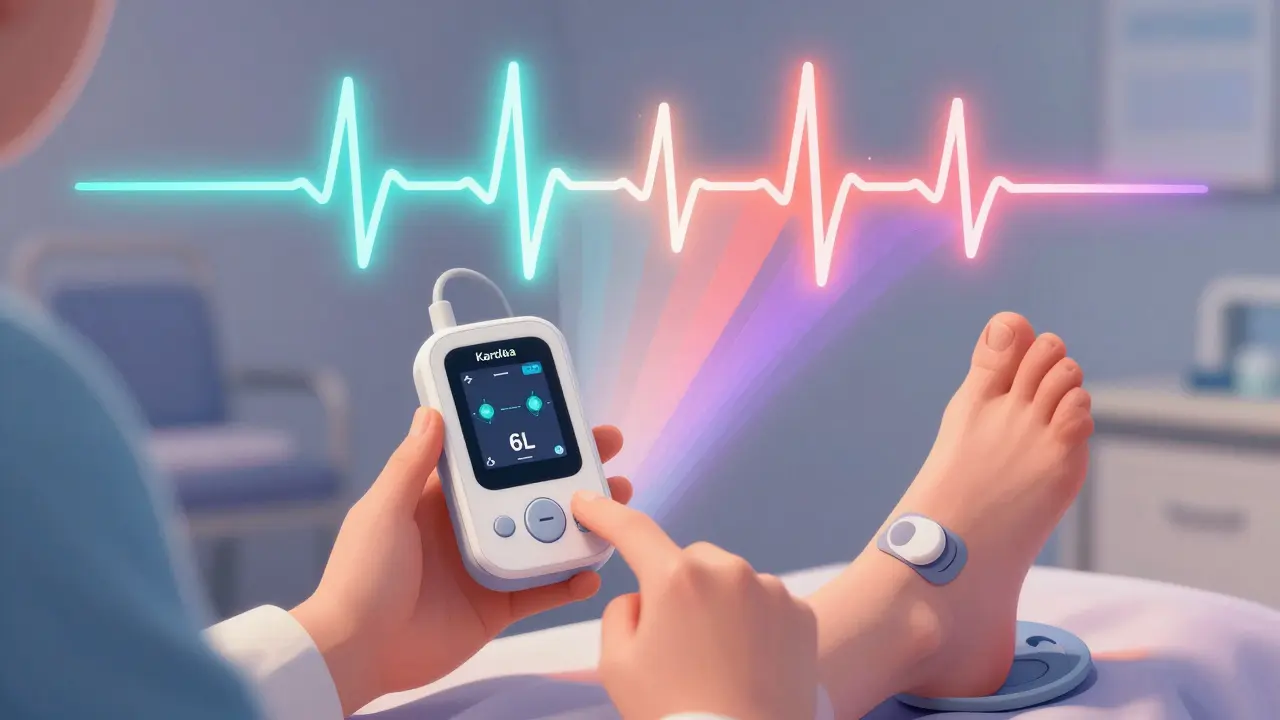
The KardiaMobile 6L is different. It’s a handheld device, about the size of a credit card. You place your thumbs on the top electrodes and your left foot on the bottom ones. That setup captures six leads - I, II, III, aVL, aVF, aVR - making it more like a mini 12-lead ECG. A 2023 review in Cleveland Clinic Journal of Medicine found its measurements matched standard ECGs within 20 milliseconds. That’s clinically acceptable for screening.
Both devices use algorithms to calculate the corrected QT (QTc), adjusting for heart rate. That’s key - a fast heart rate can make the QT look longer than it is. The algorithms don’t always get it right, but they’re improving fast.
Why This Matters in Real Life
During the pandemic, this tech went from niche to essential. Hydroxychloroquine and azithromycin were used off-label for COVID-19, even though they’re known QT prolongers. Hospitals were overwhelmed. Patients couldn’t come in. That’s when doctors turned to Apple Watches and KardiaMobiles.
One case report from 2020 described a patient on both drugs whose QTc jumped from 440 ms to 520 ms in just two days - caught by their Apple Watch. The doctor adjusted the meds before anything bad happened. Without that wearable, the patient might have gone home, developed torsades, and collapsed.
Today, it’s not just pandemic patients. People on long-term antipsychotics, cancer drugs like sunitinib, or even certain antidepressants are using these devices. Some pharmacies now offer them as part of medication safety programs. Insurance is starting to cover them for high-risk patients.
Limitations You Can’t Ignore
These aren’t magic boxes. They’re tools - and they have limits.
First, signal quality. If your skin is dry, sweaty, or you’re moving too much, the ECG can get noisy. The FDA’s 2020 guidance warned about high skin-to-electrode impedance. That’s why instructions matter: you must place your fingers or feet exactly right. A wrong grip = bad reading.
Second, they’re not diagnostic. A long QT on your watch doesn’t mean you’re in danger - it means you need a real ECG. They’re screening tools, not replacements for clinical evaluation.
Third, they miss other problems. A 2022 study found these devices only caught 20% of abnormal Q waves. They’re great for rhythm and QT, but terrible at spotting heart attacks or blockages. Don’t use them to rule out a heart attack.
And yes - most smart rings, fitness bands, and clothing sensors don’t measure QT at all. Only a few have FDA clearance for it. Check the label. If it doesn’t say “QT interval measurement,” it’s not designed for that.
The AI Revolution in QT Monitoring
Manual review of hundreds of ECGs is slow. A cardiologist might spend 10 minutes analyzing one 24-hour recording. Imagine doing that for 1,000 patients. That’s where AI comes in.
A 2024 study in PLOS Digital Health trained a deep learning model - a ResNet - to predict QTc prolongation from just two beats of single-lead ECG data. It analyzed 686 patients with genetic heart conditions. The model flagged QTc > 500 ms with 92% accuracy. That’s faster than any human, and it works 24/7.
This isn’t science fiction. It’s already being tested in clinical trials. Pharmaceutical companies are using AI-powered wearables to monitor cardiac safety in Phase I drug trials. Instead of sending patients to clinics every day, they wear the device at home. The system auto-alerts researchers if QTc rises above a threshold. That cuts costs, speeds up trials, and keeps patients safer.
Who Should Use This - And Who Shouldn’t
These devices are best for people who:
- Are starting a new medication known to prolong QT
- Have a history of long QT syndrome or sudden cardiac arrest in the family
- Are on multiple QT-prolonging drugs
- Can’t easily get to a clinic for repeat ECGs
They’re not for:
- People without a medical reason to monitor QT
- Those who want to diagnose heart disease on their own
- Anyone who ignores alerts or doesn’t follow up with a doctor
Using one without medical supervision is like using a thermometer to diagnose pneumonia. It gives data - but not context.
The Future Is Continuous
The next five years will see wearable ECGs become standard in outpatient drug safety. We’ll see:
- AI that predicts QT prolongation before it happens, using trends, not just single readings
- Integration with electronic health records - alerts auto-populate in the patient’s chart
- More devices with multi-lead capability, matching 12-lead accuracy
- Regulatory approval for real-time, automated QT alerts to physicians
AliveCor now has 16 FDA clearances for its devices. Apple’s ECG app has been used over 200 million times. The technology is here. The question isn’t if it’ll be adopted - it’s how fast we’ll use it to save lives.
For patients, it means peace of mind. For doctors, it means better data. For the system, it means fewer preventable deaths. Wearable ECGs aren’t the future of cardiac safety. They’re the present.
Can I trust my Apple Watch to detect dangerous QT prolongation?
Yes - but only as a screening tool. The Apple Watch can reliably detect significant QT prolongation (above 500 ms) with high accuracy compared to clinical ECGs. However, it’s not a diagnostic device. If your watch shows a prolonged QT, you must follow up with a doctor for a full 12-lead ECG and clinical evaluation. Don’t rely on it alone.
Is the KardiaMobile 6L better than the Apple Watch for QT monitoring?
It depends. The KardiaMobile 6L captures six leads, giving more detailed data and better accuracy for QT measurement than the Apple Watch’s single lead. Studies show its readings are closer to standard 12-lead ECGs. But the Apple Watch is always on your wrist - you can check anytime. The KardiaMobile requires you to sit still and place your hands and feet correctly. If you need maximum accuracy for clinical decisions, go with KardiaMobile. If you want convenience for ongoing monitoring, the Apple Watch works well.
Do I need a prescription to use a wearable ECG for QT monitoring?
No - you can buy the Apple Watch or KardiaMobile 6L without a prescription. But using them for QT safety monitoring should be done under a doctor’s guidance. Many hospitals and pharmacies now provide these devices as part of medication safety programs, often with a clinician overseeing the results. Self-monitoring without medical input can lead to false reassurance or unnecessary anxiety.
Can smart rings or fitness bands monitor QT interval?
Almost none can. Most fitness trackers and smart rings only measure heart rate or rhythm irregularities like atrial fibrillation. They don’t have the hardware or FDA clearance to measure the QT interval. Only specific devices - like the Apple Watch Series 4+ and KardiaMobile 6L - have been validated for this. Always check the product’s official documentation for QT measurement claims.
How often should I check my QT interval with a wearable device?
Follow your doctor’s advice. For new medications, you might check daily for the first week, then every few days. If you’re stable, weekly or biweekly may be enough. Some AI systems now auto-alert when QTc changes significantly, so you don’t need to check constantly. The goal is catching trends, not obsessing over single readings. Always pair wearable data with clinical follow-up.
Are wearable ECGs used in clinical trials?
Yes - and growing fast. Pharmaceutical companies now use wearable ECGs in Phase I-III trials to monitor cardiac safety in real time. They replace frequent clinic visits, reduce costs, and capture data patients might miss. The FDA supports this approach. In trials using KardiaMobile 6L or similar devices, researchers get continuous, real-world data that’s more reliable than sporadic ECGs.



anthony epps
December 15, 2025 AT 12:47I just got an Apple Watch last month and didn't know it could do this. My grandma's on amiodarone and she's always forgetting to go in for ECGs. This actually makes sense.
Dan Padgett
December 16, 2025 AT 09:04Man, the heart's rhythm is like a drum in a storm - quiet when calm, screaming when something's off. These gadgets? They're not magic, but they're the closest thing we got to listening to the silence before the crash. I'm glad tech finally caught up to the quiet suffering of people who don't scream until it's too late.
Hadi Santoso
December 16, 2025 AT 15:08soooo i just checked my apple watch and it says my qt is 432ms? idk if that's good or bad but i think i'm gonna start checking it every morning like i do my step count. also can anyone tell me if the kardia thingy is worth the $99? my cousin says it's like having a cardiologist in your pocket but i'm skeptical lol
Kim Hines
December 17, 2025 AT 20:31I've been on amitriptyline for 8 years. My doctor never mentioned QT. I'm not even sure if I should be worried. But now I'm just... wondering if I've been lucky or just blind.
Randolph Rickman
December 18, 2025 AT 19:52This is huge. Seriously. I work in pharmacy and we've started handing out KardiaMobiles to patients on antipsychotics or antibiotics like azithromycin. One guy had his QT jump from 460 to 510 in 48 hours - caught it before he collapsed. That’s not tech, that’s a lifesaver. If your doc doesn’t offer this, ask. It’s not expensive, it’s not complicated. It’s just smart.
Tiffany Machelski
December 19, 2025 AT 02:19Apple watch qt monitoring? i thought that was just for afib. i guess i was wrong. also why does everyone keep saying 'check with your doctor' like we don't already know that?
SHAMSHEER SHAIKH
December 20, 2025 AT 10:53Dear brothers and sisters in health, I am humbled by the divine advancement of medical science. The Lord has granted us the wisdom to create devices that watch over the heart as a shepherd watches over his flock. Let us not take this gift lightly. The QT interval is not merely a number - it is the heartbeat of life itself, and to ignore its warning is to mock the sacred rhythm of creation.
Dave Alponvyr
December 21, 2025 AT 01:49So let me get this straight - we’re using a $400 watch to replace a $500 clinic ECG? Cool. Next they’ll tell me my Fitbit can diagnose cancer.
Joanna Ebizie
December 22, 2025 AT 22:04Big Pharma loves this. They’re not doing it to save lives - they’re doing it so you’ll keep buying their drugs and never question them. You think they care if your QT’s long? No. They care if you keep taking the pill. This is surveillance disguised as care.
Elizabeth Bauman
December 24, 2025 AT 21:25Who’s funding these studies? Apple? AliveCor? You know what’s not in the article - that the FDA cleared these devices after being pressured by U.S. tech lobbyists. Meanwhile, China’s got better tech but they’re banned from our market. This isn’t science - it’s American tech supremacy wrapped in a stethoscope.
Dylan Smith
December 26, 2025 AT 07:00I’ve been using my Apple Watch for 6 months now since I started on sertraline. My QTc went from 440 to 490 last week - I didn’t panic, I just called my doctor. He said it’s fine for now but to check again in a week. This is exactly what we need - not fear, not hype - just steady data and a human to interpret it. Thank you for writing this.
Colleen Bigelow
December 26, 2025 AT 18:07They’re watching us. Every heartbeat. Every second. The government, the corporations, the AI - they’re not just measuring QT. They’re building a database of every American’s heart rhythm. And when you’re flagged as ‘high risk’? You’ll get flagged for insurance, for jobs, for travel. This isn’t safety. It’s control. And they’re selling it to us as a gift. Don’t be fooled. They’re not saving lives - they’re harvesting them.