
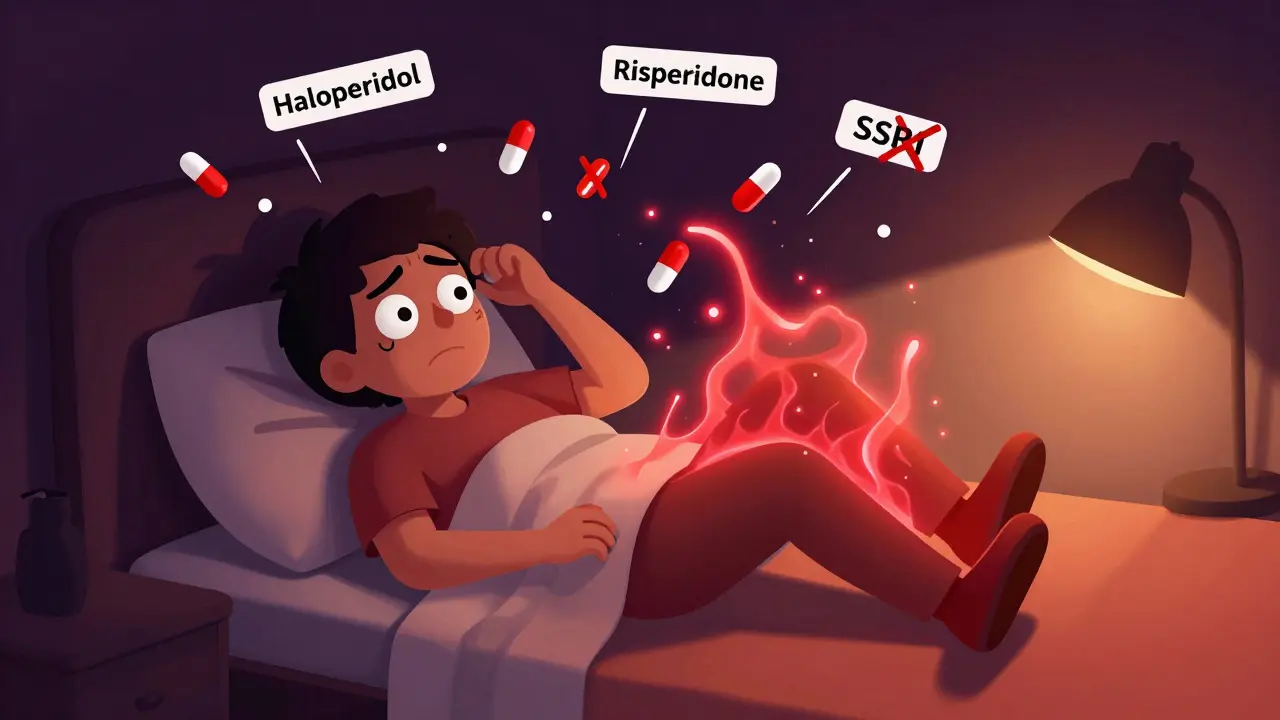
It’s 2 a.m. You can’t sit still. Your legs feel like they’re crawling under your skin. You get up, pace the floor, lie down, stand up again. Nothing helps. You tell your doctor it’s anxiety. They increase your medication. Things get worse. This isn’t just restlessness - it could be akathisia, a dangerous side effect of common psychiatric drugs that’s often mistaken for something else entirely.
Many people on antipsychotics, antidepressants, or even stomach meds like metoclopramide experience this intense inner restlessness. But here’s the problem: most doctors don’t recognize it. A 2020 study found nearly half of all cases go undiagnosed. And when they’re mislabeled as anxiety or agitation, the treatment makes it worse - often pushing patients toward suicidal thoughts or violent outbursts.
What Exactly Is Akathisia?
Akathisia isn’t just fidgeting. It’s a movement disorder caused by medications that affects the brain’s dopamine system. First described in 1959, it’s now one of the most common side effects of antipsychotics - especially older ones like haloperidol. But it also shows up with newer drugs like risperidone, quetiapine, and even some SSRIs and anti-nausea pills.
The symptoms are brutal. You don’t just feel restless - you feel like you’re being torn apart from the inside. People describe it as "aching restlessness," "need to jump out of your skin," or "your bones are begging you to move." You can’t sit still. You cross and uncross your legs constantly. You rock back and forth. You shift weight from foot to foot. You pace. You can’t sleep. You can’t focus. And the worse part? The more your doctor thinks you’re anxious, the more they increase the drug causing it.
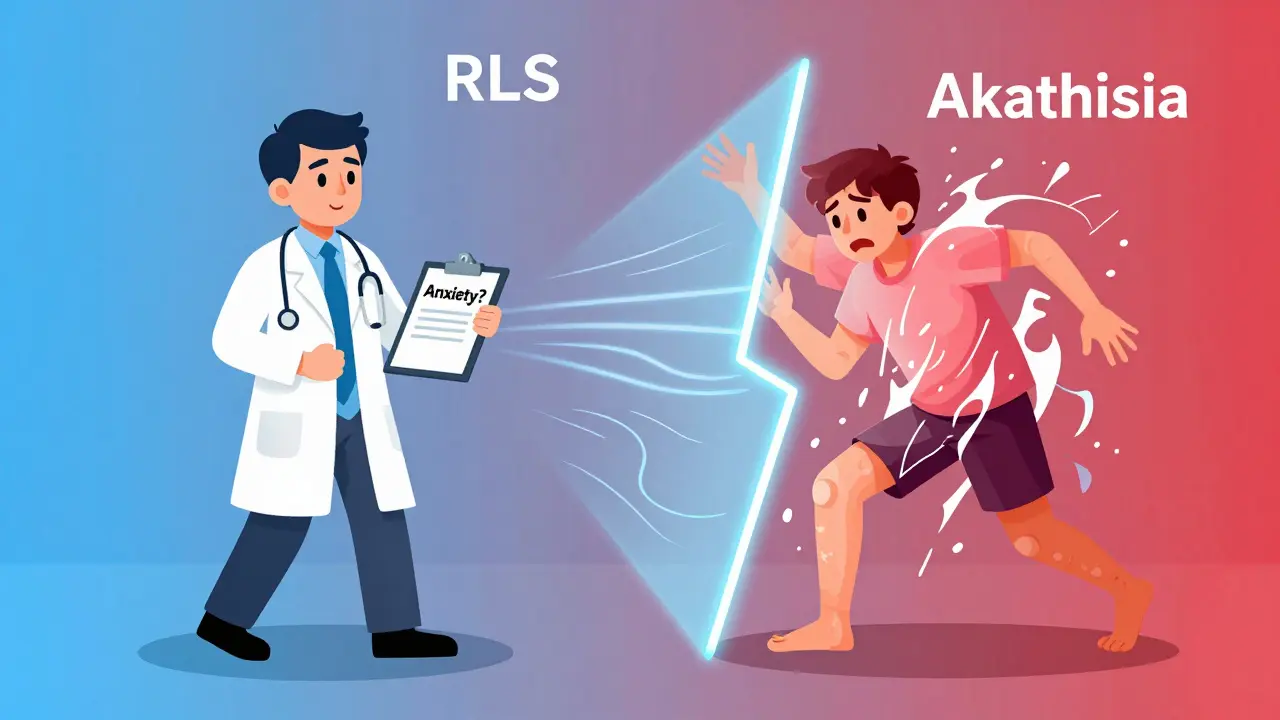
How Is It Different From Restless Legs Syndrome?
Restless legs syndrome (RLS) feels similar - but it’s not the same. RLS happens mostly at night or when you’re sitting quietly. It’s a crawling, tingling, or pulling sensation in the legs that only gets better when you move. It often runs in families and links to low iron.
Akathisia is different. It hits anytime - day or night. It’s not just in the legs. It’s in your chest, your arms, your whole body. You feel an overwhelming urge to move, not because your legs hurt, but because your brain is screaming at you to do something. Movement doesn’t relieve it - it barely helps. And it shows up within days or weeks of starting or increasing a medication.
Here’s the key test: if you stop the drug, does it vanish? Akathisia usually fades within days. RLS? It comes right back. And here’s the twist - drugs that help RLS, like levodopa, can make akathisia much worse.
Why Misdiagnosis Is Deadly
When a patient on haloperidol starts pacing and can’t sit still, the default assumption is "anxiety" or "psychosis worsening." So the doctor doubles the dose. That’s like pouring gasoline on a fire.
A 2017 case study in the Royal Australian College of General Practitioners journal showed a patient who developed acute suicidal thoughts after being given higher doses of haloperidol for "anxiety." The symptoms vanished completely within three days after stopping the drug. Another patient told researchers: "I’d rather have the psychosis than this."
According to the American Psychiatric Association, untreated akathisia contributes to 15% of antipsychotic non-adherence. People quit their meds not because they don’t believe in treatment - they quit because the side effect feels worse than the illness.
And it’s not rare. Between 20% and 40% of people on first-generation antipsychotics develop akathisia. Even second-generation drugs like risperidone cause it in 5-15% of users. The FDA has required warnings on these drugs since 2008. But most primary care doctors still don’t screen for it.
How Doctors Should Diagnose It
There’s a simple tool called the Barnes Akathisia Rating Scale (BARS). It takes five minutes. Two parts: ask the patient, then watch them.
- Ask: "Do you feel an inner restlessness that makes you need to move, even when you don’t want to?"
- Watch: Look for leg crossing, foot tapping, rocking, pacing, or fidgeting while seated.
It’s not about how much they move - it’s about whether they say they feel compelled to move and can’t find relief. If they describe it as "unbearable," "torturous," or "like my body is on fire," that’s akathisia.
Doctors must also rule out other movement disorders:
- Parkinsonism: Shaking, stiffness, slow movement - not restlessness.
- Tardive dyskinesia: Involuntary lip-smacking, tongue thrusting - usually after long-term use.
These are all extrapyramidal side effects. But only akathisia has that specific inner torment.
What Treatment Actually Works
The first step? Stop the drug - if you can. For many, haloperidol or risperidone must be tapered slowly over 3-7 days. A 2017 case showed full recovery in 72 hours after stopping.
If stopping isn’t an option - say, the patient has severe schizophrenia - then add a treatment that targets akathisia without worsening psychosis:
- Propranolol: A beta-blocker. Start with 10 mg twice daily. Works in 60-70% of cases.
- Clonazepam: A low-dose benzodiazepine. 0.5 mg at night. Helps with sleep and restlessness.
- Cyproheptadine: An antihistamine with serotonin-blocking effects. 4 mg daily. Often used when other options fail.
Important: Avoid anticholinergics like benztropine. They help parkinsonism, not akathisia - and may make it worse.
Newer options are emerging. Pimavanserin (Nuplazid), originally for Parkinson’s psychosis, reduced akathisia by 62% in a 2023 trial. Transcranial magnetic stimulation (TMS) is being tested at Harvard. And AI tools are now being trained to spot the subtle movements of akathisia in video calls - one Stanford study got 89% accuracy.
What You Can Do If You Think You Have It
If you’re on any psychiatric, anti-nausea, or antidepressant medication and feel this unbearable inner restlessness:
- Write down when it started - right after a dose increase? Within 3 weeks?
- Describe it exactly: "I can’t sit still," "I feel like I have to move to stop the ache," "It’s in my chest, not just my legs."
- Ask your doctor: "Could this be akathisia? Can we check with the Barnes scale?"
- Bring this article. Most have never heard of it.
- Don’t accept "it’s just anxiety." Push for a medication review.
There’s hope. One Reddit user, after being misdiagnosed for months, finally stopped Seroquel and started propranolol. Within days, she said: "I slept for the first time in a year. I feel human again."
Why This Isn’t Getting Fixed
There’s a knowledge gap. A 2022 survey found only 37% of U.S. psychiatric clinics routinely screen for akathisia. Electronic health records don’t have checkboxes for it. Medical schools barely teach it. And pharmaceutical companies don’t push awareness - because the drugs causing it still sell.
But change is coming. The International Parkinson and Movement Disorder Society launched a free diagnostic app in 2023. New antipsychotics like lumateperone (Caplyta) have akathisia rates under 4% - half of older drugs. Research into biomarkers and EEG patterns may soon let us predict who’s at risk before symptoms start.
For now, awareness is your best defense. If you or someone you know is suffering from unexplained restlessness on medication - it might not be anxiety. It might be akathisia. And it can be fixed.
Can akathisia go away on its own?
Yes - but only if the triggering medication is stopped or reduced. Akathisia caused by drugs usually fades within days to weeks after discontinuation. If the drug continues, it can become chronic or even permanent. It doesn’t resolve on its own while the medication stays in the system.
Is akathisia the same as ADHD or anxiety?
No. ADHD involves difficulty focusing, impulsivity, and hyperactivity - often from childhood. Anxiety causes worry, tension, and avoidance. Akathisia is a physical movement disorder with a specific, intense urge to move that begins after starting certain medications. It’s not psychological - it’s neurological. Mislabeling it as anxiety leads to dangerous treatment mistakes.
Which medications most commonly cause akathisia?
First-generation antipsychotics like haloperidol and fluphenazine carry the highest risk. Second-generation drugs like risperidone, olanzapine, and quetiapine also cause it, though less often. Non-psychiatric drugs like metoclopramide (for nausea), prochlorperazine, and even some SSRIs (like fluoxetine) have been linked. The risk increases with higher doses and rapid dose changes.
Can I still take my antipsychotic if I have akathisia?
Yes - but only with careful management. If stopping the drug isn’t safe (e.g., for severe psychosis), doctors can add medications like propranolol or clonazepam to reduce akathisia without worsening the original condition. Some newer antipsychotics like lumateperone have much lower rates. Never increase the dose to "fight the restlessness" - that makes it worse.
Why do some doctors refuse to believe akathisia is real?
Because it looks like agitation or anxiety - and those are common in psychiatric patients. Many doctors aren’t trained to recognize movement disorders. A 2020 study showed 50% of cases are misdiagnosed. It’s not denial - it’s lack of education. The condition isn’t taught well in medical school, and most clinics don’t use screening tools. Awareness is slowly improving, but progress is uneven.




Haley Gumm
February 25, 2026 AT 05:33Okay but real talk - I’ve been on seroquel for anxiety and this described my life exactly. I thought I was just ‘high-strung’ until I read this and realized I was being tortured by my own meds. Took me 8 months to convince my psych to lower the dose. Now I’m on propranolol and I actually slept last night. Like, full REM sleep. I cried. 🥹
Gabrielle Conroy
February 26, 2026 AT 01:47This is so important!! 🙌 I’m a nurse and I’ve seen this happen SO often - patients getting their antipsychotics increased because they’re ‘agitated,’ when they’re clearly in akathisia. The Barnes scale is literally 5 minutes, why isn’t it standard?? I’ve started printing it out and handing it to residents. Also - propranolol works MAGIC. 10mg BID. Try it. Seriously. And if they say ‘it’s just anxiety’ - show them the FDA warning. 💪
Spenser Bickett
February 27, 2026 AT 17:15Christopher Wiedenhaupt
March 1, 2026 AT 00:58While the clinical description of akathisia is accurate, it is worth noting that the prevalence figures cited vary significantly across studies. The 20-40% range applies primarily to first-generation antipsychotics in controlled trials, not necessarily real-world primary care settings. Additionally, while propranolol is commonly used, its efficacy is not universally supported in meta-analyses. A more cautious approach to diagnosis is warranted.
John Smith
March 1, 2026 AT 22:30Brandice Valentino
March 2, 2026 AT 13:13Larry Zerpa
March 3, 2026 AT 12:03Gwen Vincent
March 5, 2026 AT 01:12I’m a therapist and I’ve had clients describe this exact thing - but they never had the words. I’ve started asking: ‘Do you feel like your body is begging you to move even when you don’t want to?’ It’s a game-changer. I wish I’d known this years ago. Thank you for writing this. I’m sharing it with my whole team.
Nandini Wagh
March 6, 2026 AT 08:55