
Theophylline-Ciprofloxacin Interaction Calculator
Calculate Interaction Risk
This tool estimates how ciprofloxacin may increase your theophylline blood level based on your current status. Critical for COPD/asthma patients.
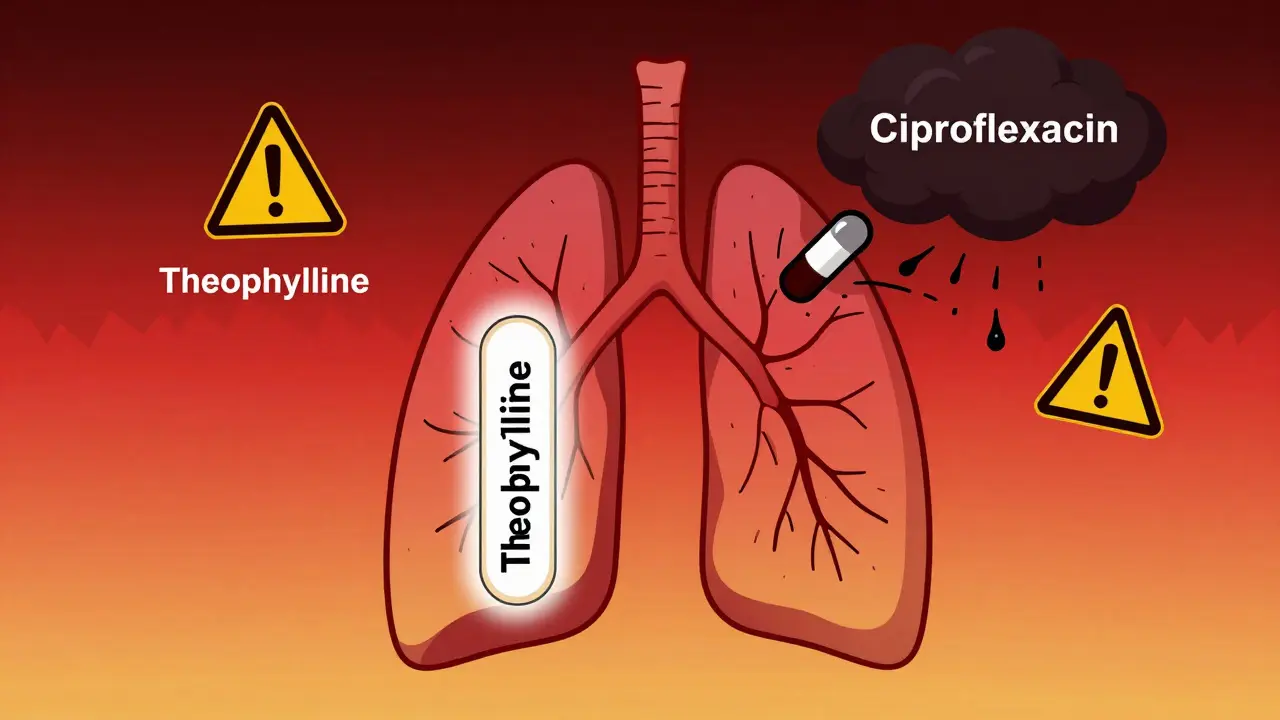
When you're managing a chronic lung condition like COPD or asthma, theophylline might be part of your treatment plan. It's an old drug, but it still works - if used carefully. Now imagine you get a bad infection, and your doctor prescribes ciprofloxacin to fight it. Sounds routine, right? But here’s the problem: ciprofloxacin can turn theophylline from a helpful medication into a dangerous one. This isn’t a rare guess or a theoretical concern. It’s a well-documented, life-threatening interaction that sends people to the hospital every year.
What Happens When These Two Drugs Meet?
Theophylline is a bronchodilator. It helps open up your airways by relaxing the muscles around them. But it doesn’t take much to push it over the edge. Its therapeutic range - the sweet spot where it works without harming you - is narrow: 10 to 20 micrograms per milliliter (mcg/mL). Go above 20, and you risk side effects. Hit 25-30, and you could be facing heart rhythm problems. Over 30? Seizures. That’s not a typo. A single overdose can trigger a grand mal seizure in someone who’s never had one before.
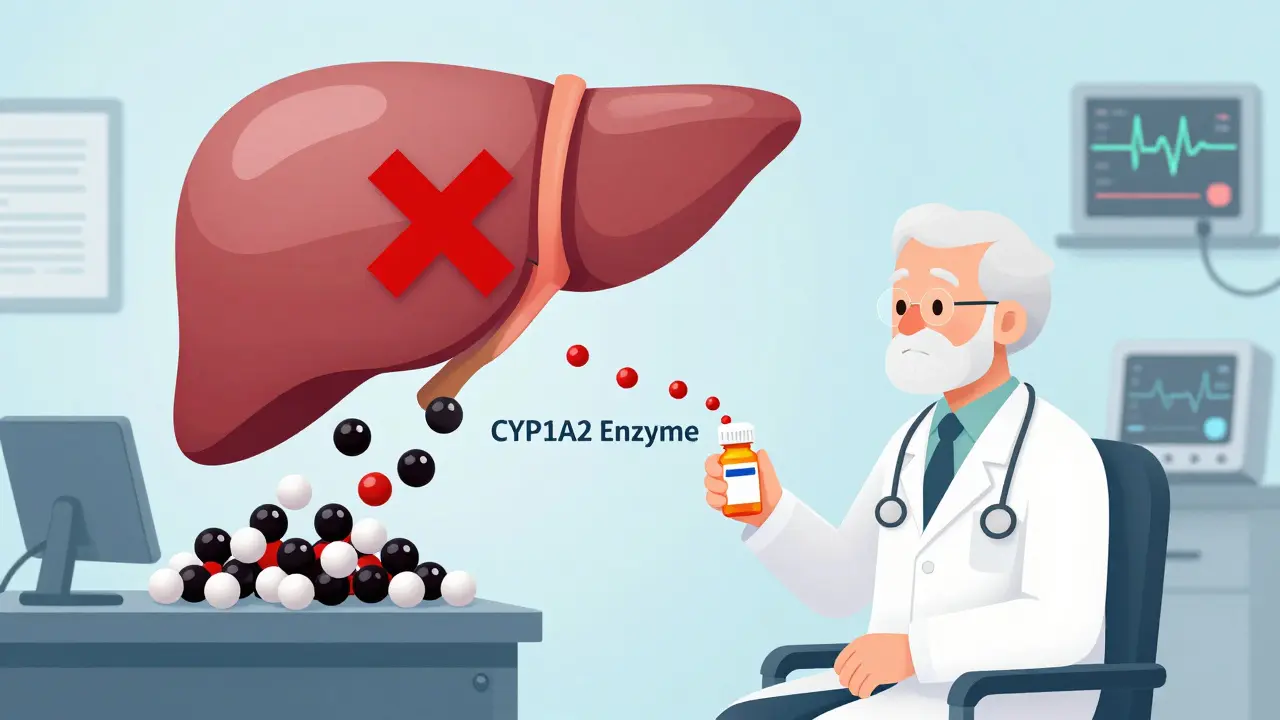
Ciprofloxacin, a fluoroquinolone antibiotic, is great for treating respiratory infections, urinary tract infections, and even some skin infections. But it has a hidden power: it shuts down an enzyme in your liver called CYP1A2. That enzyme is the main way your body breaks down theophylline. When ciprofloxacin blocks it, theophylline doesn’t get cleared. It builds up. And fast.
Studies show that when you take ciprofloxacin with theophylline, the amount of theophylline in your blood can jump by 40% to 80%. Its half-life - the time it takes for half the drug to leave your system - stretches from 8-9 hours to 12-15 hours. That means the drug stays in your body longer, and at higher levels, than it ever should.
The Evidence Isn’t Theoretical - It’s Real
This isn’t just lab data. Real people have been hurt. In 1987, a case report from the University of Glasgow documented a 78-year-old man whose theophylline clearance dropped from 2.3 liters per hour to 0.8 liters per hour after starting ciprofloxacin. After stopping the antibiotic, his clearance returned to normal. That’s a direct cause-and-effect link.
A 2011 study of over 77,000 older adults in Ontario found something chilling: those taking ciprofloxacin while on theophylline had nearly double the risk of being hospitalized for theophylline toxicity. The odds ratio? 1.86. That’s not a small bump. That’s a major red flag. And here’s the kicker - other antibiotics like levofloxacin, trimethoprim-sulfamethoxazole, or cefuroxime didn’t show the same risk. This interaction is specific to ciprofloxacin.
Even more alarming, a 2018 study in the Journal of the American Geriatrics Society found that over 12% of older adults still got ciprofloxacin while on theophylline. That’s one in eight. And according to U.S. data, around 4,200 hospitalizations each year are directly tied to this interaction. That’s 4,200 avoidable trips to the ER - many involving seizures, arrhythmias, or vomiting so severe patients couldn’t keep fluids down.
Why Elderly Patients Are at Higher Risk
Age matters. As you get older, your liver slows down. Your kidneys slow down. Your body clears drugs less efficiently. A 2015 meta-analysis found that in patients over 65, ciprofloxacin reduces theophylline clearance by about 45%, compared to 35% in younger adults. That means older people don’t just get a little more theophylline - they get a lot more.
And yet, many doctors still prescribe ciprofloxacin to elderly patients on theophylline. Why? Because they’re treating an infection - and infections feel urgent. They assume the patient “tolerated it before.” Or they think, “It’s just one course.” But theophylline doesn’t care about your intentions. It only cares about what’s in your bloodstream.
What the Guidelines Say - And Why They’re Ignored
The FDA added a black box warning to ciprofloxacin labels in 1994 - the strongest possible warning. By 2017, they updated it to say: if you must use ciprofloxacin with theophylline, reduce the theophylline dose by 33%. The American College of Chest Physicians, the ASHP, and the American Thoracic Society all say: avoid ciprofloxacin in these patients. Use something else.
So what do clinicians do? A 2017 study in the European Journal of Hospital Pharmacy found that 68% of electronic alerts warning about this interaction were overridden. Why? Because 78% of doctors said they felt the antibiotic was too urgent to delay. Another 12% thought the patient had handled the combo before. But past tolerance doesn’t mean future safety. Theophylline levels can spike even if you’ve taken both drugs together without issue last time.
What Should You Do Instead?
If you’re on theophylline and need an antibiotic, here’s what works:
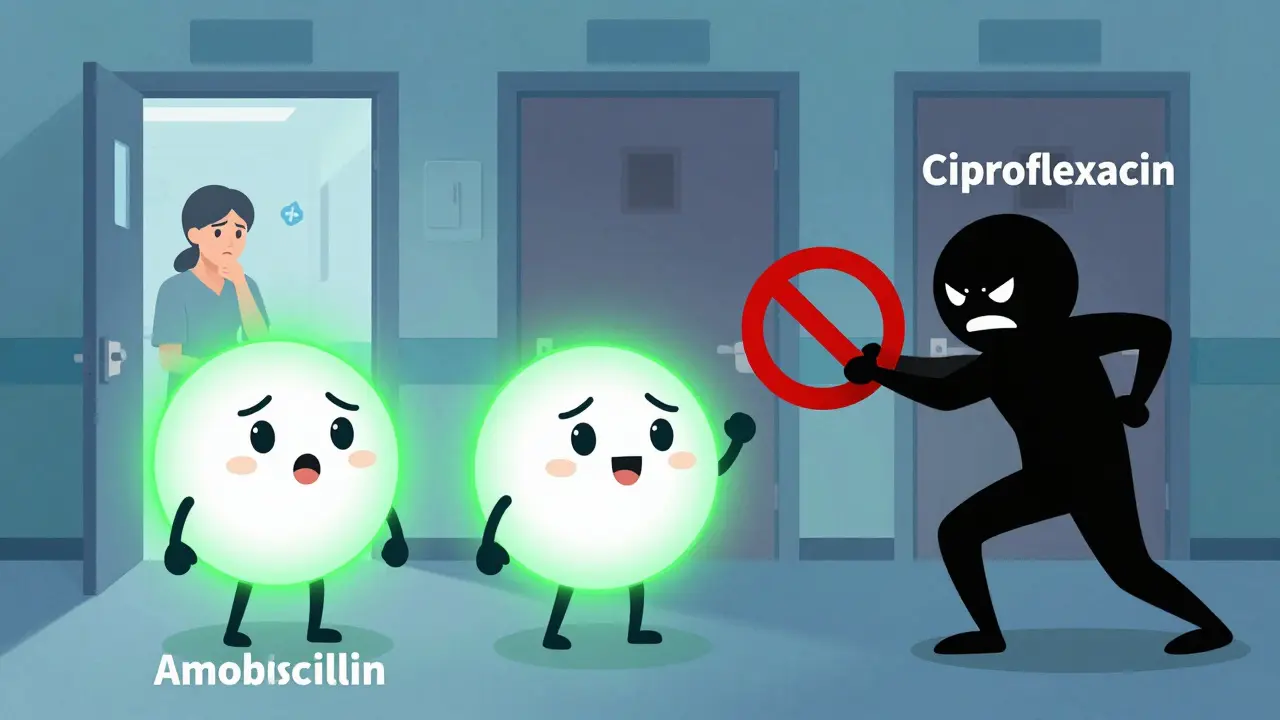
- Levofloxacin or moxifloxacin: These are fluoroquinolones too, but they barely affect CYP1A2. Levofloxacin raises theophylline levels by only 10-15% - manageable. Moxifloxacin? Even less impact.
- Amoxicillin-clavulanate: A common choice for respiratory infections. No known interaction.
- Azithromycin: Another safe option. It’s often used for pneumonia or bronchitis in COPD patients.
If ciprofloxacin is the only option - say, for a complicated urinary infection or resistant bacteria - then you need strict monitoring:
- Check your theophylline level before starting ciprofloxacin.
- Reduce your theophylline dose by 30-50% right away.
- Check your level again within 24-48 hours.
- Watch for early signs: nausea, vomiting, fast heartbeat, jitteriness, trouble sleeping.
These steps aren’t optional. They’re life-saving.
The Future: Genetics Might Change the Game
Not everyone reacts the same way. Some people’s bodies break down theophylline faster. Others slower. Why? Genetics. A variant called CYP1A2*1F makes the enzyme more sensitive to inhibition by ciprofloxacin. Early research from the University of Toronto shows that people with this variant experience a 65% greater drop in theophylline clearance than those without it.
That means someday, we might test for this gene before prescribing ciprofloxacin. But we’re not there yet. Right now, the only safe approach is to assume everyone is at risk - especially if you’re over 65, have liver disease, or smoke (smoking speeds up theophylline clearance, so when you quit, levels can spike even without ciprofloxacin).
Bottom Line: This Interaction Is Deadly - And Avoidable
Every year, nearly 10,000 people in the U.S. alone experience a theophylline-related adverse event because of ciprofloxacin. That’s not a number. That’s 10,000 people who could have been treated safely with a different antibiotic. That’s 10,000 families who didn’t need to face an ICU stay, a seizure, or a cardiac arrest because of a simple, well-known drug interaction.
If you’re on theophylline, ask your doctor: Is ciprofloxacin really necessary? If they say yes, ask: Have you checked my theophylline level? Are we reducing my dose? If they hesitate - push back. This isn’t a risk you can afford to ignore.
There’s no magic pill here. Just good practice. Clear communication. And a willingness to question what seems routine.





Callum Duffy
March 3, 2026 AT 12:30It's staggering how often life-saving medical knowledge gets buried under routine prescribing habits. This interaction isn't some obscure footnote-it's a well-documented, preventable catastrophe. The fact that 68% of electronic alerts are overridden speaks volumes about systemic complacency. We treat antibiotics like interchangeable tools, but the body doesn't work that way. One enzyme, one drug, one cascade. And yet, we keep pretending complexity is optional.
It's not about blame. It's about awareness. And awareness starts with listening-not just to guidelines, but to the silent signals the body sends before it breaks.
Chris Beckman
March 4, 2026 AT 19:27Levi Viloria
March 6, 2026 AT 11:37What's fascinating is how this interaction exposes the gap between clinical knowledge and clinical practice. We have mountains of evidence, yet doctors still default to cipro because it's familiar, broad-spectrum, and "gets the job done." But medicine isn't about efficiency-it's about precision. Theophylline isn't a sledgehammer; it's a scalpel. And cipro? It's the hand that slips.
It's not just about the drug combo. It's about how we train, how we prioritize, and how we silence the quiet alarms before they scream.
Richard Elric5111
March 7, 2026 AT 02:38One might argue that this interaction is emblematic of a deeper epistemological failure within modern pharmacology: the reduction of human physiology to algorithmic pathways, while neglecting the emergent, nonlinear nature of biological systems. The liver does not compute; it interprets. The enzyme CYP1A2 is not a switch-it is a conversation. And when we interrupt that conversation with a blunt instrument like ciprofloxacin, we do not merely alter pharmacokinetics-we disrupt homeostasis itself.
Perhaps the real tragedy is not the toxicity, but our collective refusal to see this as a metaphysical failure of reductionism.
Dean Jones
March 7, 2026 AT 09:47Let’s be brutally honest here: this isn’t a glitch in the system-it’s the system working exactly as designed. Pharmaceutical education is a series of checklists, not critical thinking. Doctors are trained to treat the infection, not the patient’s entire pharmacological ecosystem. Theophylline? Old. Cipro? New. New wins. Always. The fact that 12% of elderly patients still get this combo isn’t negligence-it’s institutional inertia wrapped in white coats.
And let’s not pretend the FDA’s black box warning means anything. If a warning label could save lives, we’d have zero overdoses. The truth? We don’t lack information. We lack the will to change. We’d rather risk 4,200 hospitalizations than rewrite a protocol. That’s not medicine. That’s gambling with people’s brains.
Betsy Silverman
March 7, 2026 AT 12:43I’ve seen this play out in my mom’s care team. She’s 72, on theophylline for COPD, and last winter, her pulmonologist prescribed cipro for a sinus infection. I asked if they’d checked her levels. They hadn’t. I had to push. Hard.
It took three calls, a printout of the 2011 Ontario study, and a polite but firm "I will take her to the ER if you don’t adjust this" before they finally lowered her dose and ordered a level. She’s fine now. But what if I hadn’t been there? What if she’d been alone?
This isn’t just about drugs. It’s about who gets to speak up-and who gets ignored.
Ivan Viktor
March 9, 2026 AT 07:02Zacharia Reda
March 9, 2026 AT 23:17It’s funny how we treat antibiotics like they’re interchangeable. You’ve got a chest infection? Here’s cipro. You’ve got a UTI? Cipro. You’ve got a 70-year-old on theophylline? Still cipro. Why? Because it’s cheap. Because it’s fast. Because it’s easy.
But here’s the thing: medicine isn’t a vending machine. You don’t just drop in a symptom and get a pill. You’re dealing with a human body that remembers every interaction, every enzyme, every metabolic pathway.
So next time someone says "it’s just one course," ask them if they’d give a diabetic insulin and then a sugar IV drip. "It’s just one time."
Jeff Card
March 10, 2026 AT 06:33I’ve worked in ERs for 18 years. I’ve seen theophylline toxicity three times. Each time, the patient was on cipro. Each time, they were told it was "fine" because they’d taken it before. Each time, they ended up in the ICU with a seizure and a new arrhythmia.
There’s no "before." There’s only now. And now, the numbers are climbing. Not because people are dumb. Because the system doesn’t protect them.
I wish I could say I’m shocked. But I’m not. I’m just tired.
Matt Alexander
March 11, 2026 AT 08:58Simple version: if you take theophylline, don’t take cipro. Use amoxicillin or azithromycin instead. Easy. If you must use cipro, get your blood tested before and after. Your life isn’t worth guessing.
Don’t overthink it. Just listen to the doctors who know.
Stephen Vassilev
March 12, 2026 AT 00:35Have you considered that this interaction may not be accidental-but structural? The pharmaceutical industry profits from polypharmacy. Theophylline is generic. Ciprofloxacin is branded. Hospitals are incentivized to prescribe newer drugs. Electronic health records are designed to push prescriptions, not pause them. Alerts are overrideable because compliance is low-and low compliance justifies more automation, more drugs, more revenue.
And when patients die? It’s called "unavoidable." But nothing about this is unavoidable. It’s inevitable. Because the system is built this way. The FDA warning? A checkbox. The 4,200 hospitalizations? A statistic. The families? An afterthought.
Deborah Dennis
March 12, 2026 AT 22:41Shivam Pawa
March 13, 2026 AT 13:38Diane Croft
March 15, 2026 AT 04:13